Physical Address
304 North Cardinal St.
Dorchester Center, MA 02124
Physical Address
304 North Cardinal St.
Dorchester Center, MA 02124
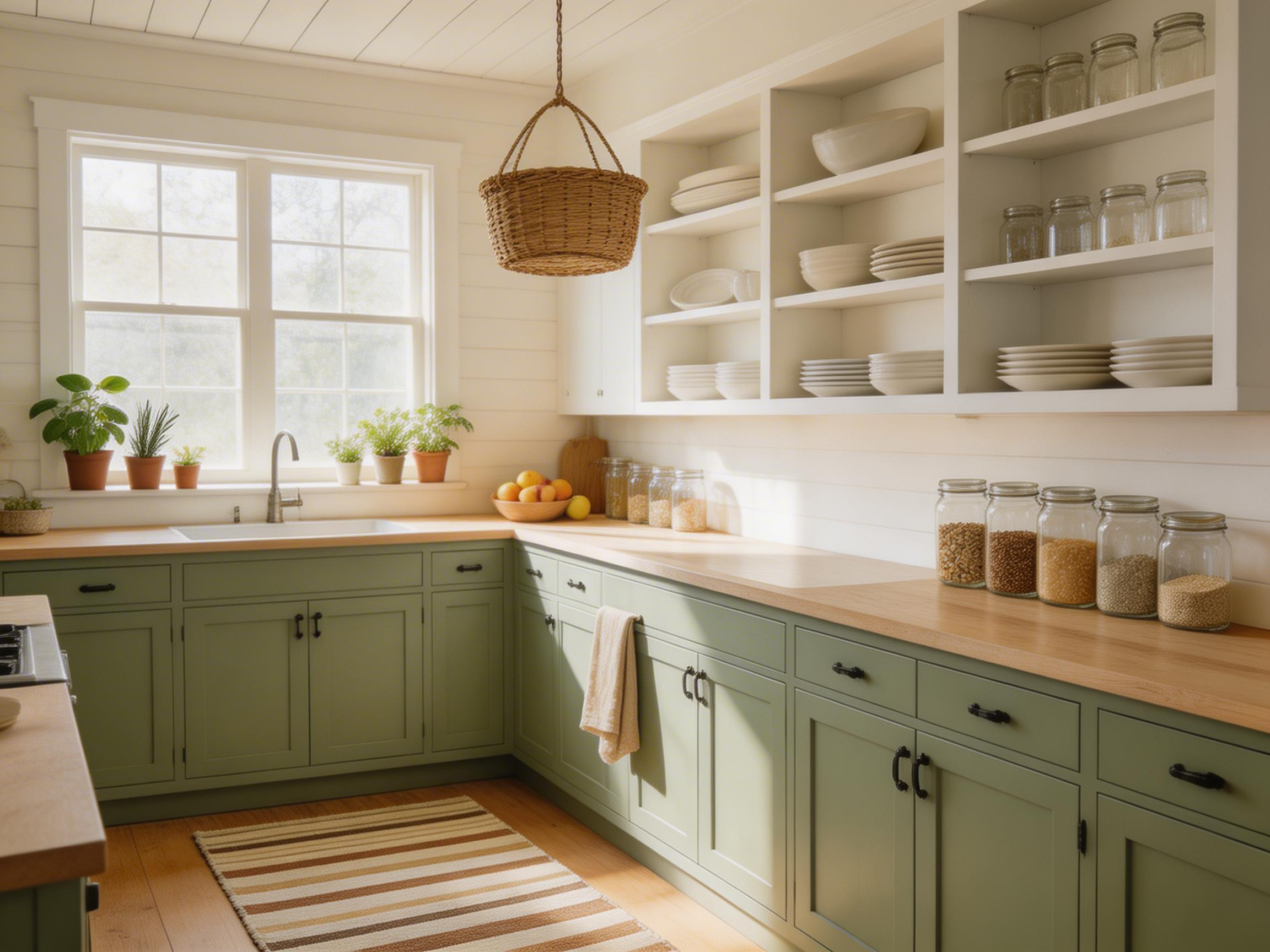
Discover 16 kitchen decor on a budget ideas that actually transform your space — with real prices, top product picks, and pro tips from a kitchen design expert.
Most people assume a beautiful kitchen needs a renovation. Interior design shows push granite countertops and custom cabinetry like those are the baseline. Home improvement stores stock whole departments around the idea that your kitchen is a few thousand dollars away from being what you want. Here’s what that narrative gets wrong: the kitchens I’ve loved most — the ones people crowd around at dinner parties, the ones that feel genuinely alive — weren’t expensive. They were intentional.
I’ve spent over a decade helping families create warm, welcoming kitchens on real budgets. And time after time, the smallest changes do the most. A few labeled jars. A $45 pendant light. A pot of basil on the windowsill. Kitchen decor on a budget isn’t a consolation prize — it’s a sharper, more creative approach to making a space feel like yours.
These 16 kitchen decor on a budget ideas are the ones I recommend most. Each has a real price range, a specific product or source, and a pro tip from what I’ve seen actually work. You don’t have to do all of them — even two or three will change how you feel walking into your kitchen every morning.
Open shelving is one of the fastest ways to change a kitchen’s personality without touching a single cabinet door. Replace the visual weight of upper cabinet fronts with styled shelves and the room opens up, feels lighter, and looks like somewhere you chose — not somewhere you inherited.
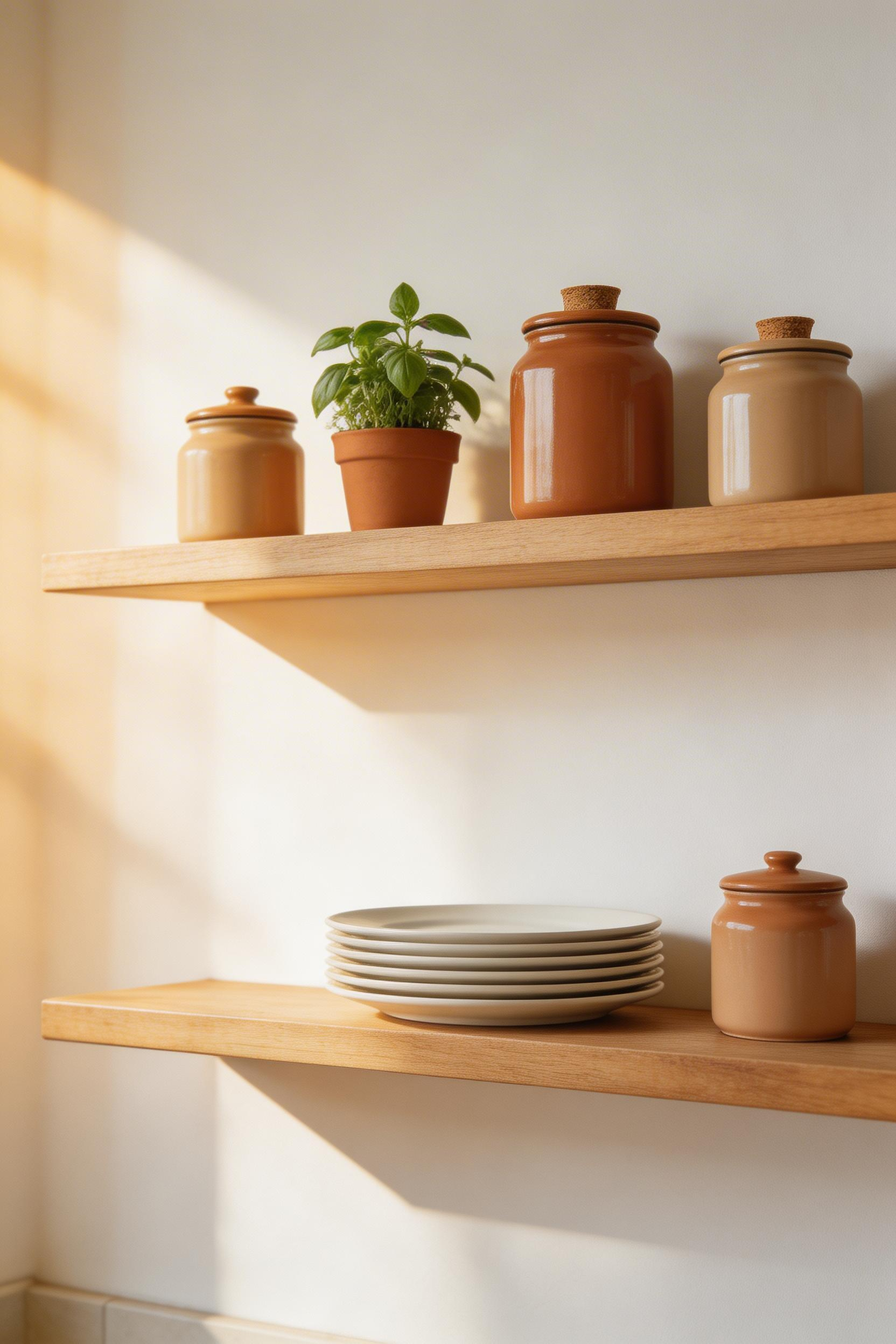
The reason open shelves work so well isn’t just visual — it’s psychological. When your most-used items are on display, your kitchen stops feeling like a storage room you cook in and starts feeling like a working kitchen with character. The things you reach for every day become part of the decor.
IKEA’s BERGSHULT shelf with PERSHULT bracket runs $22-$35 per shelf — two shelves for under $70. Wallniture’s rustic pine floating shelves on Amazon ($29-$45) install in under 30 minutes.
The golden rule: keep 30-40% of shelf surface open. If every inch is packed, it reads as clutter rather than display. Group items in threes, vary the heights within each group, and mix textures — a ceramic jar next to a wooden bowl next to a small potted plant hits all three notes at once.
Pull 3-4 matching pieces from inside your existing cabinets before you spend anything. You may already have everything you need to start.
Style with real items first, then decide what’s missing. Most people over-shop for shelf decor when they already own the best pieces. This is kitchen decor on a budget at its core: start with what you have, live with it for a week, and only buy what feels genuinely absent.
If you rent, or if you want a kitchen update without demo dust and a contractor, peel-and-stick backsplash tiles are the single most effective tool in budget kitchen decor. Done well, they’re virtually indistinguishable from grouted tile — and done badly, they’re still removable.
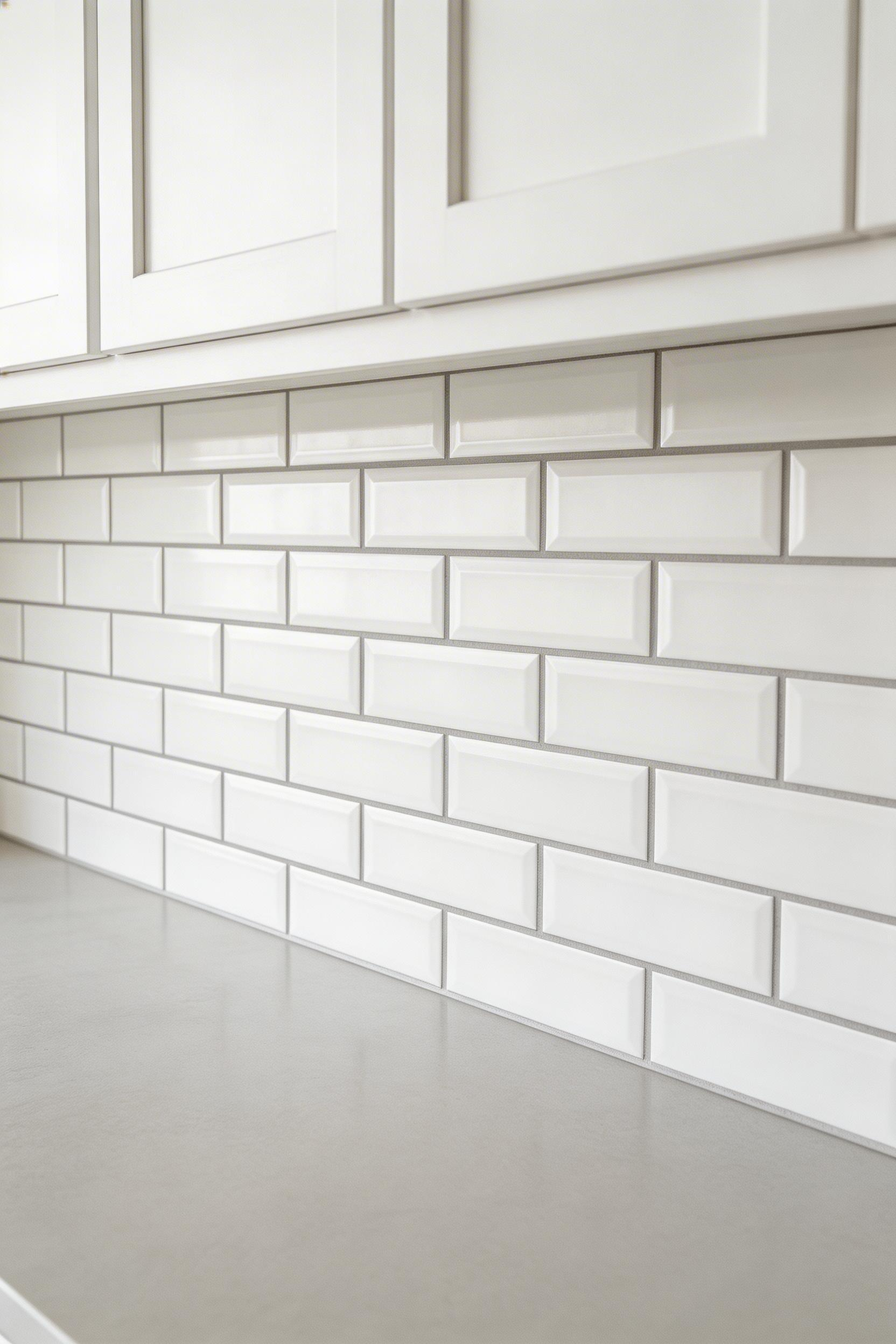
The standard rental kitchen backsplash area runs 15-20 square feet — and at $28-$55 per pack (about 5 sq ft coverage), you’re looking at a $75-$150 total project. Art3d and Tic Tac Tiles are the two most reliable brands; both are waterproof and heat-resistant up to 250°F, which matters near a stove. Aspect Long Glass Tile is pricier at $15-$20 per linear foot but gives a genuine glass mosaic look.
Subway tile and herringbone mosaic are the two most-searched peel-and-stick patterns in 2025-2026. For small kitchens, a clean white subway is the safest move — it reflects light and doesn’t compete with other decor. For larger kitchens, a patterned encaustic-style tile adds personality without overwhelming.
Start from the center of the backsplash wall and work outward. This keeps the pattern symmetrical even when you hit corners or outlets — the cuts on each edge will be equal, so neither side looks like an afterthought.
A rug is not a common first thought for kitchen decor on a budget. Most people think of a rug as a living room thing. But a well-chosen kitchen rug — a runner down a galley, a flat-weave in front of the sink — changes the feel of a hard-floored kitchen faster than almost anything else.
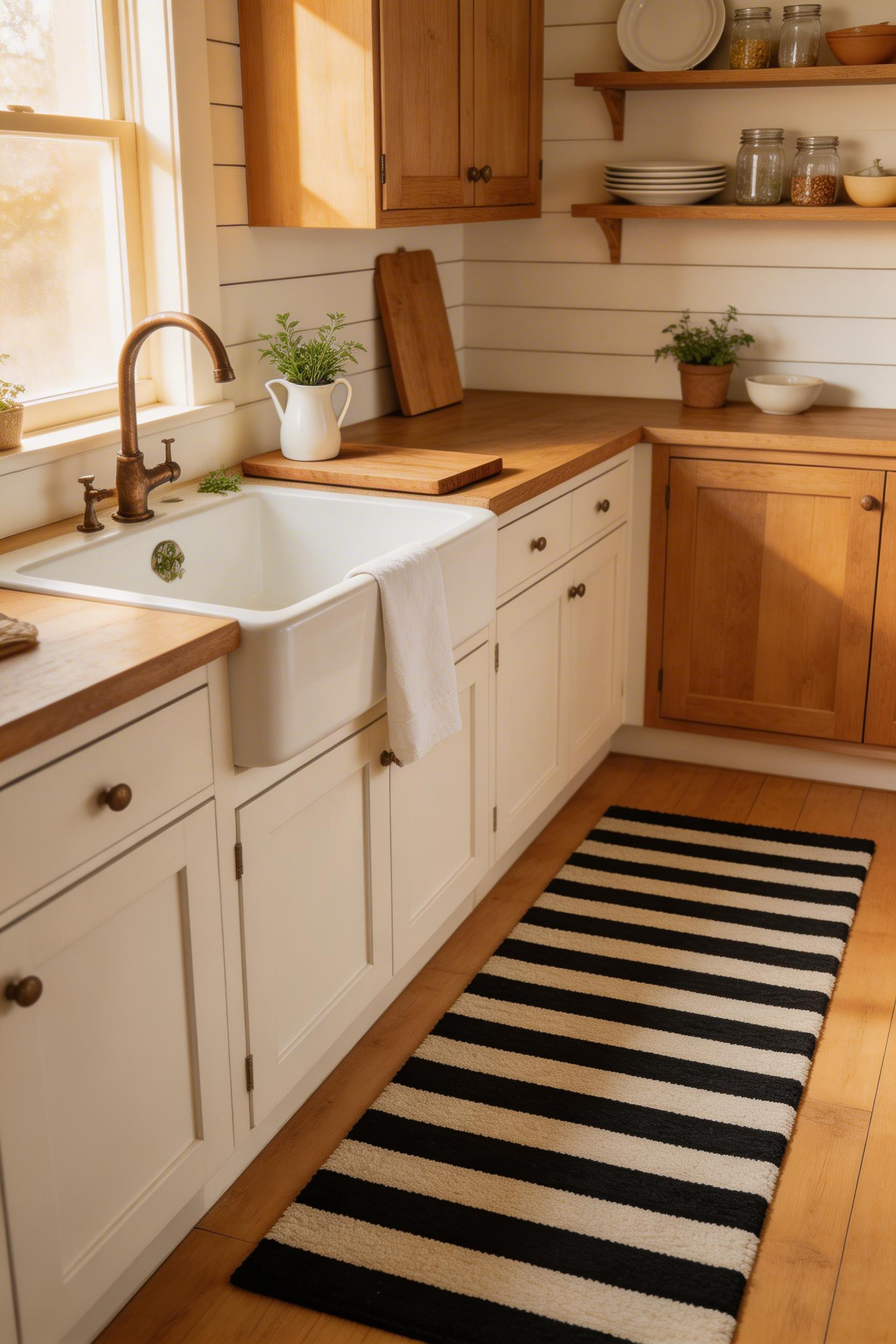
Hard floors — tile, vinyl plank, concrete — bounce sound and cold. A rug absorbs both. And as budget kitchen decor goes, a $40 runner punches well above its weight. But beyond comfort, a rug defines a zone. In an open-plan space, it says “this is the kitchen area.” In a galley, it softens what might otherwise feel like a hospital corridor.
Ruggable runners start at $59-$89 for a 2.5×7, machine-washable cover included. Amazon’s Lahome Farmhouse Runner at $38-$55 — fringed cotton-blend in stripe and check — looks twice its price.
For a galley kitchen, a 20×60 runner is the ideal size. Leave about 6 inches of clearance from the walls or cabinets on each side. For an open-plan kitchen with a defined sink area, a 20×36 mat directly in front of the sink is enough. Anti-fatigue properties matter too — standing on a cushioned surface every time you cook makes a difference over time.
Go bolder with pattern than you think. A solid-colored rug disappears in a busy kitchen — it looks like a bath mat that wandered in. A stripe or wide check gives the floor something to say and photographs beautifully if you ever list your home.
One of the most Pinterest-worthy kitchen counter displays I’ve ever seen cost $14. It was three blue-and-white ceramic jars from a local Goodwill, grouped on a wooden cutting board, with a small bunch of eucalyptus in the tallest one. That’s it. That’s affordable kitchen decor at its most effective — intentional, imperfect, and genuinely beautiful.
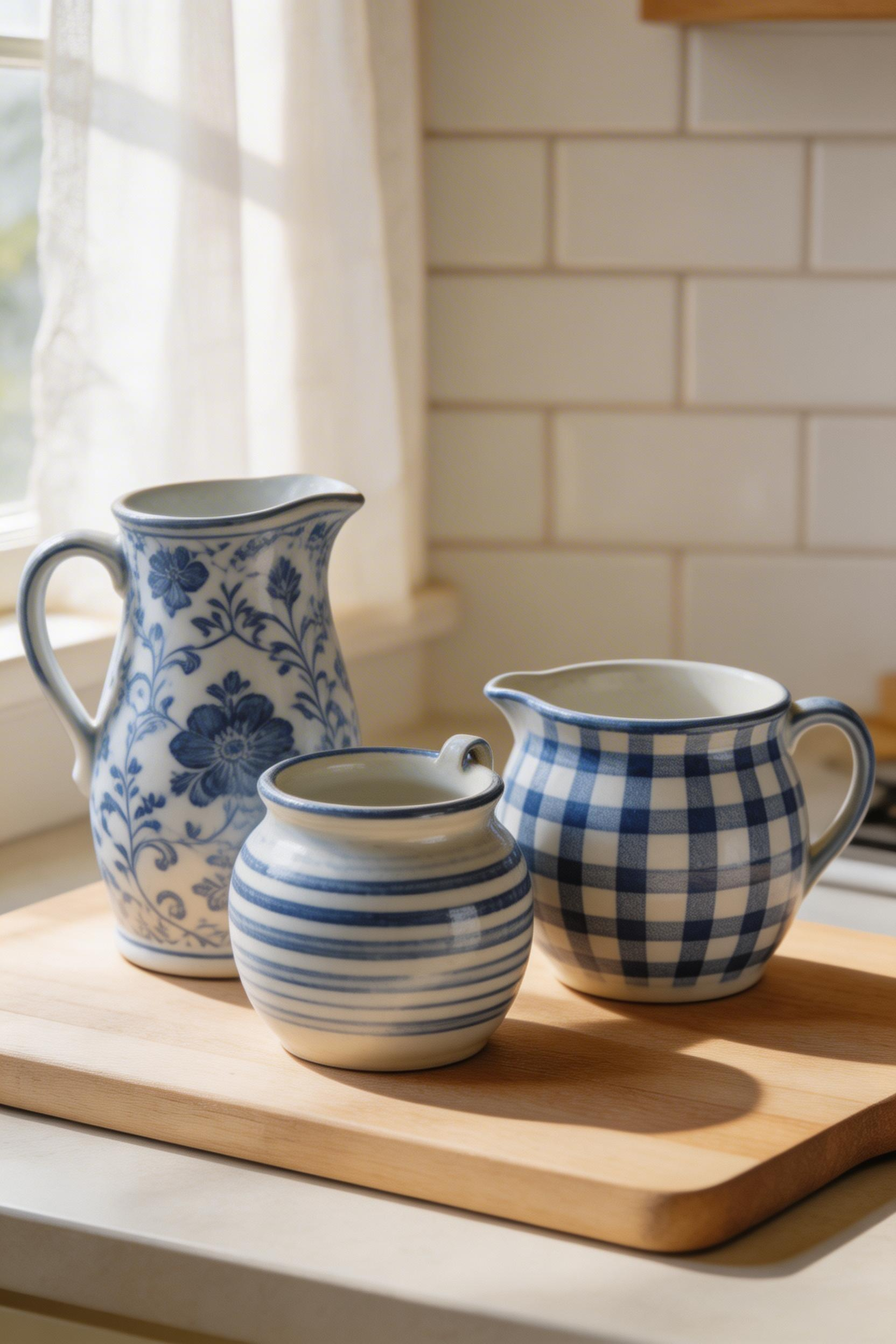
The ‘collected over time’ aesthetic is having a significant moment in 2025-2026 kitchen design, and for good reason — it reads as genuinely lived-in rather than freshly staged. When you put four identical pieces together, it looks like a display. When you put three pieces in the same color family but different shapes, it looks like a home.
The two best color families: blue and white and cream and terracotta. Both blend with nearly any cabinet color.
Target pitchers, ceramic crocks, stoneware jars, and glass bottles. Goodwill and Salvation Army are the most consistent sources; Tuesday through Thursday tends to have the freshest stock after weekend donations are sorted. Facebook Marketplace estate sale listings sometimes yield full vintage kitchen sets for $15-$30.
Repurpose freely: a vintage pitcher as a utensil holder, a stoneware crock as a bread bin.
Wash thrift finds in hot water with a splash of white vinegar before displaying them. It removes any musty smell and residue without harsh chemicals, and it’s satisfying to know exactly what you’re bringing into your kitchen.
Nothing makes a kitchen feel more alive than plants, and a windowsill herb garden is the most practical version of that investment. You get texture and color on your windowsill, fresh herbs for cooking, and the kind of gentle, living energy that no other decor item can quite replicate.
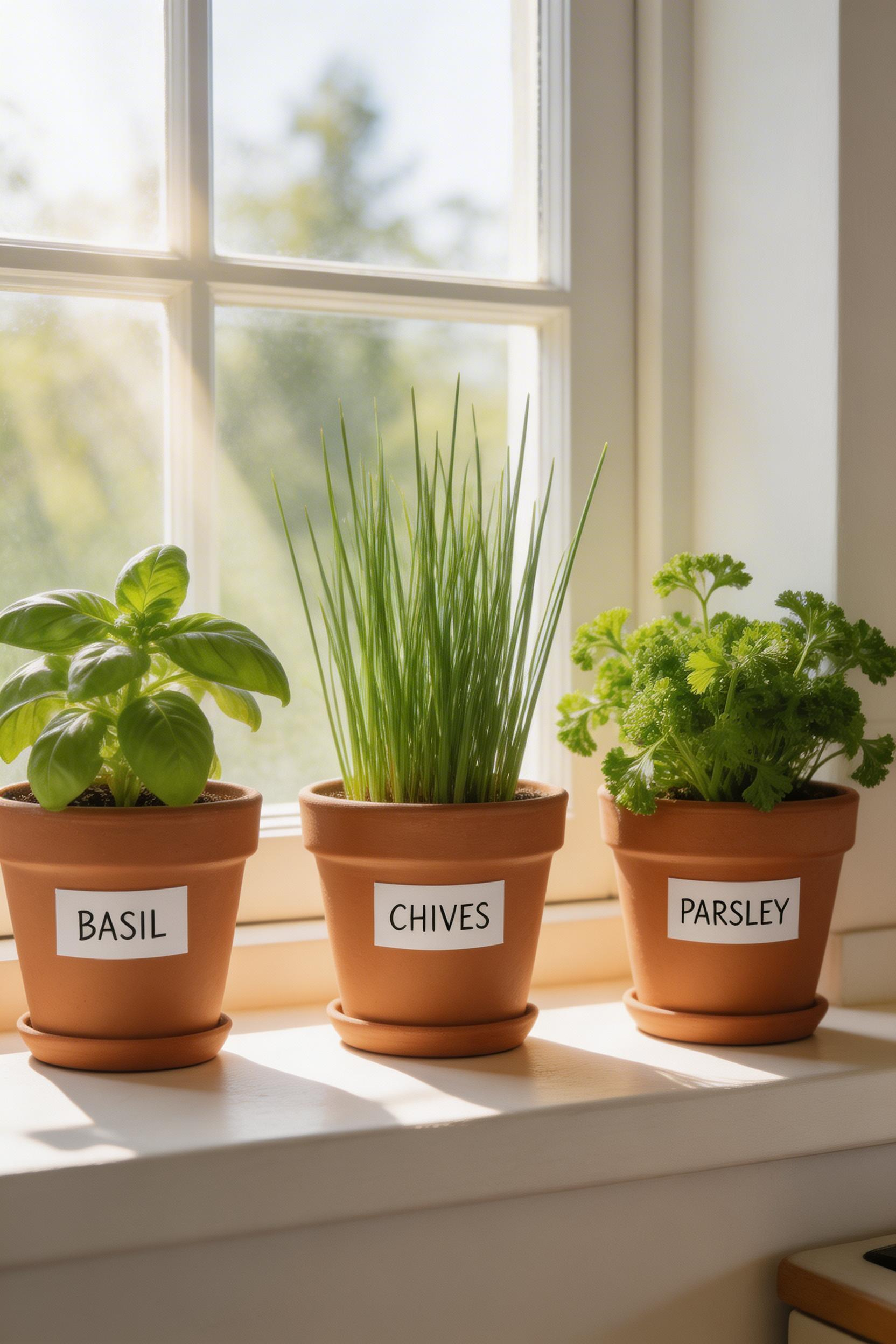
A set of three terracotta pots runs $12-$18. Herb starters from the grocery store produce section cost $8-$12. The whole setup lands at $20-$25 and does double duty as decor and pantry.
For low-light kitchens or north-facing windows: mint, chives, and parsley. They tolerate indirect light and grow steadily without much fuss. For bright, south-facing windowsills with 6+ hours of direct sun: basil, thyme, oregano, and rosemary. These are the culinary heavy-hitters, and they thrive with heat.
IKEA’s BITTERGURKA hanging herb planter at $4.99 each is designed specifically for this use — it has a drainage hole and attaches directly to a windowsill rail. Mason jars also work well for cuttings kept in water; herbs like basil and mint root easily and look charming in a row of clear jars.
Buy herb starter plants from the grocery store produce section — usually $2-$4 each — rather than growing from seed. You get an instantly lush display and can harvest from the same week. For kitchen decor on a budget, this is one of the few ideas where function and beauty cost the same amount: almost nothing.
I want to be clear here: painting your cabinets is not a weekend-afternoon project. It takes prep, patience, and probably two full days. But it is also, by a significant margin, the highest-impact budget kitchen decor move available to you — and it costs $50-$120 compared to $5,000-$25,000 for replacement cabinets.
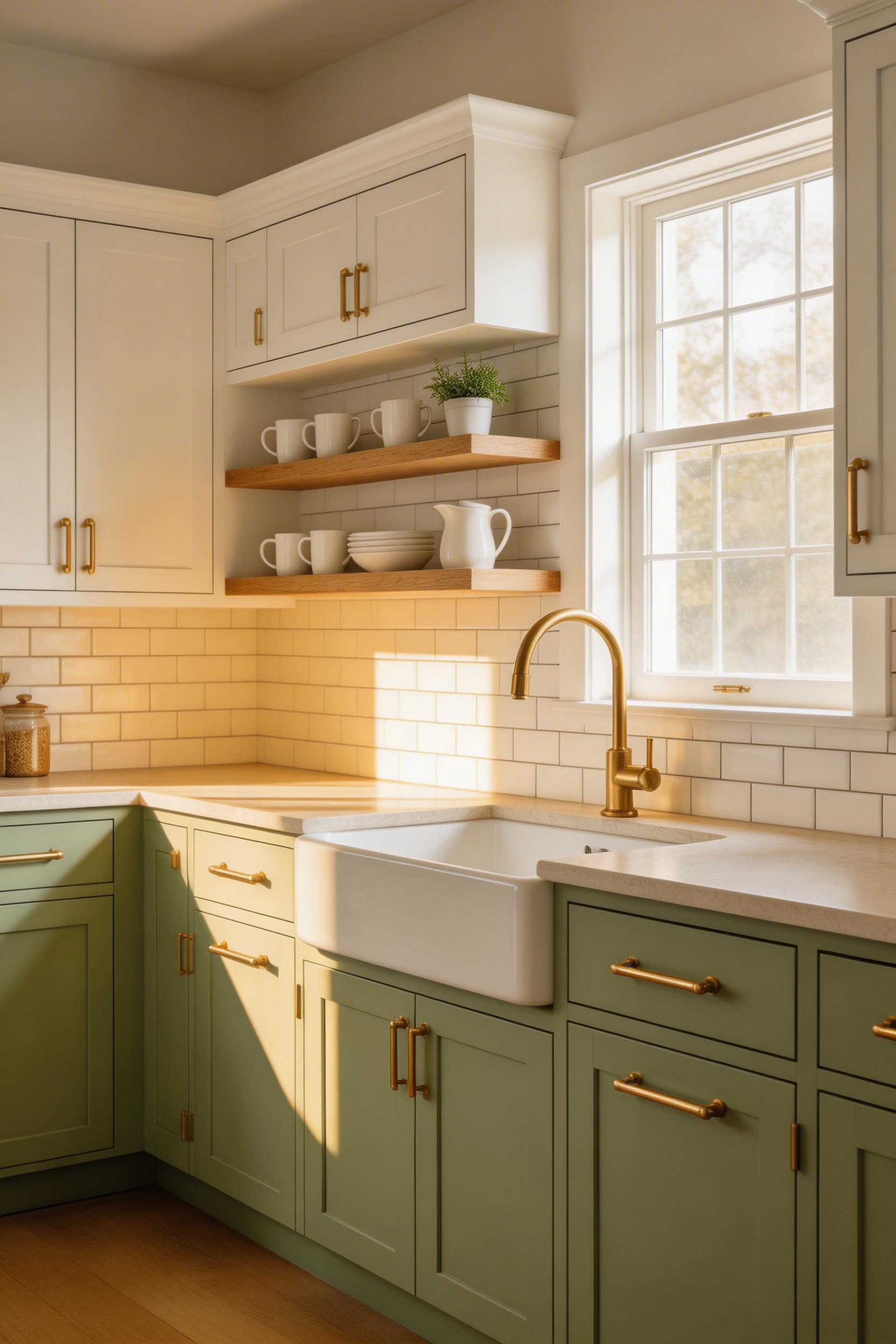
The reason cabinet paint works so well is proportion. Cabinets cover more visual surface area in a kitchen than anything else — more than countertops, floors, or walls. When you change that dominant surface, the entire room shifts. It’s not a small update. It’s a new kitchen.
The two-tone look — dark lowers, white uppers — is the top kitchen visual on Pinterest right now. It adds depth and makes the space feel taller. Rust-Oleum Cabinet Transformations ($79-$109) includes deglosser, base coat, and bond coat — no primer needed.
Top picks: Benjamin Moore Chantilly Lace (warm white), October Mist (sage), Hale Navy, and Revere Pewter. All work with wood floors, white countertops, and brushed brass or stainless hardware.
For a real splurge-quality result without the price, Benjamin Moore Advance at $75-$85 per gallon is the professional standard. It’s self-leveling and nearly brush-stroke-free when applied correctly.
Paint only the lower cabinets if you want a faster, cheaper result that’s also more fashionable. Lower cabinets in a deep color, upper cabinets in white — that’s the look, and it takes half the time and half the paint.
There’s a version of this that looks forced — a Pinterest-perfect row of identical jars that reads like a staged photo. And there’s a version that looks genuinely good — a counter where things are organized visibly, labeled clearly, and aesthetically considered without trying too hard. As affordable kitchen decor goes, this is one of the most functional options on this list.
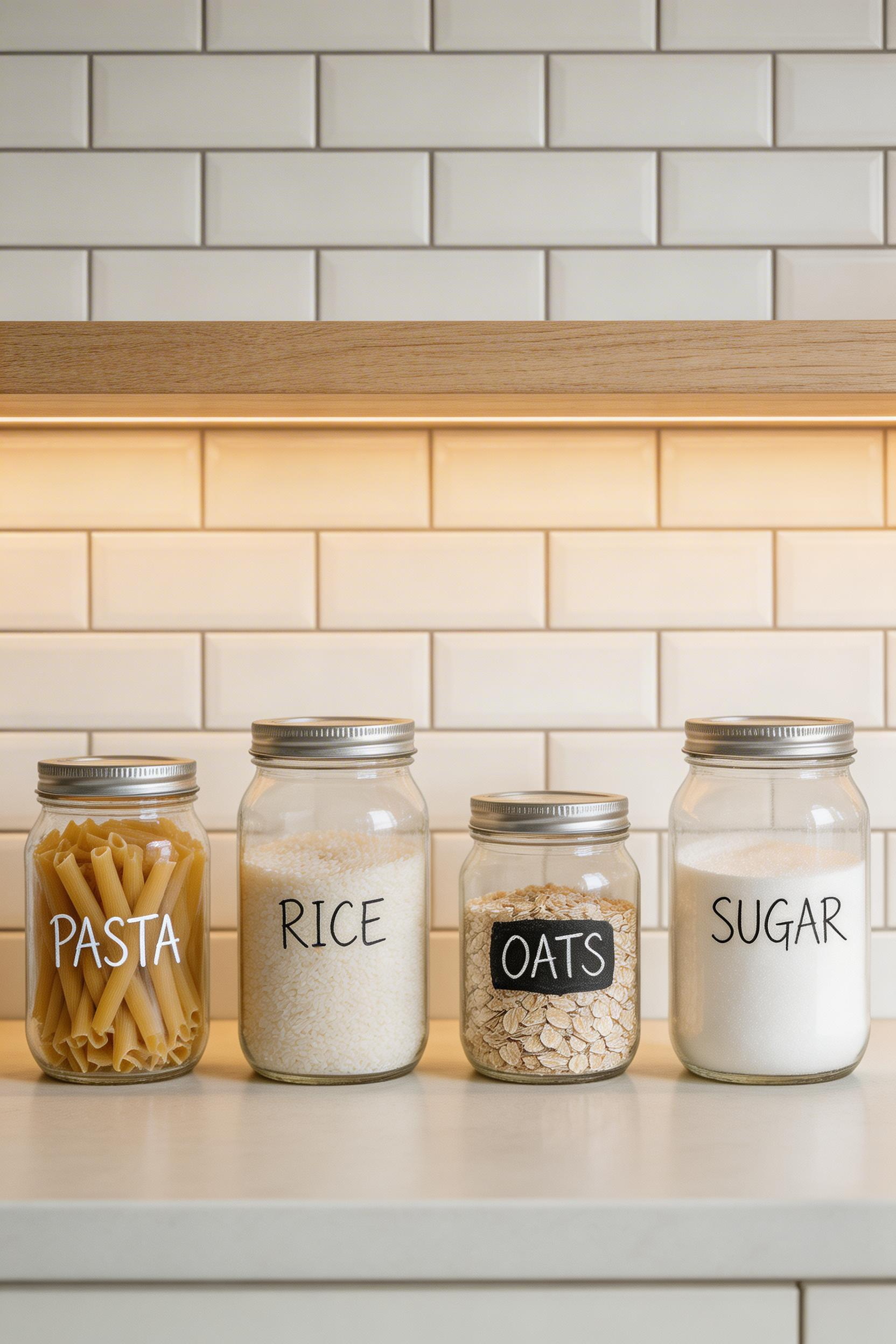
When your dry goods are in matching glass jars with chalk labels, something shifts in how your kitchen reads. It looks considered. It looks like a place where someone actually thinks about cooking. And practically, it means you can see at a glance when you’re running low on pasta or coffee.
Ball mason jars (12-pack, 1-quart, $14-$18) are the American standard for this. IKEA’s KORKEN clip-top jars ($2.99-$5.99 each) have a clean Scandinavian look that works particularly well in modern or minimal kitchens. Either way, a full 6-jar counter setup costs under $25 including chalk labels.
Best items for jar display: pasta, rice, lentils, oats, sugar, coffee beans. Match jar size to quantity — a quart jar half-filled with loose-leaf tea looks sad. Group by frequency of use: daily items nearest the stove.
Use the same chalk marker color for all labels — even if your jar sizes vary, matching label script creates visual coordination throughout the set.
There’s something a new item from a big-box store can’t quite do: tell a story. Vintage pieces have a weight to them, a particularity, a sense that they’ve been somewhere and done something before landing in your kitchen. And the best part of kitchen decor on a budget is that vintage is often cheaper than new.
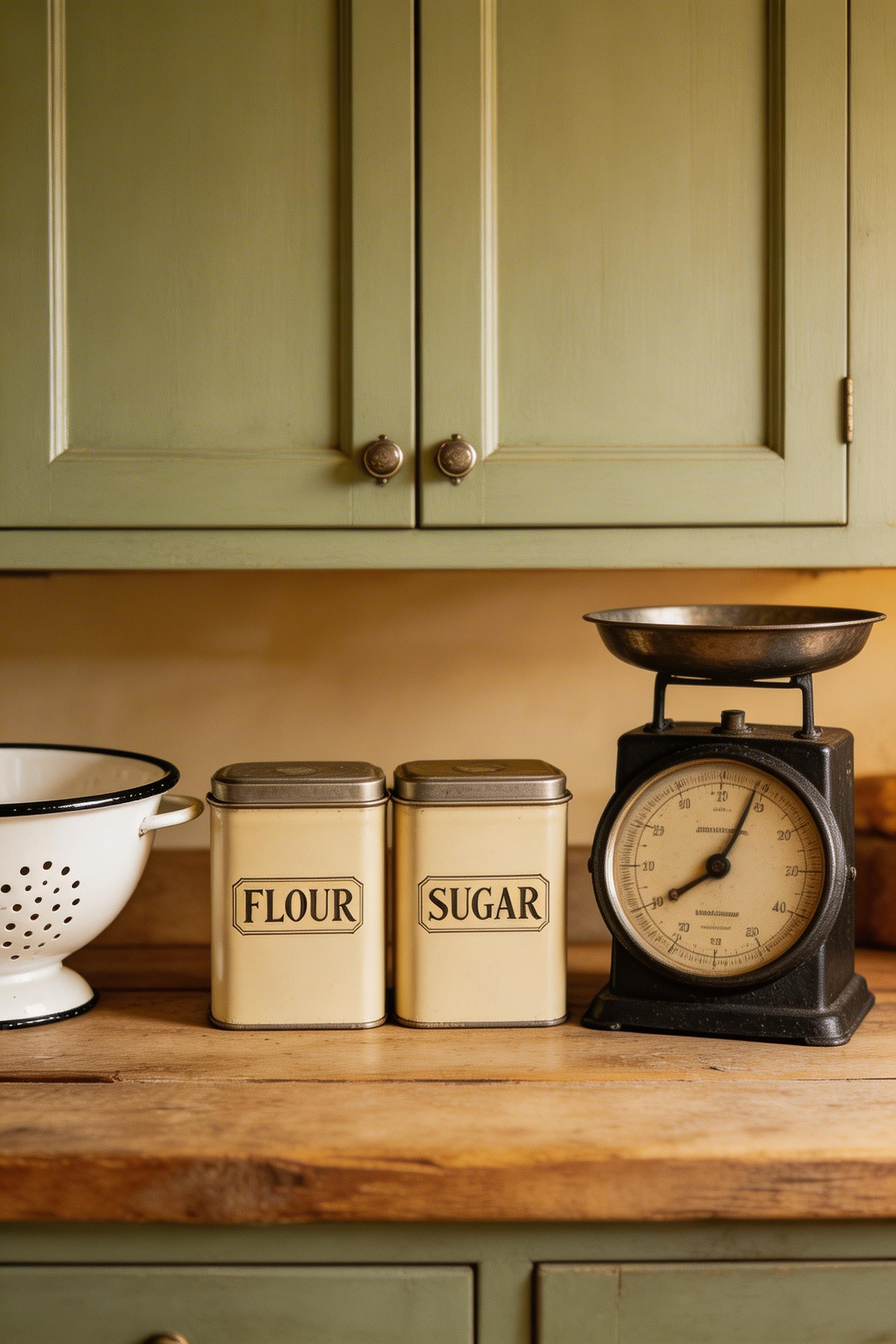
A vintage piece carries visual evidence of its own history — a slight patina on enamelware, the worn lettering on a 1960s tin, the honest heft of a cast iron scale. That specificity is exactly what makes a kitchen feel curated rather than decorated. One or two good vintage finds do more for a kitchen’s personality than a shelf of brand-new decor items.
The best vintage kitchen items to hunt: blue-and-white speckle enamelware, ceramic flour and sugar canisters, tin signs, old kitchen scales, and wooden spoon collections.
Etsy vintage: search “vintage farmhouse kitchen decor” and sort by Price: Low to High. Set a $10 max filter first — there’s more available there than most people realize. Flea markets reward early arrival; the first hour has the best pieces at the best prices. Facebook Marketplace estate sale listings sometimes include full vintage kitchen sets for under $20.
Also check 18 Kitchen Wall Decor Ideas to Transform Your Space for complementary ideas if you’re going for a vintage kitchen wall display alongside your counter finds.
Buy vintage items with a specific color in mind. If your kitchen runs warm — cream, wood, sage — stick to those tones when thrifting. Curated vintage looks intentional. Random vintage looks random, even if every individual piece is charming.
If I had to pick one single kitchen decor on a budget upgrade for maximum visual impact, it would be the light fixture. Lighting is the thing people always notice but rarely credit. A builder-grade white flush mount is so invisible that you stop seeing it. Replace it with a woven rattan pendant or an industrial black fixture and suddenly the kitchen has a point of view.
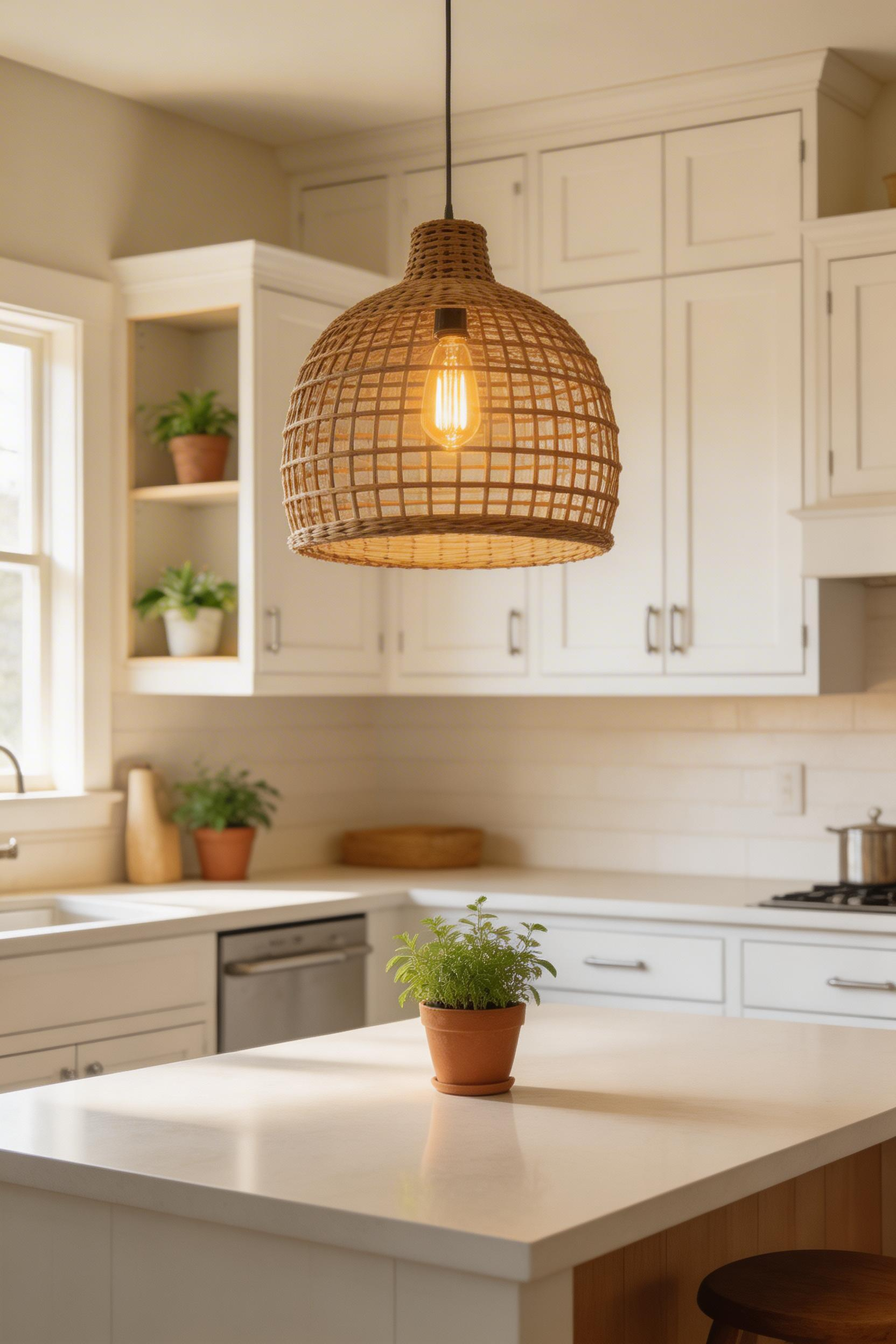
Warm bulbs at 2700K-3000K make food look good and the room feel cozy. Cool white at 4000K+ makes even a nice kitchen feel clinical. Temperature matters as much as the fixture.
Brightech’s Rattan Woven Pendant runs $45-$75 — it’s 12 inches in diameter, fits a standard E26 socket, and works with a standard ceiling box. The Amazon-available dupe of West Elm’s industrial pendant (matte black, 8-10 inch shade, adjustable 59-inch cord) comes in at $38-$65.
If you have 8+ foot ceilings and a defined area to hang over, go with a pendant — bottom of shade should be 30-36 inches above the counter. For lower ceilings or rentals, a globe-style Edison flush mount ($28-$55) adds warmth without the height requirement.
Check whether your current fixture connects to a standard ceiling box before ordering. If it does, swapping it is a 20-minute DIY requiring only a flathead screwdriver and a voltage tester. If not, an electrician visit runs $50-$80 — still worth it for a fixture you’ll look at every day.
A chalkboard in a kitchen is one of those ideas that sounds trendy but actually earns its place. A surface you can write on each week — a meal plan, a seasonal menu, a note for the kids — gives a kitchen a living quality that static decor can’t match.
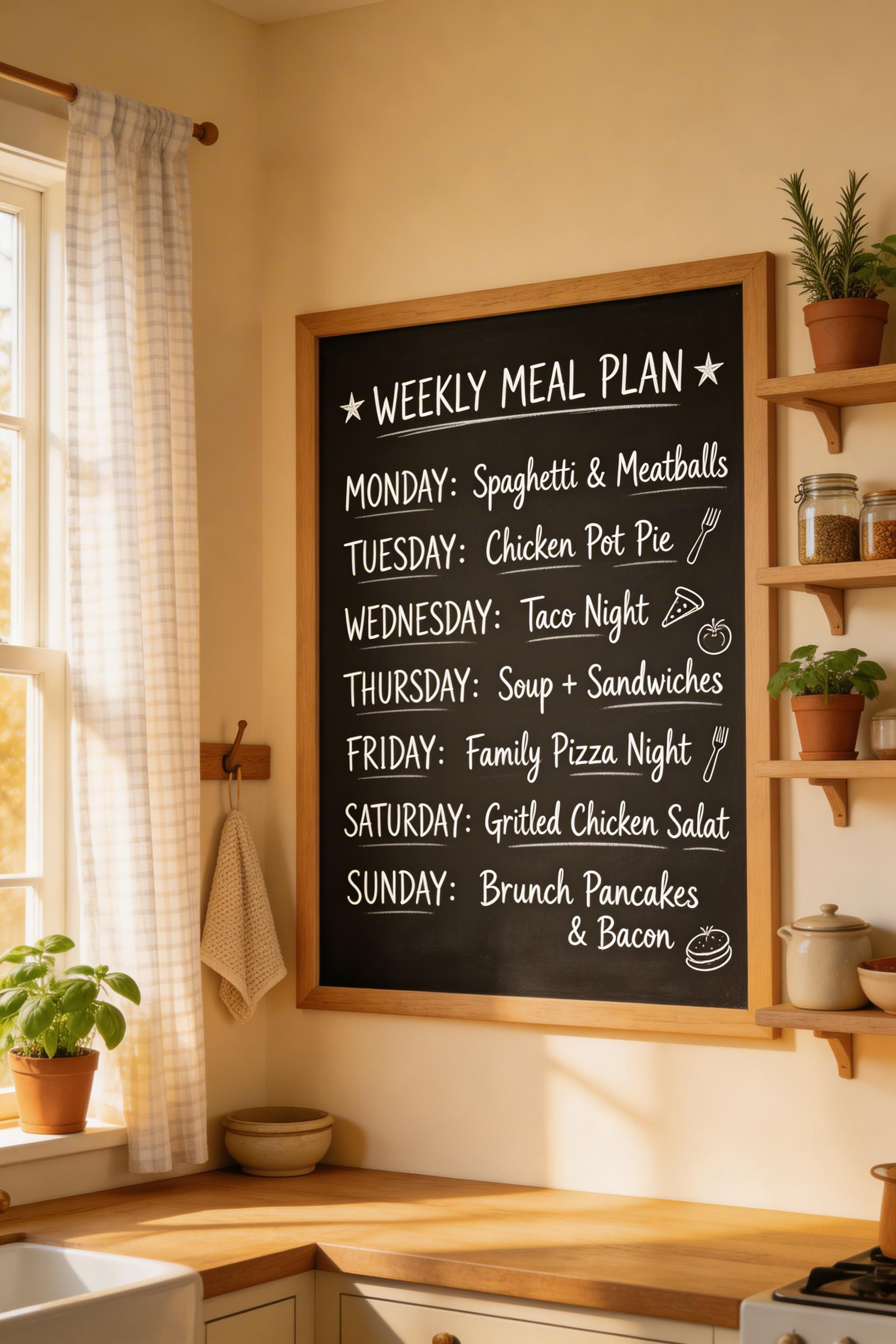
Static wall art says something about who you are once. A chalkboard says something different every week. Writing a new menu, wiping it clean, and starting again keeps the kitchen feeling current and personal rather than permanently decorated.
A framed chalkboard runs $22-$40. Rust-Oleum Chalkboard Spray Paint at $8-$12 a can turns any flat surface — plywood, a cabinet door, a section of wall — into a chalkboard. A painted 24×36 panel costs about $18 total.
A framed chalkboard is portable, easier to install, and can move with you if you rent. A painted chalkboard panel or wall section is more dramatic, more custom, and cheaper for larger sizes. Both work. The choice depends on whether you want something you can take down or something built into the room.
Season a new chalkboard before first use: rub the flat side of a chalk stick over the entire surface, then erase it completely. This prevents ghost images from your first writing from showing through forever after. A chalkboard panel is one of the most overlooked kitchen decor on a budget ideas — it costs under $20 and genuinely gets used every day.
This is one of the best kitchen decor on a budget moves for anyone with mismatched dining furniture. It requires the least money and the most willingness to let go of matching. If you have four kitchen chairs that don’t work together, painting them all one color is the single act that transforms mismatched furniture into a deliberately eclectic dining set.
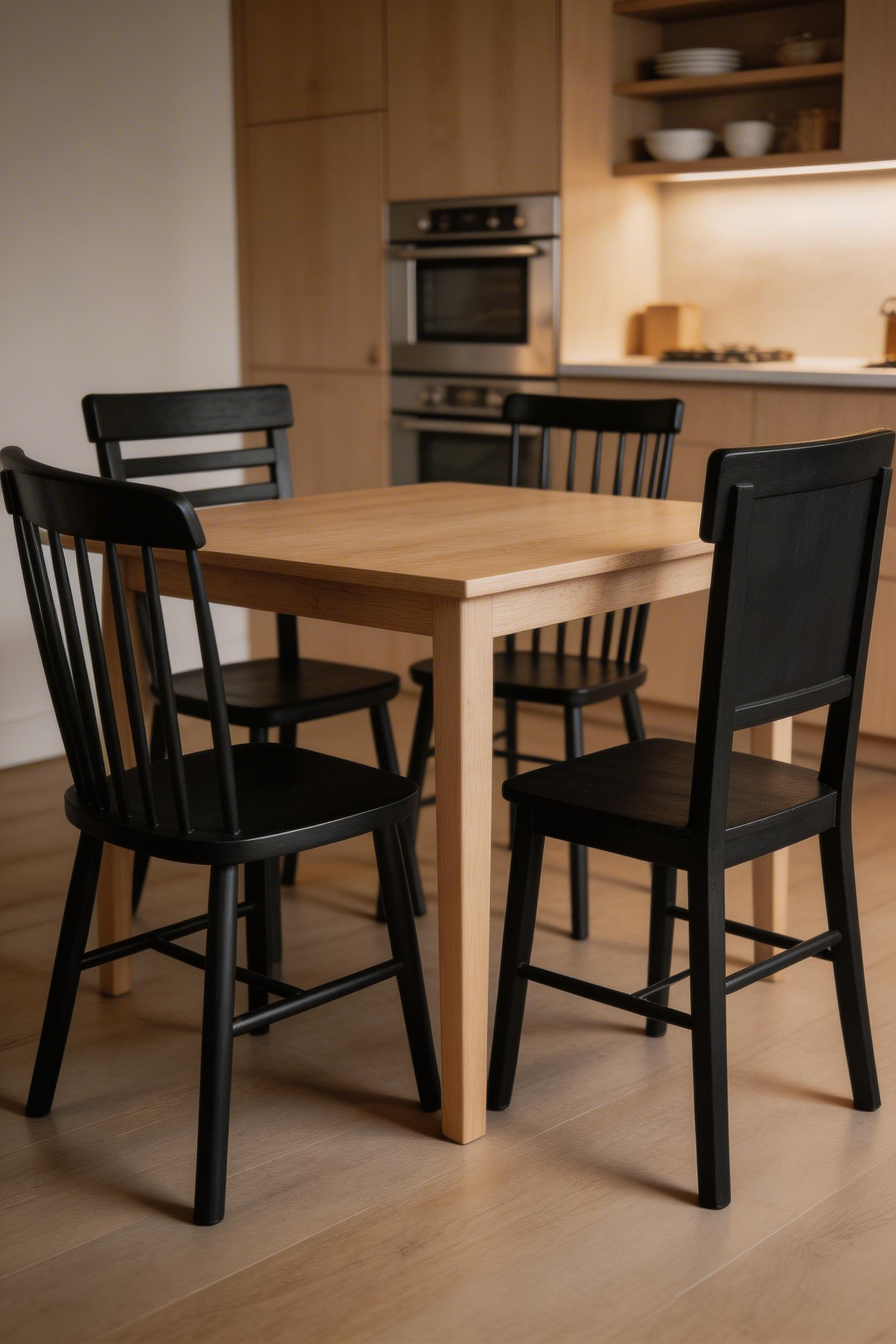
When four chairs share a color but differ in shape, they read as collected. The paint creates the thread. And the slight variations in silhouette — ladder back, spindle, turned legs — make the set more interesting than four identical chairs.
Rust-Oleum Painter’s Touch 2X ($7-$12 per can) covers wood or metal in two coats. For four chairs, plan on 2-3 cans. Finish with Varathane Clear Polyurethane Spray ($8-$14) — kitchen chairs get daily contact, and unprotected paint chips fast.
Matte black chairs are the current most-versatile choice — they work with wood, white, sage, or navy cabinet colors. Sage green chairs look extraordinary against white or cream kitchens. Warm white chairs with a lightly distressed finish have a classic farmhouse quality that photographs beautifully. Cost for four chairs: $20-$40 total.
Don’t try to buy matched chairs and then paint them. The slight shape variations between thrifted or mixed chairs make the finished set look more intentional, not less. Source different chairs, pick your color, and own the eclecticism.
This is the budget kitchen decor idea that most people underestimate entirely — until they try it. A set of new dish towels costs $8-$28. Hung from an oven handle or draped on a hook near the sink, they’re visible every time you cook. Changed seasonally, they become the easiest and cheapest form of kitchen refresh available.
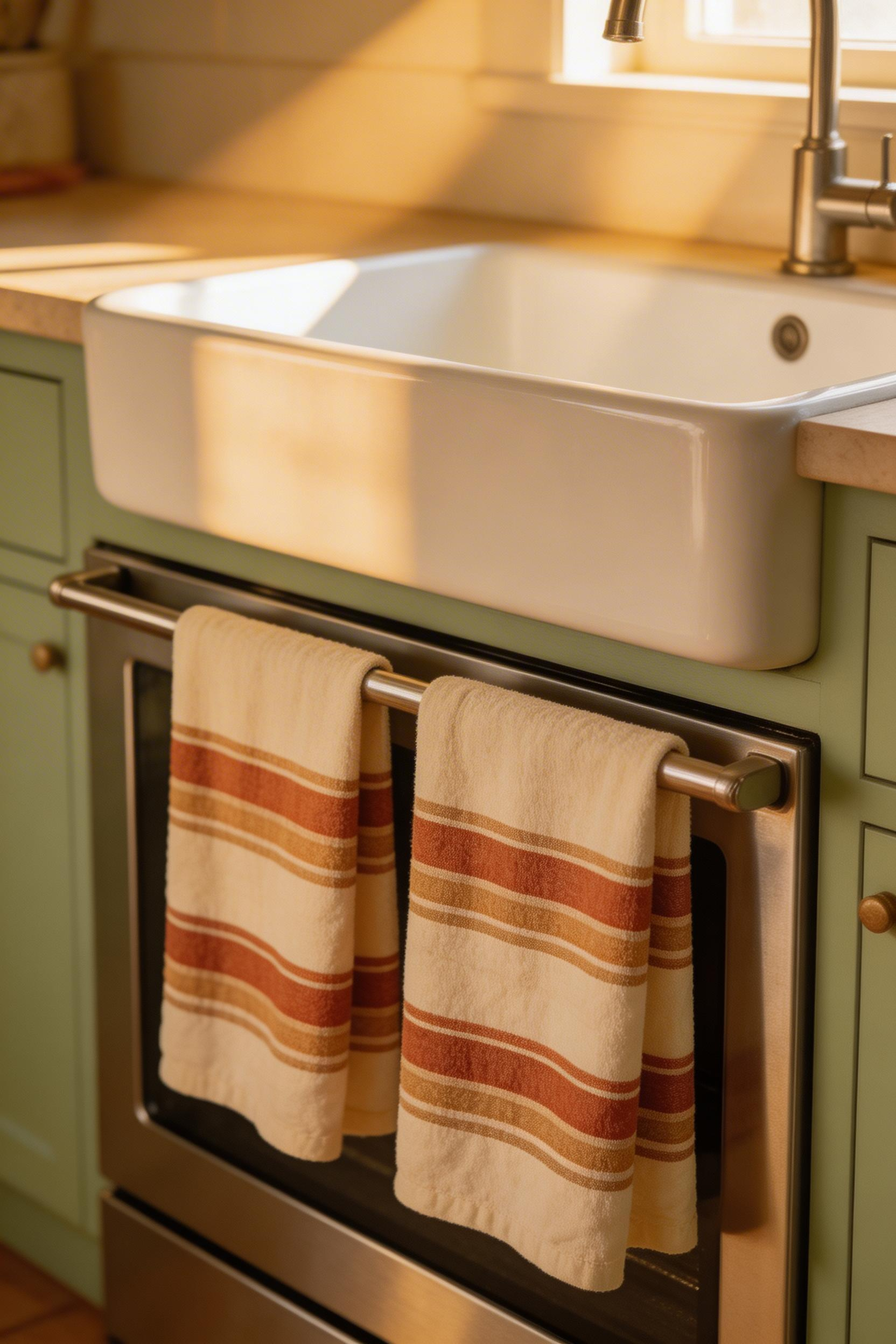
The kitchen is one of the few rooms where textiles are both functional and visible — you don’t have to justify dish towels as decor. Spring florals in April, warm plaids in October, simple linen in summer: a $20 set gives you a new kitchen every season without buying any furniture.
Etsy handmade linen towels in sets of two run $16-$28 — look for vendors who make them in kitchen-specific dimensions (20×28 or 18×28 inches). H&M Home cotton kitchen towels are consistently $8-$15 for a two-pack and come in strong seasonal colors. Both options are a level above the thin utility towels that most kitchens default to.
A kitchen window without a treatment looks bare. A cafe curtain costs $10-$20 using a tension rod and a piece of cotton fabric. It covers only the lower half of the window, giving you privacy without blocking light. No sewing required if you use fabric hem tape. IKEA’s MATILDA sheer at $9.99 per panel fits a tension rod and creates a soft, privacy-with-light-still-in result that’s hard to improve on for the money.
If you’re looking for broader kitchen wall decor ideas that pair well with textile choices, coordinating your towel patterns with wall art creates a finished, intentional look.
Buy dish towels that match one accent color already in your kitchen — a blue towel if your canisters are blue, a sage green if your rug has sage in it. That tie-in is what makes a space look designed rather than accumulated.
A kitchen gallery wall is one of the best kitchen decor on a budget ideas that creates a truly magazine-quality result — and it takes a Saturday afternoon at most. The framing costs almost nothing with IKEA options, the prints cost almost nothing with digital downloads, and the result looks like something out of a home design magazine.
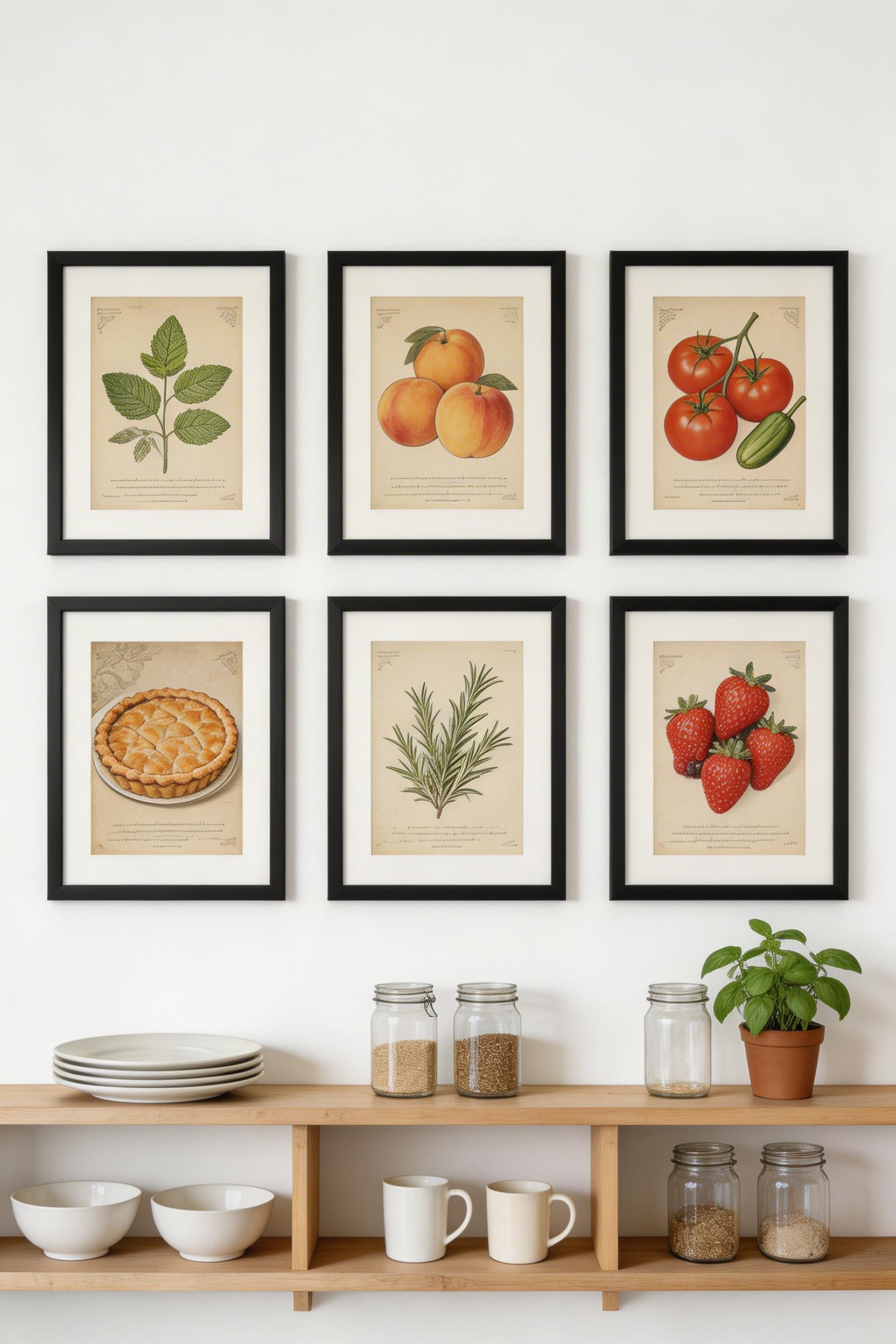
The reason gallery walls feel designed is because they treat a wall the way a magazine treats a page — with intention, composition, and a clear aesthetic point of view. In a kitchen specifically, food-themed art ties the room’s function to its decor, which creates coherence rather than decoration-for-decoration’s-sake.
A 6-print gallery using digital downloads ($3-$8 per print on Etsy) plus IKEA RIBBA frames ($4.99-$9.99 each) costs $30-$50 total. The most popular themes in 2025-2026: vintage French botanical prints, retro produce illustrations, spice label art, and mid-century recipe card graphics.
Canva has 50+ free kitchen-theme templates — download as PDF, print at Staples for $0.39 per page on matte paper. Etsy vintage digital downloads are often $3-$6 per print and come with commercial print rights. Once downloaded, you can print them at home or at a copy shop at whatever size fits your frames.
Print on matte photo paper, not regular copy paper. The paper quality is what separates a printable that looks like a real print from one that looks like a printout. Staples and Office Depot both offer cheap matte photo paper printing per sheet.
Cabinet hardware is the jewelry of your kitchen. The difference between builder-grade brushed nickel knobs and matte black bar pulls is about $30-$60 for a full kitchen and one hour of your Saturday.
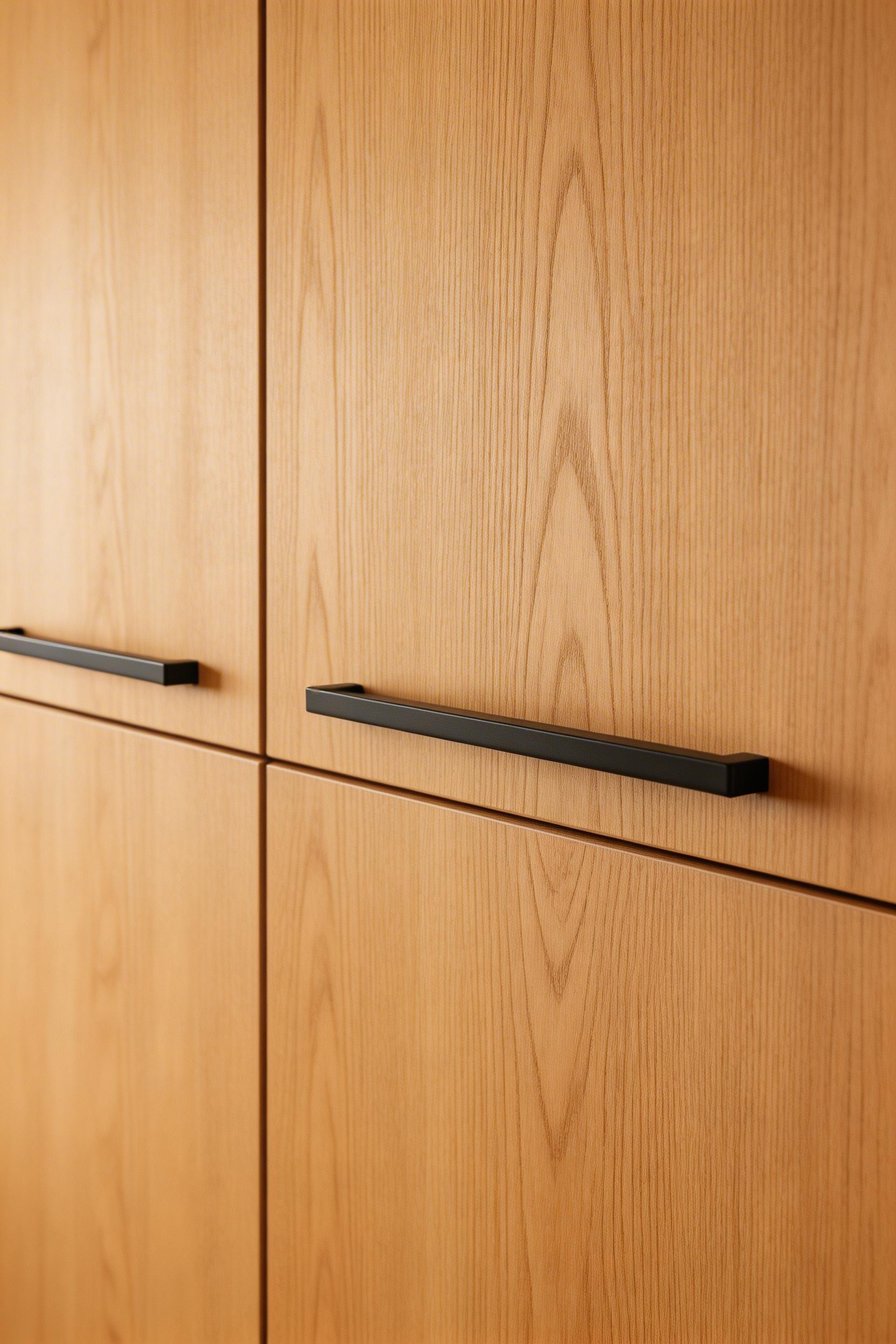
Hardware gets touched dozens of times a day. It’s at eye level. It reflects light. In a kitchen where cabinets dominate the visual space, hardware is the detail that says “this was chosen.” A 10-pack of matte black bar pulls runs $22-$40. Brushed brass knobs run $18-$35 for a 10-pack.
Matte black goes with white, cream, sage, navy, and wood-toned cabinets — essentially everything. Brushed brass pairs especially well with white or sage, where the gold tone complements rather than competes. Brushed nickel is the most neutral and matches stainless appliances naturally.
Measure your existing hole spacing before ordering bar pulls. Standard is 3 inches center-to-center, but some builders use 3.5 or 4 inches. If you order the wrong size, you’ll need to drill new holes — worth 30 seconds of measuring to avoid.
Plastic bins and wire shelving solve a storage problem without creating a visual one. Woven baskets and natural fiber bins are affordable kitchen decor on a budget that also looks intentional — this is the most practical category, where everything has a job. For budget kitchen decor, that distinction matters — functional items that look good are twice the value.
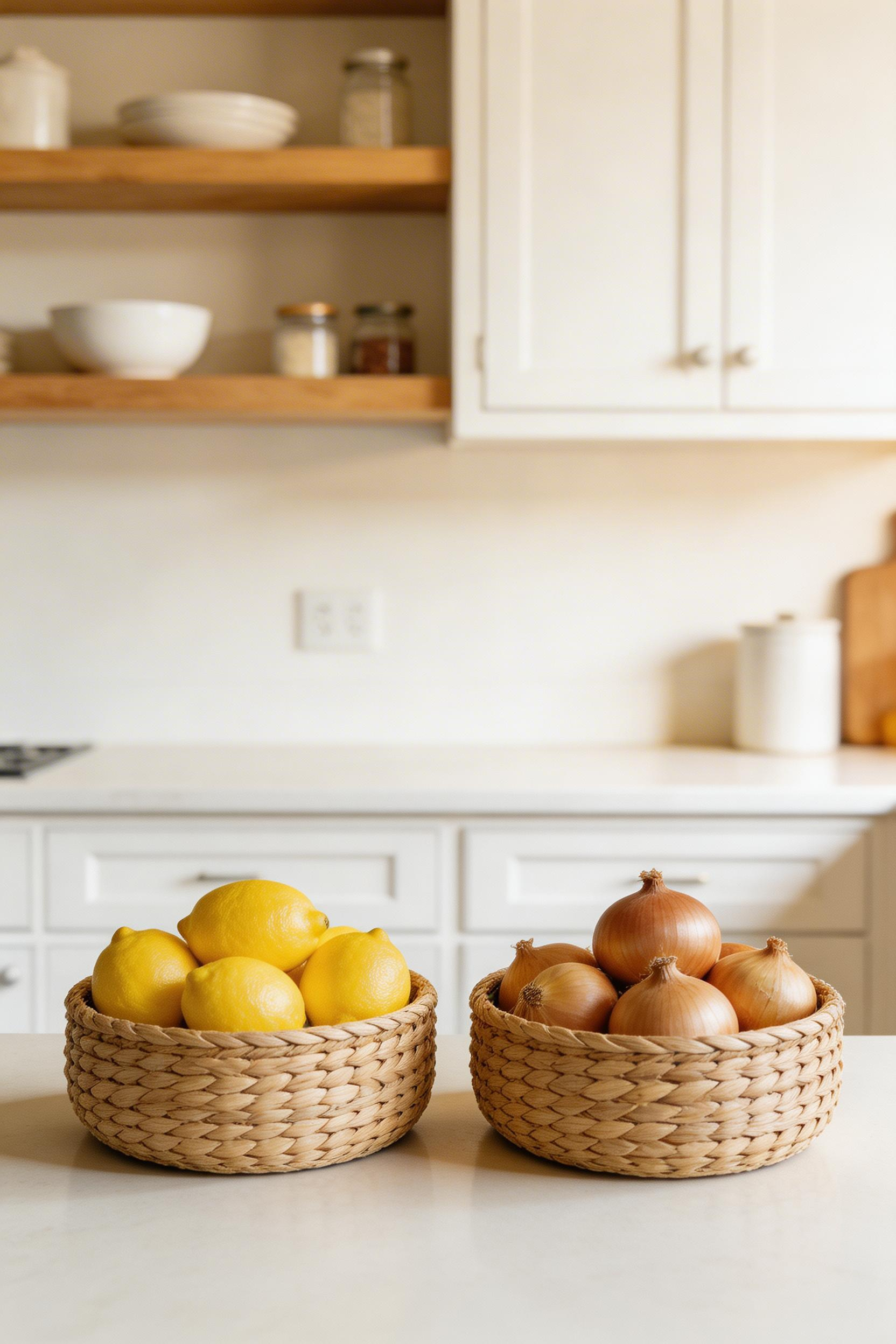
A basket of onions, garlic, and lemons is simultaneously the most practical and most beautiful thing on a kitchen counter. Natural materials — seagrass, jute, rattan — bring texture and warmth that plastic never does.
Target’s Threshold seagrass bins run $15-$30. IKEA’s LURPASSA basket (set of 2 for $12.99) nests for storage and works well on pantry shelves. A three-basket set — small for garlic, medium for onions, large for bread — costs $35-$60. You can also find complementary 18 Kitchen Island Ideas for Small Kitchens that pair storage and style at every price point.
Display in baskets: onions, garlic, potatoes, seasonal fruit, bread, folded linen napkins. These items look natural and fresh in an open basket. Keep hidden in closed cabinets: cleaning products, plastic bags, batteries, appliance cords. The rule of thumb: if it’s a food item or a textile, it can probably live in a basket. If it’s a product or a cord, it should live behind a door.
Label baskets with small chalk tags or leather tag labels. It adds the organized-but-organic look that’s everywhere in kitchen design right now — and it genuinely helps other household members know where things belong.
A single plant on a kitchen shelf or counter has a disproportionate effect on how alive the room feels. It’s not about quantity — one healthy pothos, one pot of aloe, one cluster of succulents is enough. Plants bring the one quality that no candle, art print, or basket can replicate: actual living energy.
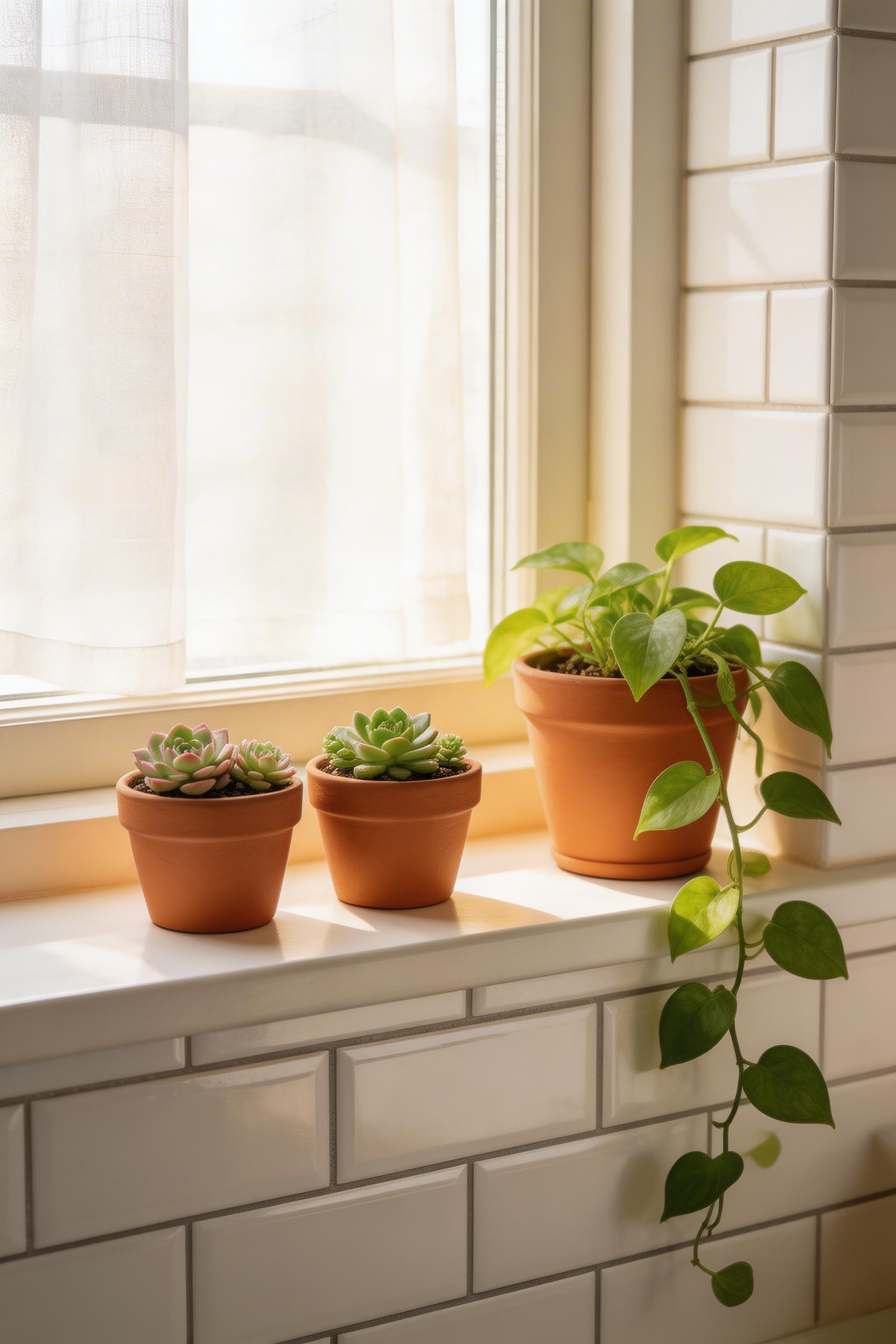
Plants soften hard surfaces, introduce organic shape into right-angle-heavy spaces, and signal that someone tends this room. In a kitchen full of tile, metal, and glass, a plant is the textural antidote.
A pothos from IKEA costs $4-$6. A 2-inch succulent from Trader Joe’s runs $1.99-$3.99. Aloe vera — which doubles as a practical burn remedy for cooking accidents — costs $4-$10 at most grocery stores. The whole plant section of a budget kitchen decor plan costs $10-$25 and has the longest lifespan of anything on this list.
For kitchens without direct sun: pothos (Epipremnum aureum) and snake plants. Both tolerate low light, inconsistent watering, and the temperature fluctuations that come with a working kitchen. For sunny south-facing windows: aloe vera, succulents, and herbs (see item 5 above). Pothos is especially forgiving — water when the top inch of soil is dry, and it rewards neglect with long, trailing vines.
A pothos trailing from a high shelf fills vertical space that artwork can’t reach. A cluster of three succulents on a small tray creates a focused display. A hanging macrame planter ($12-$25) turns a kitchen corner into something alive.
Propagate your pothos. Once established, take 4-inch stem cuttings, place them in small jars of water, and wait two weeks for roots. A $10 plant becomes 5 plants within a season — free decor for the rest of the house.
The honest answer to where to start isn’t whichever idea looks best on Pinterest. It’s: start with your kitchen’s biggest pain point.
If your kitchen feels dark and closed, start with items 1 (open shelves) or 9 (lighting). If it feels bare and unfinished, items 13 (gallery wall) or 6 (cabinet paint) have the most surface-area impact. If it feels cluttered and chaotic, start with items 7 (mason jar organizers) or 15 (baskets). If the bones are fine but the personality is missing, items 4 (thrift crockery), 8 (vintage finds), or 5 (herb garden) are the fastest ways to inject warmth.
The goal isn’t a styled kitchen — it’s one that works and feels like yours.
Start with the free and low-cost moves: rearrange what you have on the counter, pull those matching jars from the cabinet, bring in one plant, hang a dish towel with intention. Get those right first — they cost nothing and they’ll clarify what’s actually missing. Then move to the $20-$50 moves: a rug, a set of hardware, a printable gallery wall. Save the larger investments (cabinet paint, a light fixture) for when you know exactly what you want and why. Budget kitchen decor done in that order is almost always more satisfying. You don’t want to spend $100 on a fixture and then realize a $12 basket would have solved the problem.
If you’re considering a more structural update alongside your decor work, 18 Small Kitchen Remodeling Ideas That Work is a good reference for where decorating ends and renovation begins. And for countertop options at every price, 18 Kitchen Countertops With White Cabinets is worth a read.
Start with one idea this weekend. You’ll know where to go from there.