Physical Address
304 North Cardinal St.
Dorchester Center, MA 02124
Physical Address
304 North Cardinal St.
Dorchester Center, MA 02124
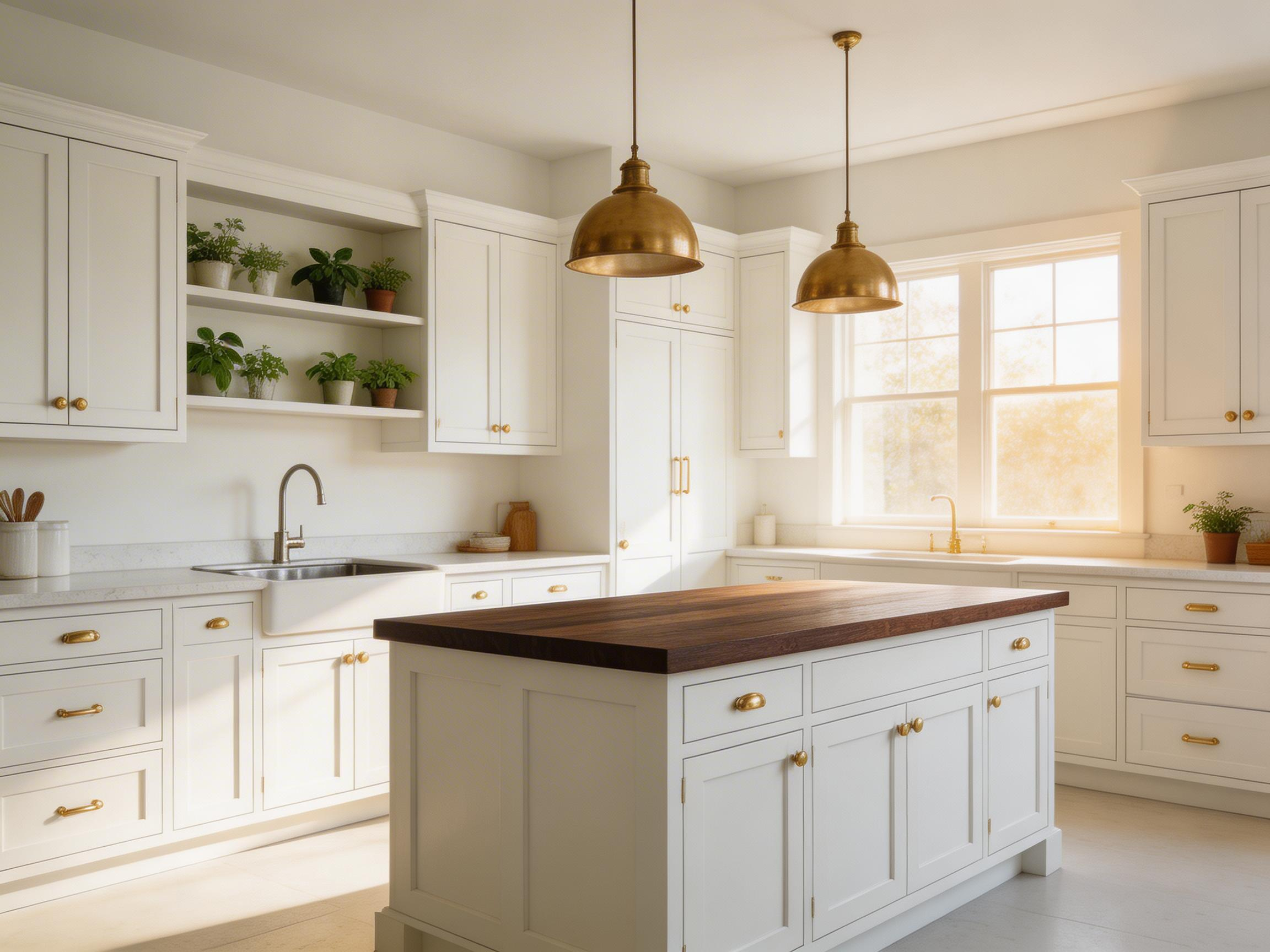
18 kitchen countertops with white cabinets — marble, quartz, granite, butcher block, porcelain slab, and more, with prices, pros, and honest advice.
White cabinets are the most forgiving base a kitchen can have. They reflect light, open up a space, and pair with almost every countertop material on the market. Almost. Some pairings read as cold and sterile. Others feel dated six months after installation. A few are so reliably good that kitchens built around them still feel current ten years later.
I’ve helped a lot of families design kitchens around white cabinets. The countertop question is always where the most second-guessing happens. The right material does more than complete the look. It sets how the kitchen feels to cook in every day, how much maintenance you’re signing up for, and whether the room still feels right in a decade. These 18 kitchen countertops with white cabinets cover the full range. Classic marble, practical quartz, warm wood, durable porcelain, and a few options you might not have considered yet.
Calacatta marble is the countertop choice that makes a kitchen feel like a destination. The bold, branching veins — cream to gold to gray, depending on the slab — create a surface that demands to be the room’s focal point. Against white cabinets, the marble takes centre stage without competition.
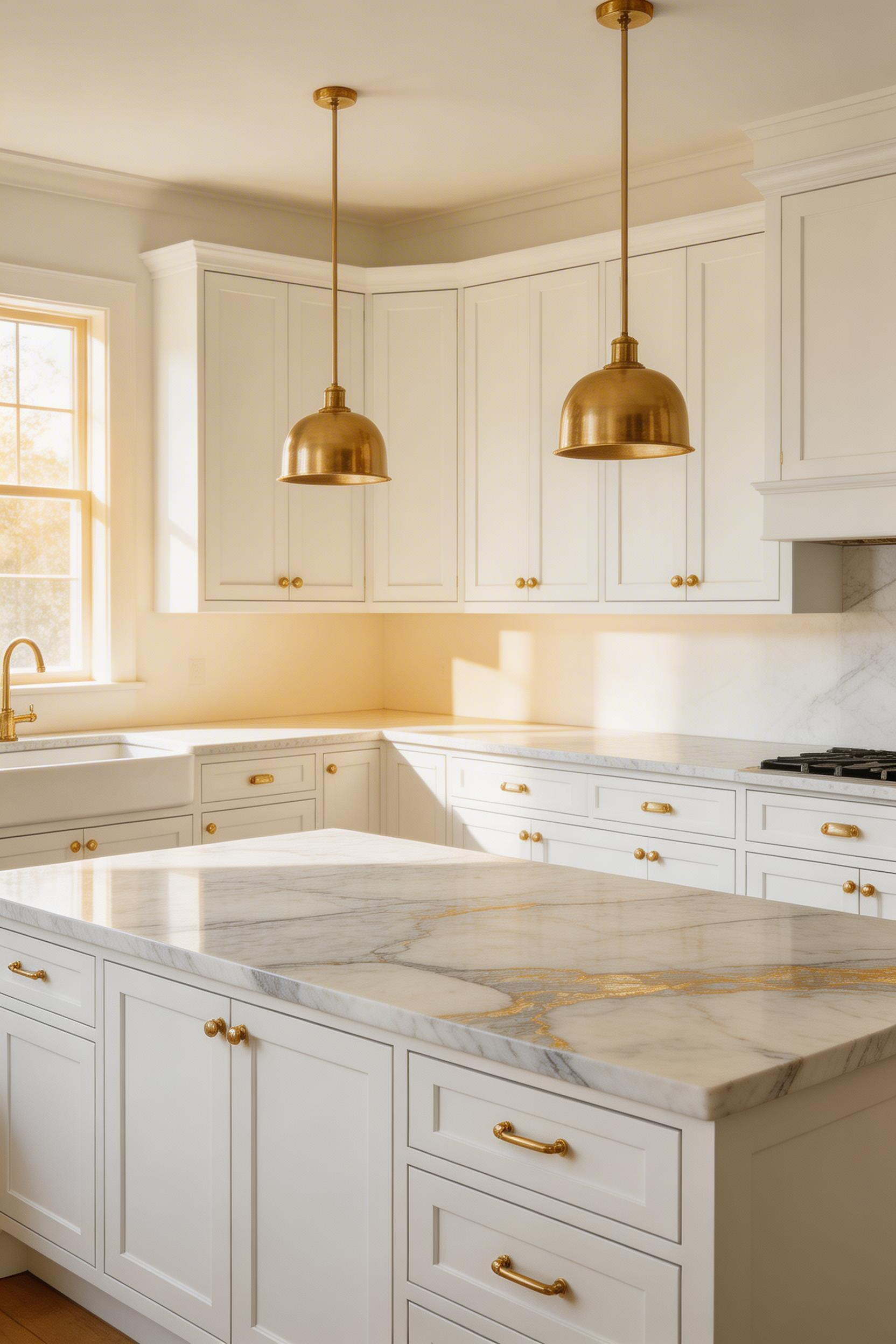
The key distinction: Calacatta has fewer, thicker, more dramatic veins. Carrara has finer, more frequent grey veins and a cooler background tone. For white cabinets, Calacatta reads warmer and more luxurious. Carrara reads softer and more classic. Neither is wrong — they just tell different stories. Calacatta Gold marble runs $80–$150 per square foot installed. The MSI Sensa Calacatta engineered lookalike sits at $65–$120 and needs no sealing. For busy cooks, the engineered version is the honest recommendation. Same drama, no panic when red wine spills.
If you choose genuine marble, seal every 6–12 months with a penetrating stone sealer like Miracle Sealants 511. The goal isn’t waterproofing — it’s slowing staining. Marble etches from acids (lemon juice, vinegar, wine) even when sealed, so keep cutting boards close and wipe spills quickly. Bookmatching two slabs on an island — mirroring the veining for a symmetrical butterfly pattern — is worth the extra cost. Do it when the island is visible from multiple angles.
The most common mistake with white cabinet kitchens: pairing them with a countertop that’s also cool white or stark grey. The result is a kitchen that looks beautiful in listing photos and feels clinical to cook in. A soft cream quartz — one with warm undertones rather than cool ones — solves this completely.
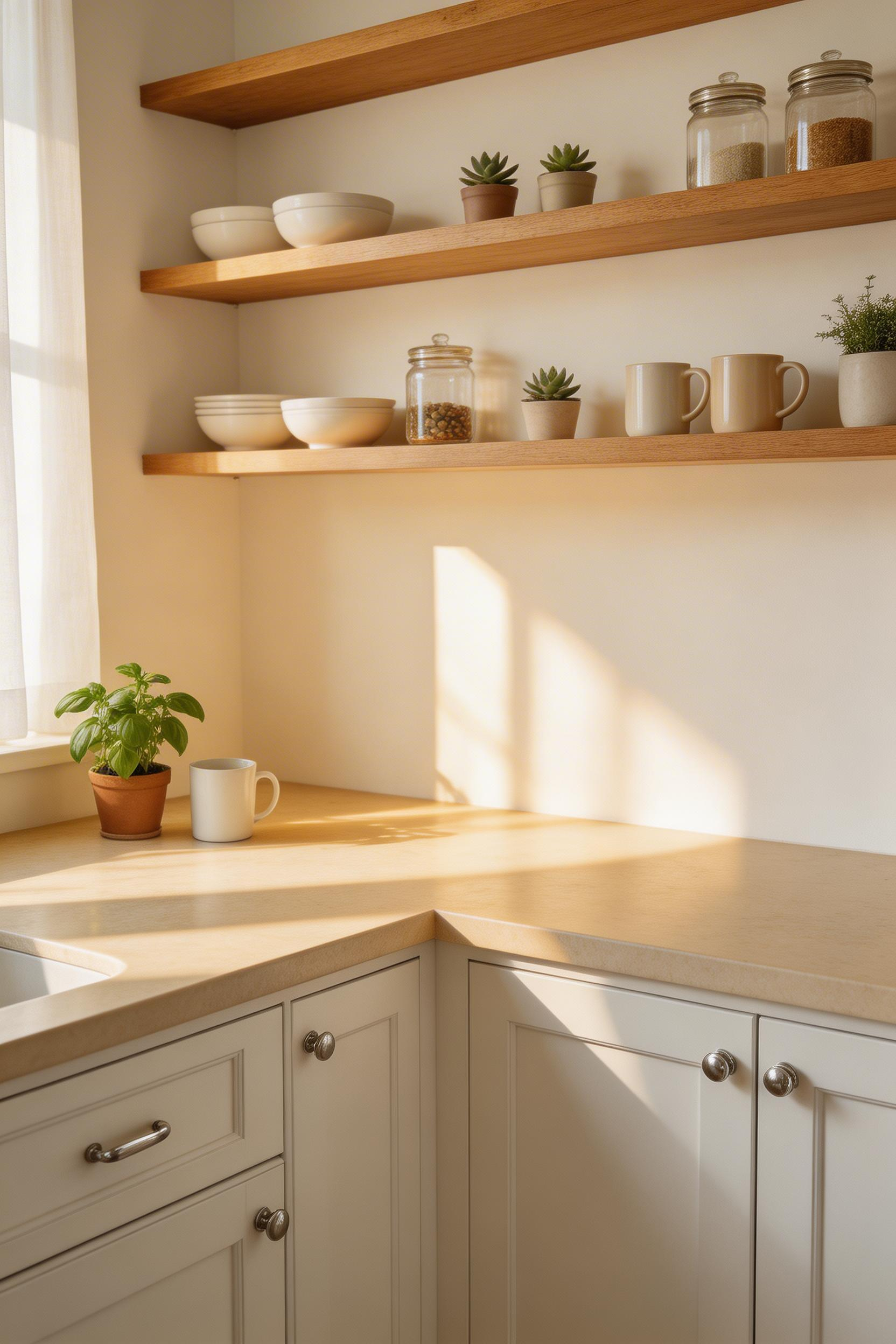
Bring a cabinet door sample to the stone yard. Hold the quartz sample directly against your cabinet white under different lighting conditions: warm showroom light and daylight. MSI Calacatta Laza Quartz ($60–$90/sqft installed) and Caesarstone Dreamy Marfil ($65–$95/sqft) both read warm. Silestone Calacatta Gold ($70–$100/sqft) skews slightly warmer still. Request a sample tile — not a 2-inch chip — because quartz reads very differently at scale.
Quartz is 93% ground stone bound in resin. That makes it non-porous and far more forgiving than marble for everyday cooking. No sealing needed. Heat resistance runs to around 300°F — sufficient for most pots, but use trivets for anything coming directly off the stove. The engineered surface also means consistent patterning across multiple slabs, so a larger kitchen won’t have awkward tonal differences between sections.
Black-and-white is one of the most enduring kitchen combinations, and honed black granite is one of the kitchen countertops with white cabinets that keeps proving the point. A honed black granite countertop against white shaker or flat-panel cabinets is clean, graphic, and completely timeless. Honed is the critical word here — polished black granite shows every water spot, smudge, and fingerprint in a working kitchen. Honed reads as matte velvet and is far more forgiving.
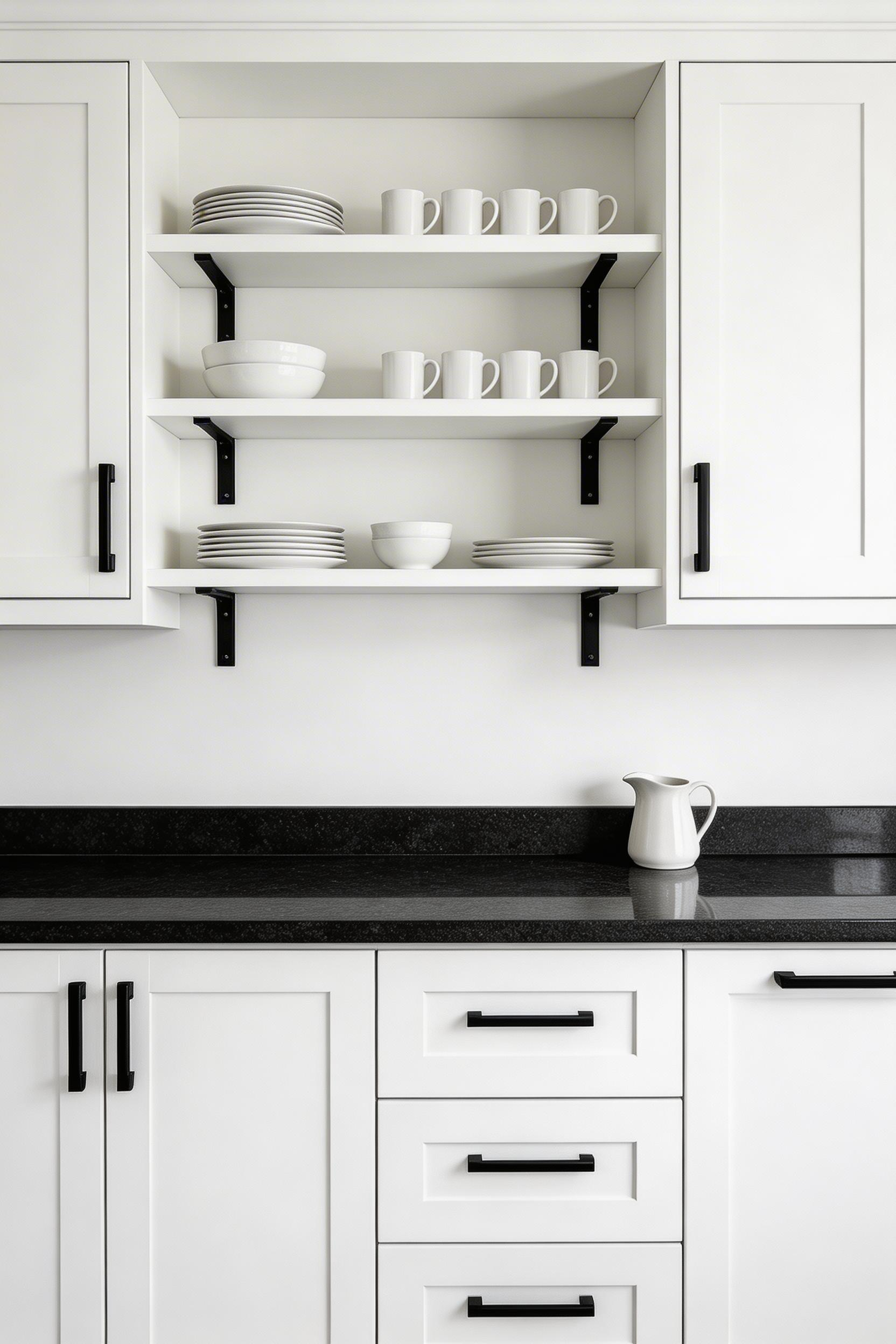
Absolute Black Granite (honed) runs $45–$70 per square foot installed and has the most uniform colour — very few spots or variations. Zimbabwe Black runs slightly higher ($50–$75/sqft) with a finer grain. MSI Black Pearl Leathered adds texture to the contrast if you want more visual interest than a flat honed surface. Sealing once a year with a penetrating sealer is still recommended even for honed granite — black finishes show etching if left unsealed near acidic foods.
With a stark colour pairing like black granite and white cabinets, the edge profile matters more than with subtler countertops. An eased (slightly rounded) edge softens the contrast at the counter’s lip. A waterfall edge — running the slab vertically down the island side — turns the material into a design feature rather than just a surface.
No material warms up kitchen countertops with white cabinets faster than a butcher block wood surface. The natural grain, the honey tones of maple, or the richer brown of walnut against white cabinets creates immediate contrast without coldness. Wood countertops also have a tactile quality — the warmth underhand when you’re working at the counter — that no engineered surface replicates.
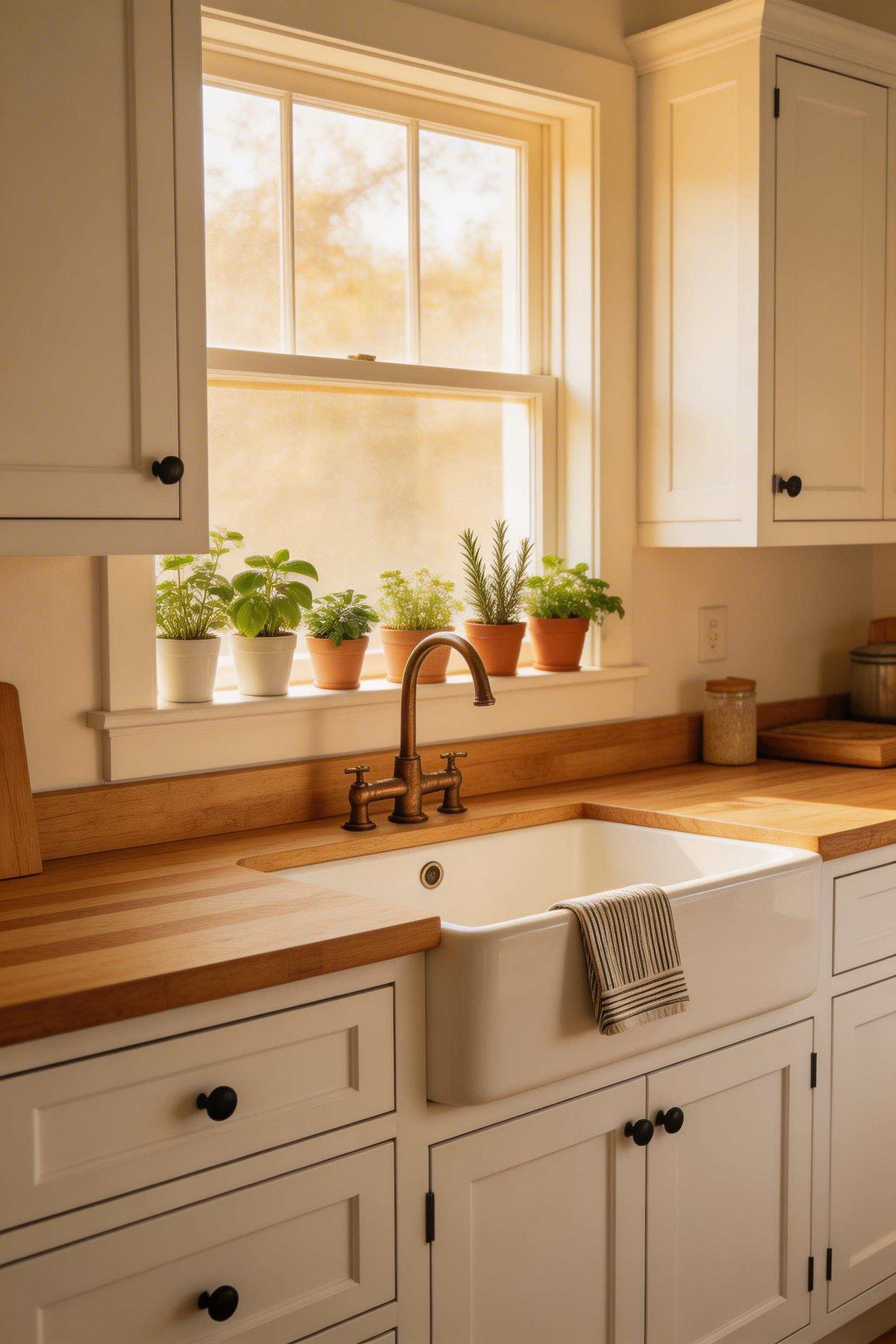
Maple butcher block ($35–$50/sqft) has a pale golden tone that lightens the kitchen while adding warmth. Walnut ($70–$100/sqft) reads much darker and richer — excellent if you want more contrast, but a bigger commitment. IKEA BADELUNDA butcher block ($229–$449 per length) is the accessible entry point for maple. John Boos Maple Edge-Grain ($80–$130/sqft) is a step up in quality and longevity. Edge-grain is harder and more durable than face-grain for surface work.
Keep butcher block away from the sink zone or waterproof it thoroughly before installation. Water damage at the sink — where the wood is constantly wet and drying — is the main reason butcher block countertops get replaced. Seal the underside and edges before installation, apply food-grade mineral oil every one to three months, and use a silicone-caulked sink mount rather than undermount if moisture protection is a concern.
Pale quartzite is one of the most elegant kitchen countertops with white cabinets — the material many people mean when they say marble but want something harder. It’s a natural metamorphic rock — harder than granite (Mohs 7–8), with softer, more organic movement than granite’s speckled pattern. Pale gray quartzite like Taj Mahal or Fantasy Brown brings a warm, textured stone quality to a white cabinet kitchen without the maintenance anxiety of marble.
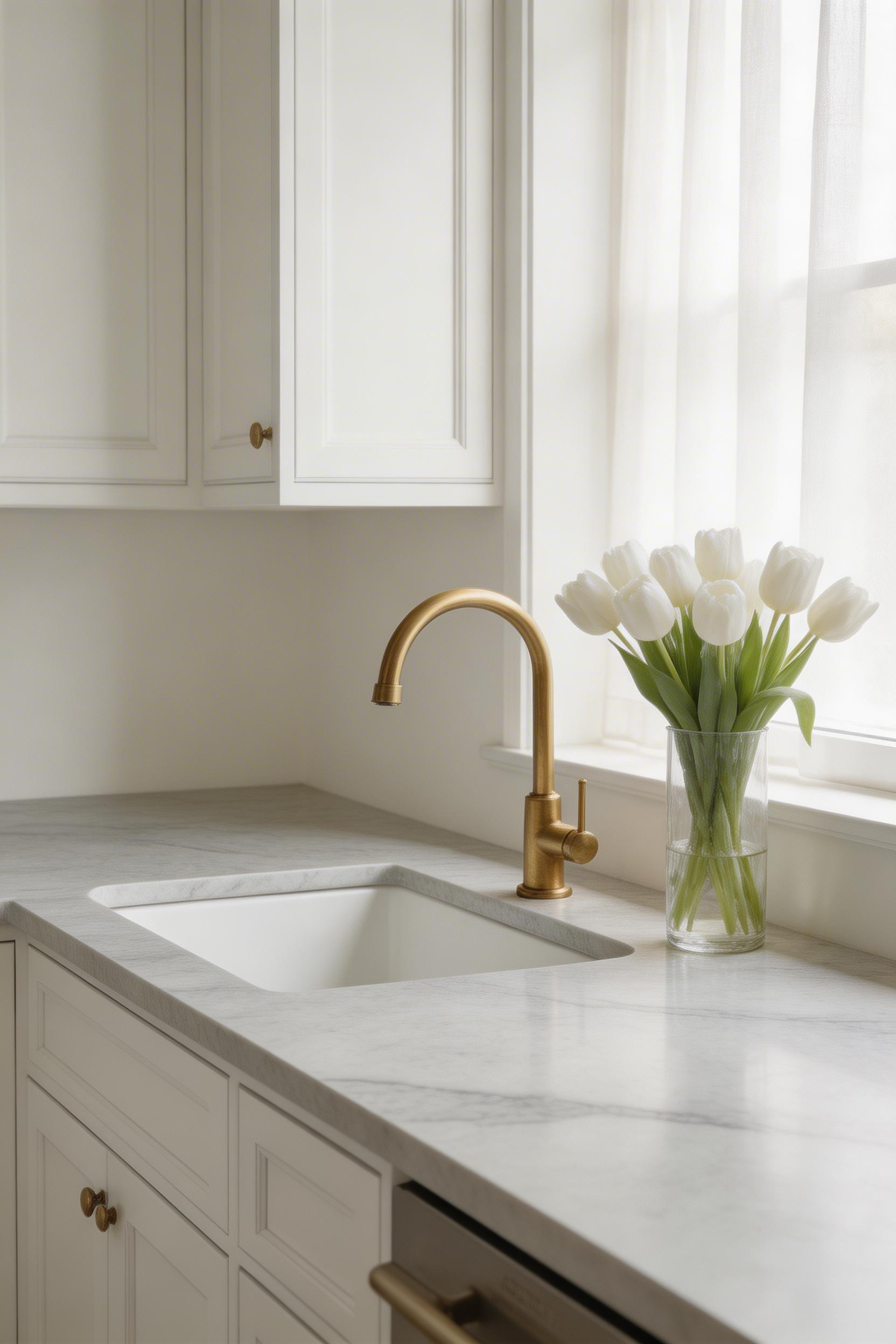
The visual difference between quartzite and engineered quartz is subtle but present: quartzite has the mineral depth and natural variation of a stone that was formed under heat and pressure. The surface reads differently under light — less uniform, more alive. Taj Mahal Quartzite ($60–$100/sqft installed) has warm cream-grey tones. White Macaubas ($65–$95/sqft) reads cooler and more translucent. Fantasy Brown ($55–$90/sqft) has more brown-pink movement — the warmest of the three.
Quartzite may still need annual sealing — porosity varies significantly by slab. Ask your supplier for a water drop test: put a few drops on an unsealed piece and watch. If it absorbs in under 4 minutes, seal before installation. Don’t confuse quartzite (natural stone) with quartz (engineered). If the supplier can’t tell you which you’re buying, ask for a scratch test or a certificate.
Soapstone is the kitchen countertop with white cabinets for people who want dark contrast but find black granite too stark and dark quartz too uniform. Vermont soapstone is grey-green-black, with a soft, almost powdery surface texture and a Mohs hardness of only 1–2. It scratches easily, develops a rich patina, and improves with age in a way no other countertop material does.
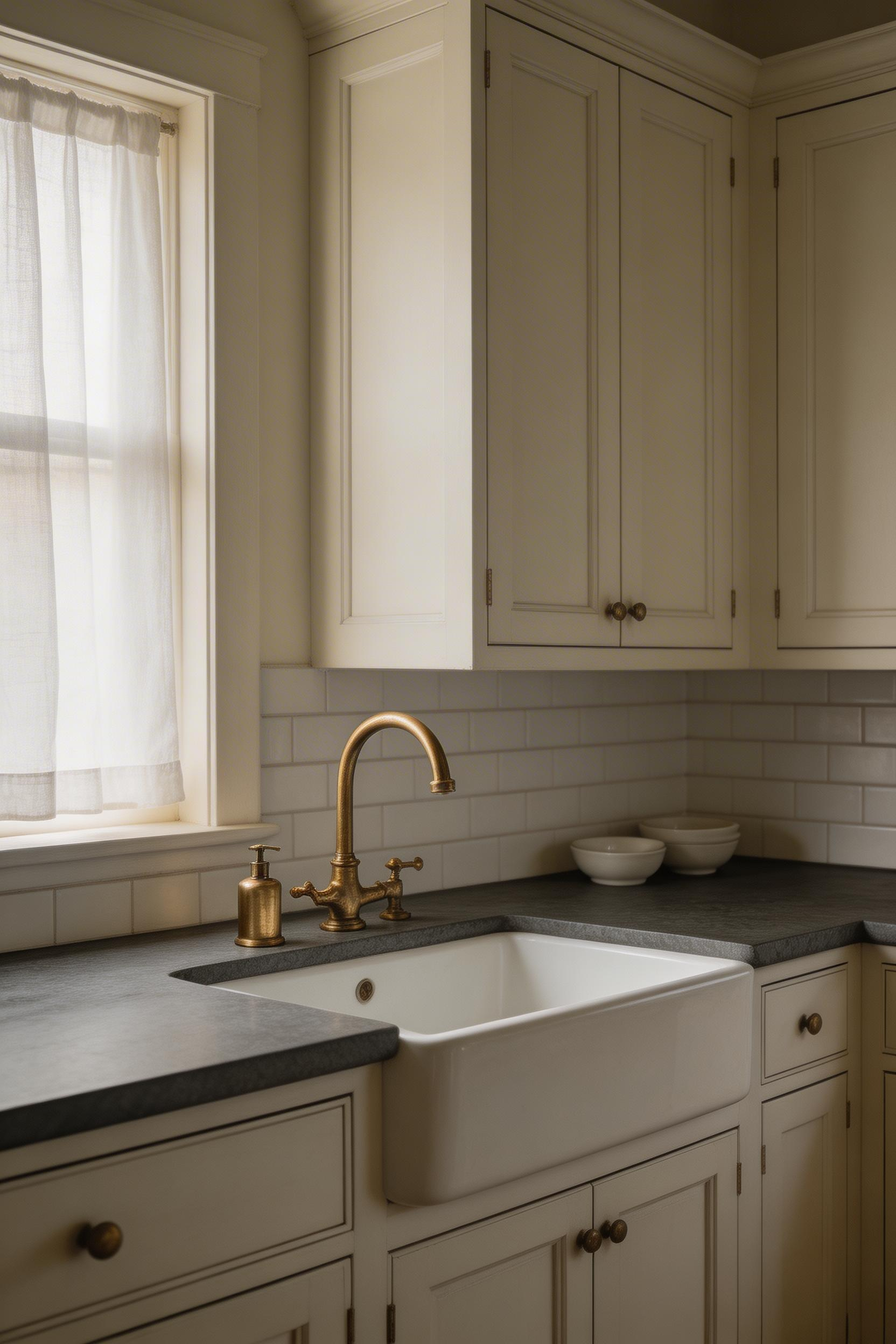
Rub new soapstone with mineral oil monthly for the first year to develop an even patina. Without oiling, soapstone lightens unevenly in high-use areas and develops a patchwork appearance. With consistent oiling, it darkens uniformly to a deep charcoal green. Vermont Soapstone ($75–$150/sqft installed) and Alberene Soapstone ($80–$140/sqft) are the two main North American sources. Scratches in soapstone sand out easily with fine-grit sandpaper — many owners treat this as a feature rather than a maintenance problem.
Soapstone suits kitchens with antique white, off-white, or cream cabinets better than stark modern white. Against very bright white cabinets, the pairing can look startling rather than intentional. It’s also a commitment to a specific, slightly aged-farmhouse character — if you’re planning to sell in a few years, a more neutral stone might serve the resale better.
Most granite comes polished. Leathered granite is the alternative — a diamond-brushed surface that creates a matte, textured finish with subtle topography you can feel when you run your hand across it. The effect on kitchen countertops with white cabinets is immediate: the granite reads warmer, more tactile, and considerably more contemporary than its polished equivalent.
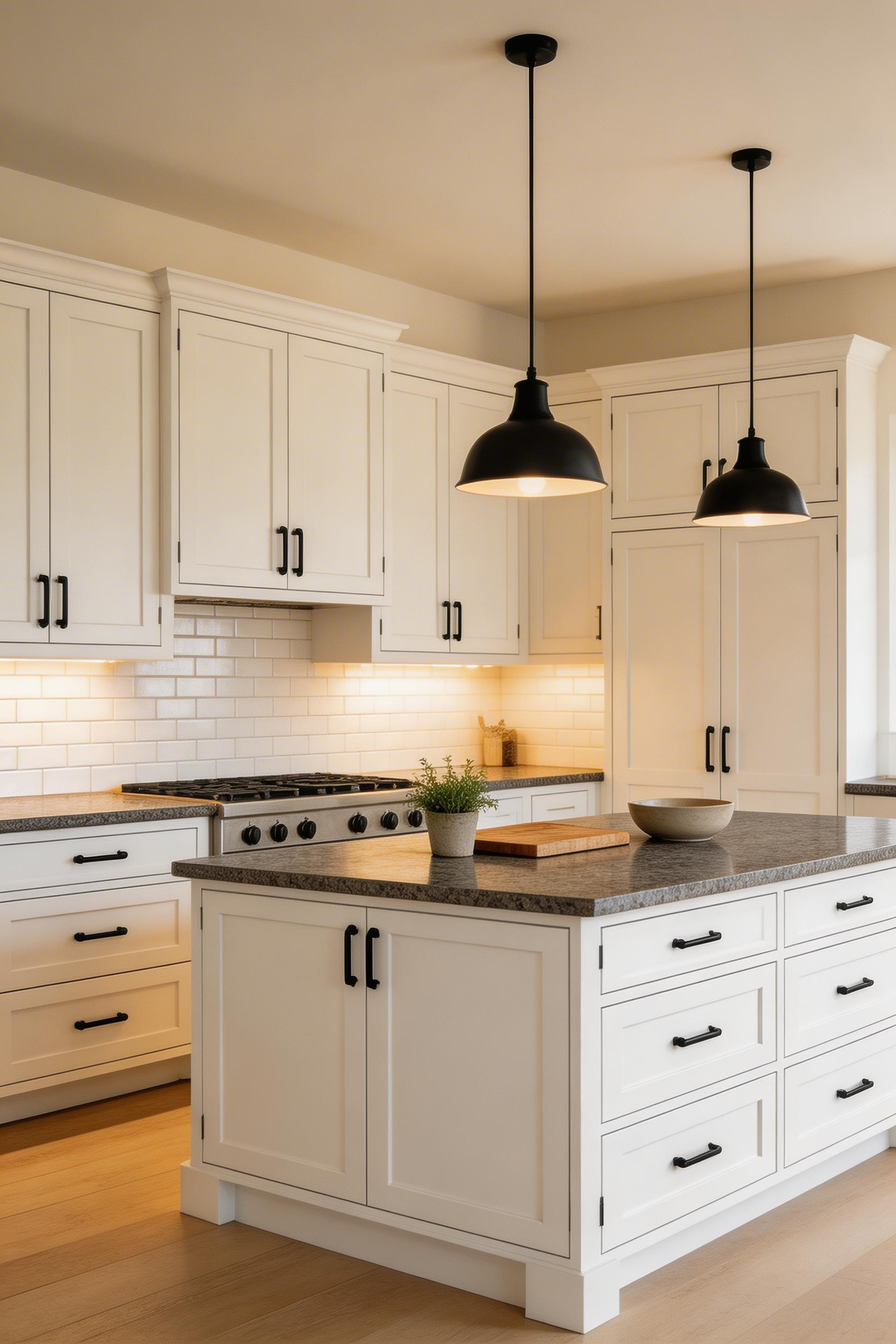
The textured surface hides fingerprints, water spots, and small crumbs far better than a polished finish. In a white cabinet kitchen — where contrasting surfaces are already doing a lot of visual work — this matters. Uba Tuba Leathered Granite ($55–$80/sqft installed) has a dark green-black tone with gold flecks. Bianco Antico Leathered ($60–$85/sqft) reads lighter, cream-pink-grey, and adds warmth to the pairing. Santa Cecilia Leathered ($50–$75/sqft) falls between the two.
The leathered finish reads differently under different lighting. Request a full-size sample — at least 12×12 inches — and take it home to view under your actual kitchen lighting, not showroom fluorescents. The texture also picks up under-cabinet LED differently than overhead recessed lights. See it under both before committing.
A waterfall edge countertop — where the slab runs continuously down one or both sides of the island — is less a material choice than an architectural one. But the material matters, and white quartz is the most versatile choice for the waterfall treatment with white cabinets. The continuous panel creates a furniture-like presence for the island that grounded quartz (which ends at the cabinet face) doesn’t.
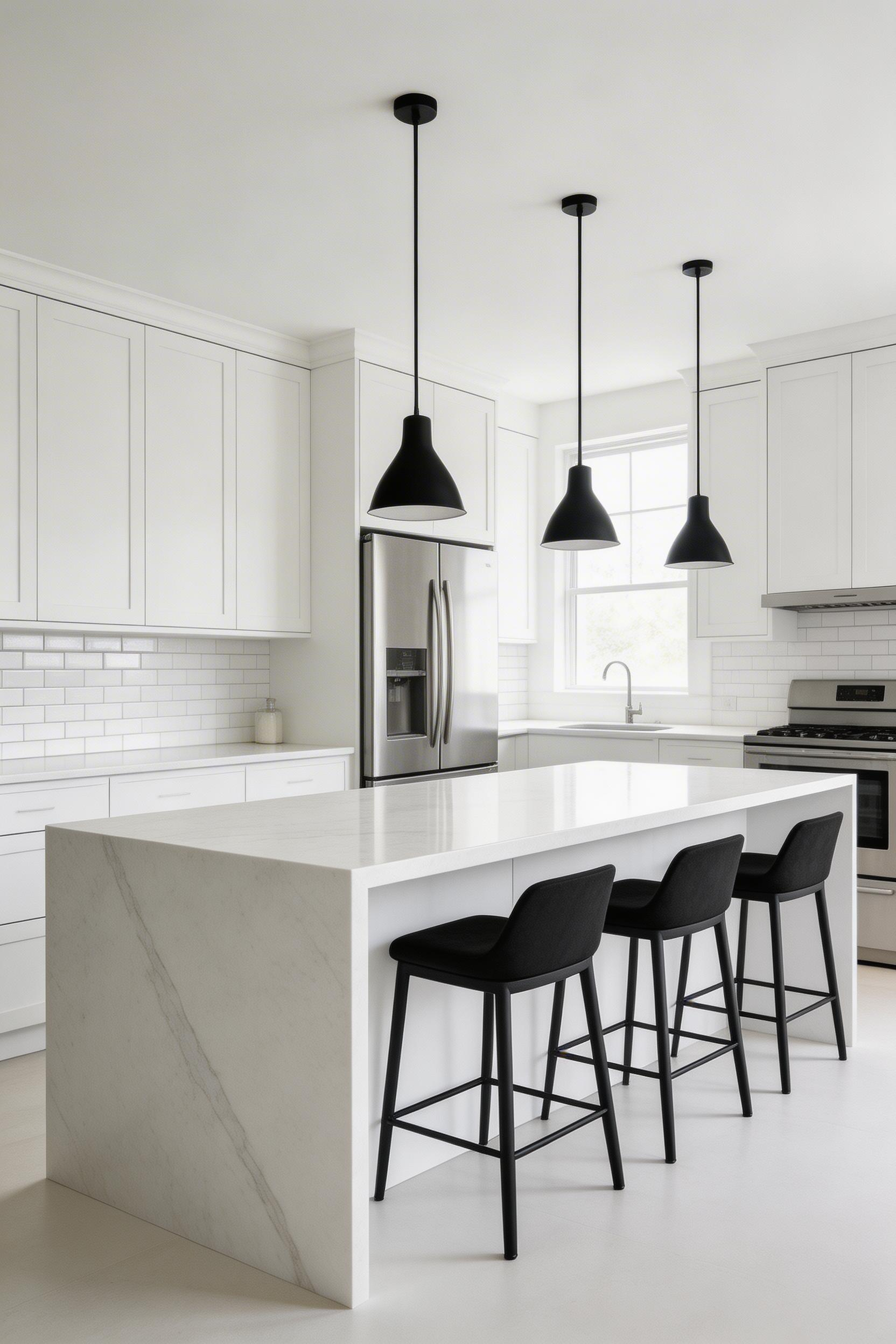
Budget for the waterfall panel — it uses a near-full slab just for the side drop. On a 36-inch-tall island, that’s roughly 22 square feet of material for one waterfall face alone. Silestone Yukon White ($80–$130/sqft installed for the slab plus panel) and Caesarstone Cloudburst Concrete ($85–$125/sqft) both work well. Cambria Calacatta waterfall runs higher ($90–$140/sqft) but includes the most realistic veining.
Waterfalling both sides doubles the material cost and makes the island look like a monolith. For most kitchens, one waterfall side is enough — and choosing the side visible from the main room entry makes the visual impact land without the full cost. Also consider our kitchen island design guide if you’re still deciding on island size and configuration before choosing the surface.
Poured concrete is among the most customisable kitchen countertops with white cabinets available — colour, aggregate texture, edge profile, and embedded objects can all be specified. Against white cabinets, concrete brings an industrial warmth: the matte surface and slight variation absorb light rather than reflecting it, which softens the contrast with white in a way polished surfaces don’t.
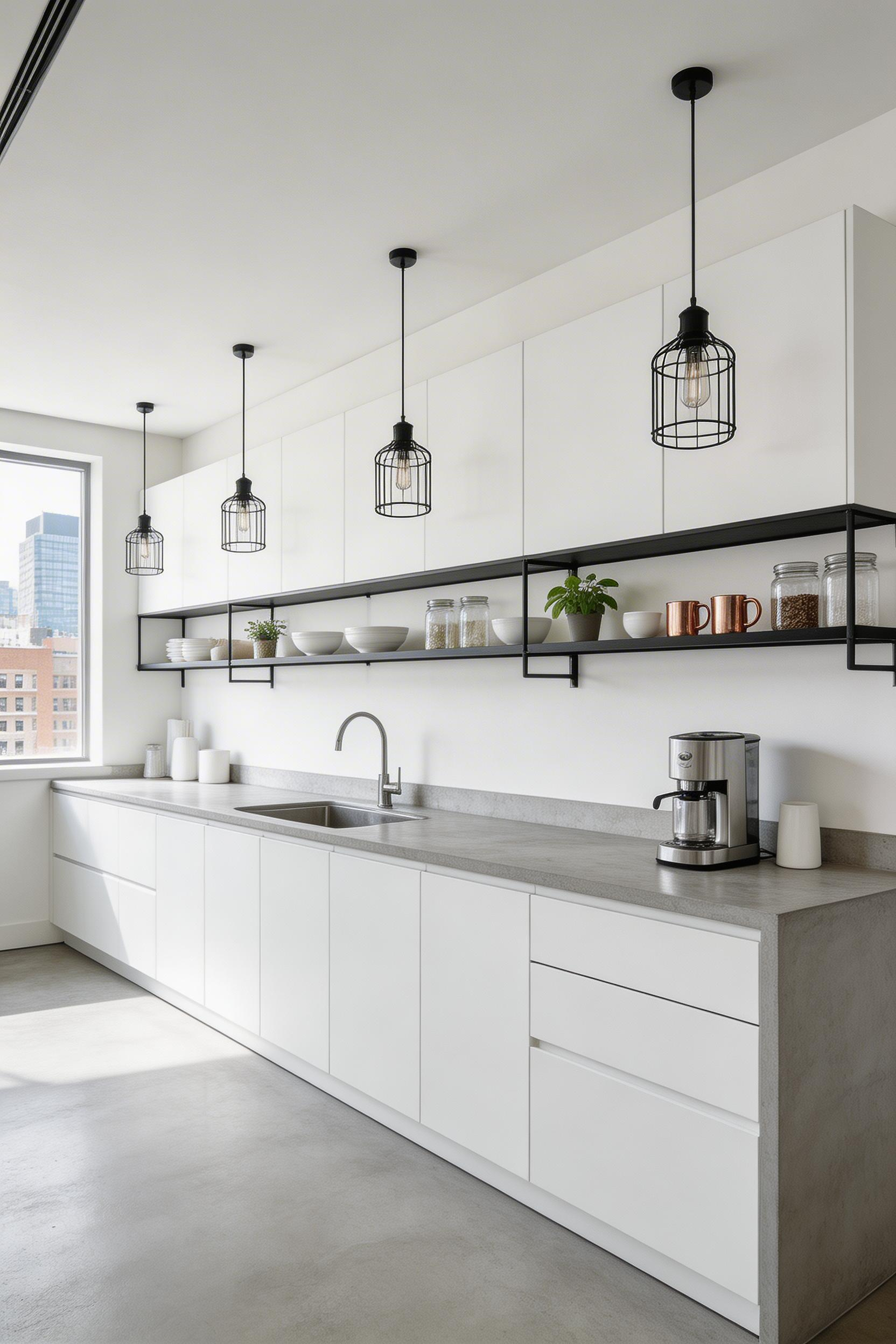
Concrete is heavy. A 30-square-foot countertop can weigh 250–300 pounds — verify your cabinet structure can handle the load before installation. Buddy Rhodes Concrete Mix ($65–$85/sqft DIY or $90–$150/sqft installed) is the most established residential product. Sealing with a penetrating or topical sealer is required and needs refreshing every 1–2 years. Concrete can also hairline crack if the substrate shifts — this is an aesthetic risk worth accepting if the look is right for your kitchen.
If full poured concrete is beyond budget, Formica Concrete 180fx laminate ($8–$15/sqft DIY) captures the colour and texture at a fraction of the price. The difference is visible up close but the overall kitchen effect is surprisingly similar. For a rental kitchen or a budget renovation, it’s the most honest suggestion.
Full marble slabs are expensive. Marble tile countertops use the same stone in 12×12 or 12×24-inch tiles, applied over a cement board substrate with minimal grout lines. The result has the same cool, classic stone quality as a slab at roughly 40–60% of the cost — with the trade-off of visible grout lines and more regular maintenance.
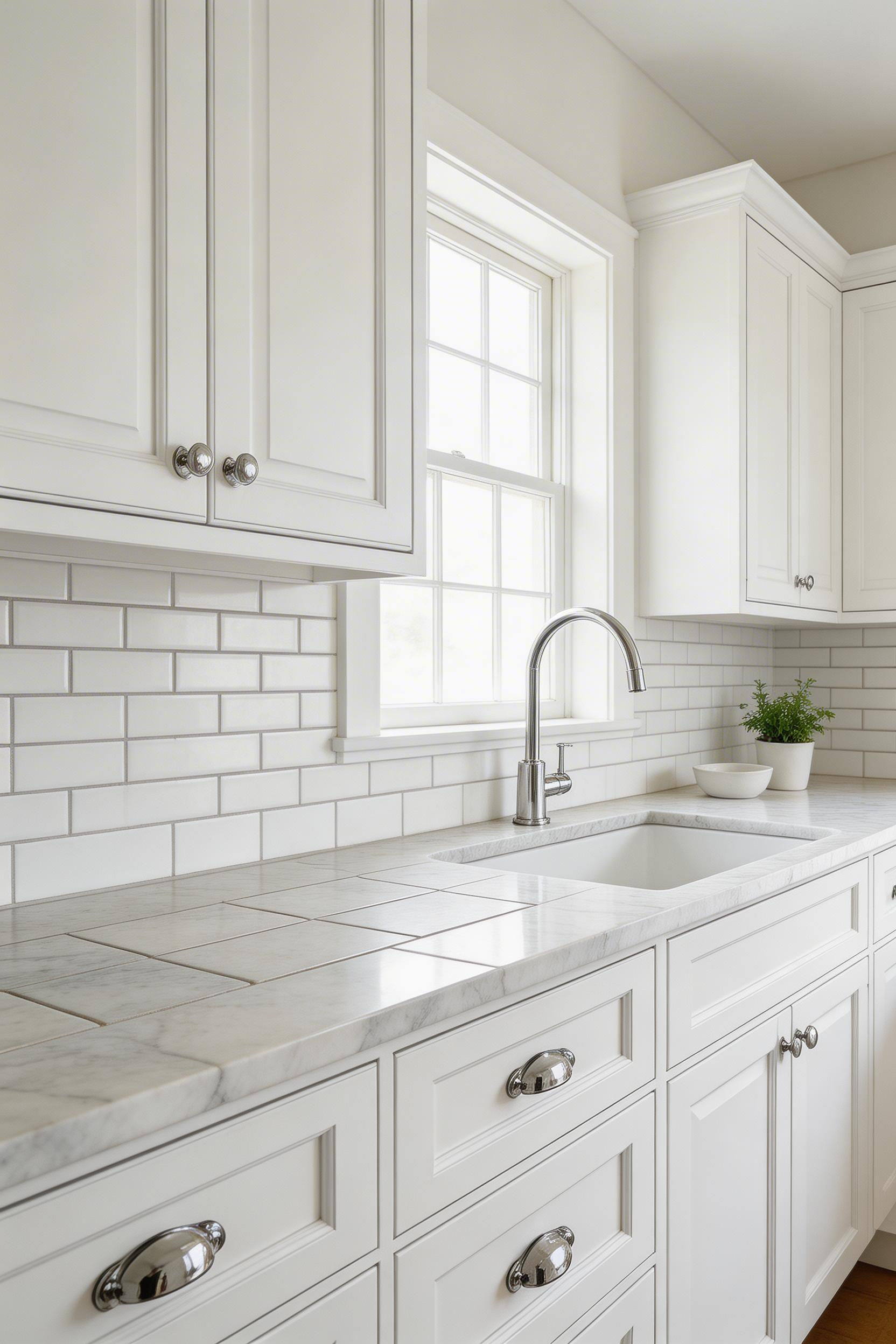
Use the widest tiles you can source — 12×24 or 18×18 minimizes grout line frequency compared to 3×6 subway tiles. Daltile Rittenhouse Square marble-look ceramic ($3–$6/sqft) and Merola Tile Carrara subway ($5–$8/sqft) are widely available. Seal the grout lines with a penetrating grout sealer after installation and re-seal annually. Light grout (white or pale grey) makes lines less visible but shows staining more. Medium grey grout looks more intentional and hides kitchen mess better.
Tile countertops suit bathrooms and lower-use kitchen sections better than heavy food-prep zones. The grout lines catch crumbs and become prep obstacles near cooktops. On a baking island or a breakfast bar — areas used for lighter tasks — the look holds up well and the maintenance is manageable.
Blue Pearl Granite is one of the kitchen countertops with white cabinets that rewards not playing it safe. The polished surface has a deep blue-grey base with labradorescent shimmer — a mineral play of light from feldspar crystals that makes the surface appear to change colour as you move across it. Against white cabinets, it reads as quietly dramatic.
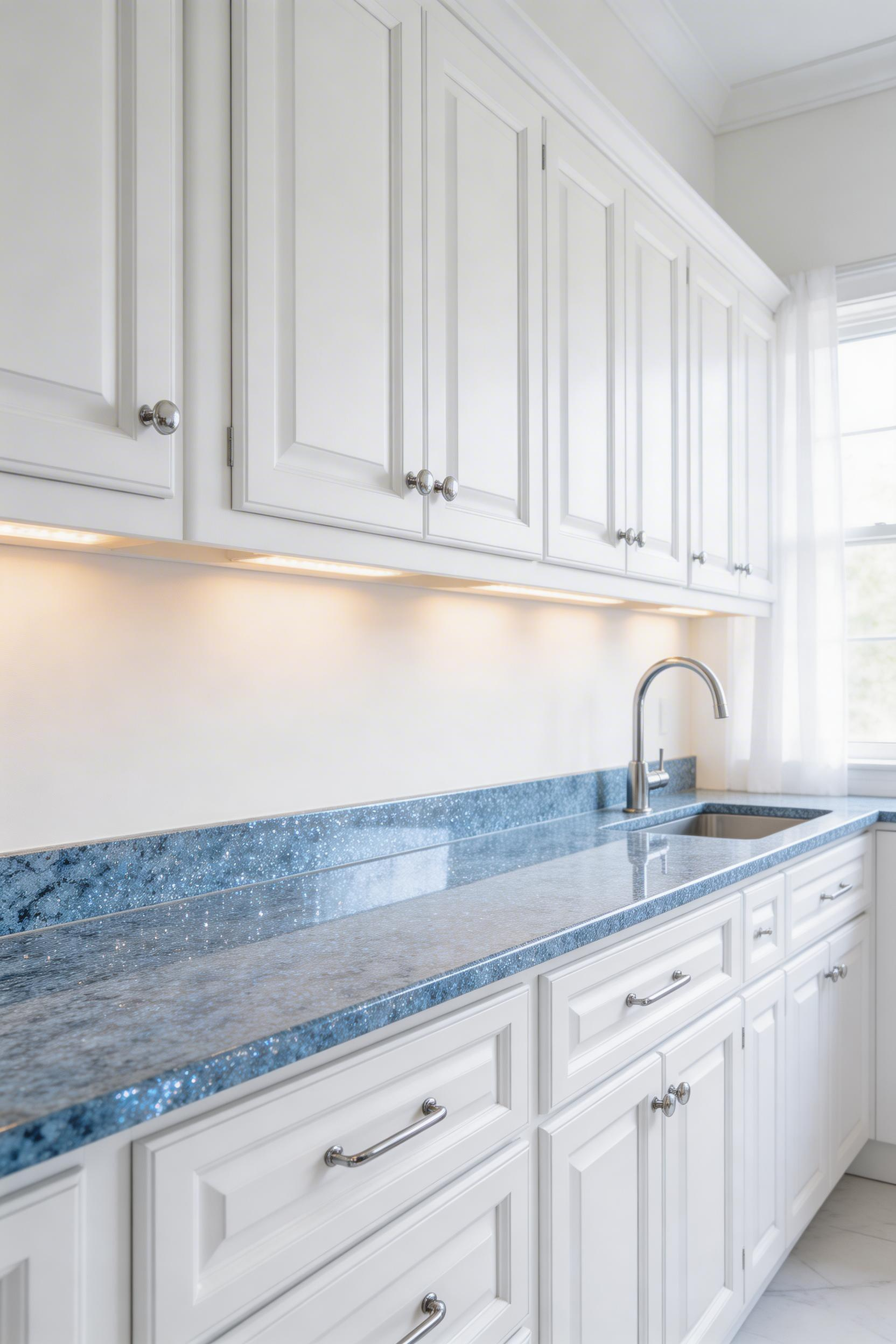
Ask for a full slab sample and view it under three different conditions: daylight, warm incandescent, and cool LED recessed lighting. The blue shimmer in Blue Pearl GT Granite ($50–$75/sqft installed) is vivid under daylight and can appear nearly grey under some artificial light. Labradorite Blue ($65–$90/sqft) has a more consistent shimmer. Azul Platino ($55–$80/sqft) is subtler. The polished finish is required to see the labradorescent effect — honed Blue Pearl loses the shimmer entirely.
Chrome or brushed nickel hardware reads most naturally with Blue Pearl’s cool tones. Brass can work if the kitchen has warm wood elements elsewhere to balance it. Avoid matte black hardware — it competes with the granite’s dark tones and the result looks underplanned.
Large-format porcelain slabs — 63×126 inches is a standard size — have become the go-to material for clients who want the marble look with none of the maintenance. They’re non-porous, UV stable, heat resistant to 1,400°F, and produce far fewer seams than tile. With the right veining pattern, a porcelain slab is indistinguishable from marble at five feet.
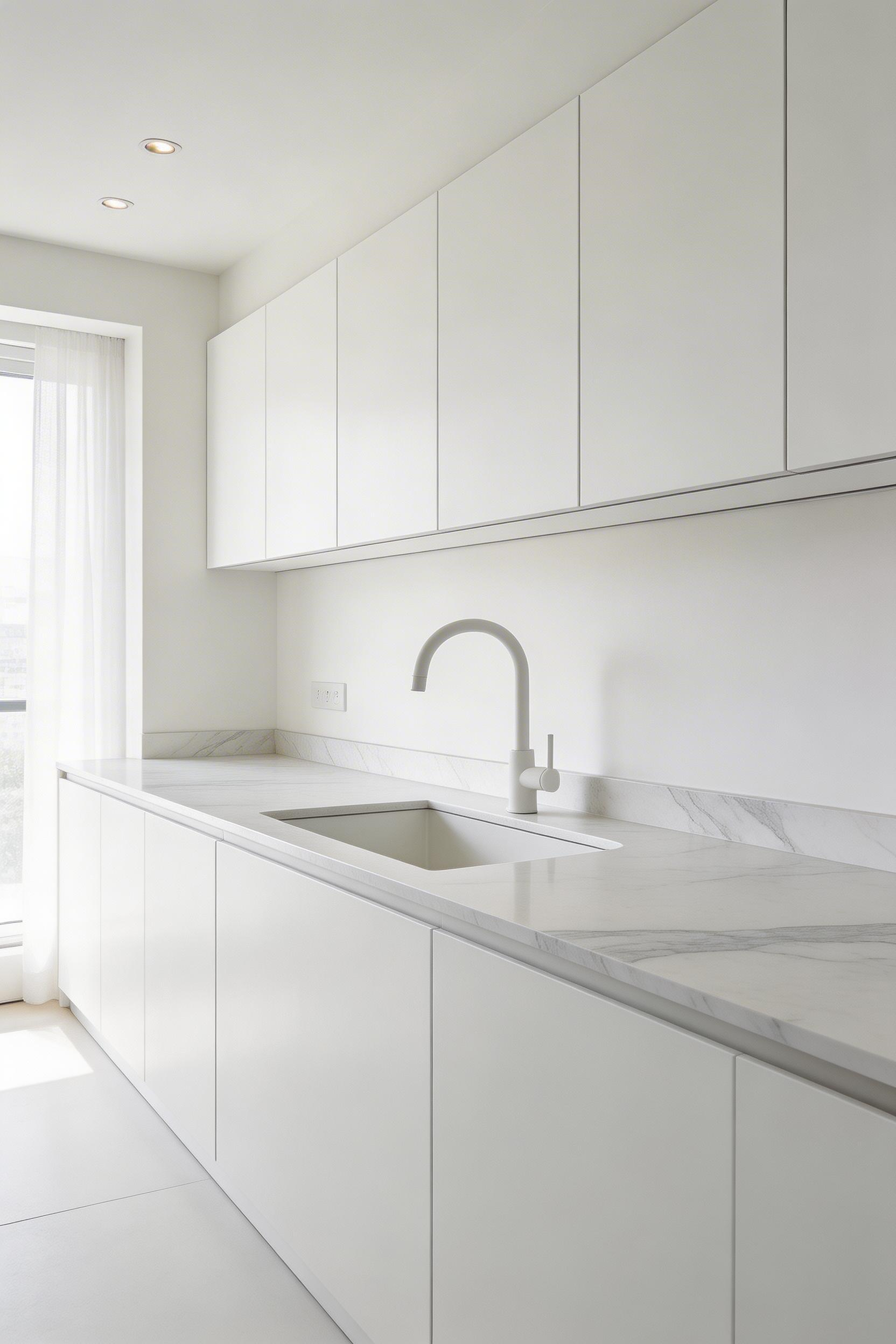
The 12mm (½ inch) thickness is sufficient for most applications. Specify 20mm (¾ inch) for islands that take heavy daily use or anything with an unsupported overhang. Porcelain chips at the edges under impact — the main practical weakness. An eased or slightly rounded edge profile is significantly more durable than a sharp 90-degree edge. MSI Calacatta Porto ($60–$95/sqft installed) and Arizona Tile Milos ($65–$100/sqft) are two widely available options with convincing marble-look patterning.
One full-width slab can cover a standard 8-foot run without a seam. For longer runs, plan seam placement at natural breaks — by the sink or the cooktop — rather than mid-counter. Unlike marble, porcelain colour is consistent throughout the material, so seam lines are less visible than in natural stone.
Green quartzite brings a natural, earthy edge to kitchen countertops with white cabinets — without the design risk of a fully coloured surface. The pale-to-medium green tones in stones like Sea Pearl or Calacatta Macaubas look like something lifted from a forest floor — organic, grounded, and completely unlike the marble and grey quartz that fill every new kitchen renovation.
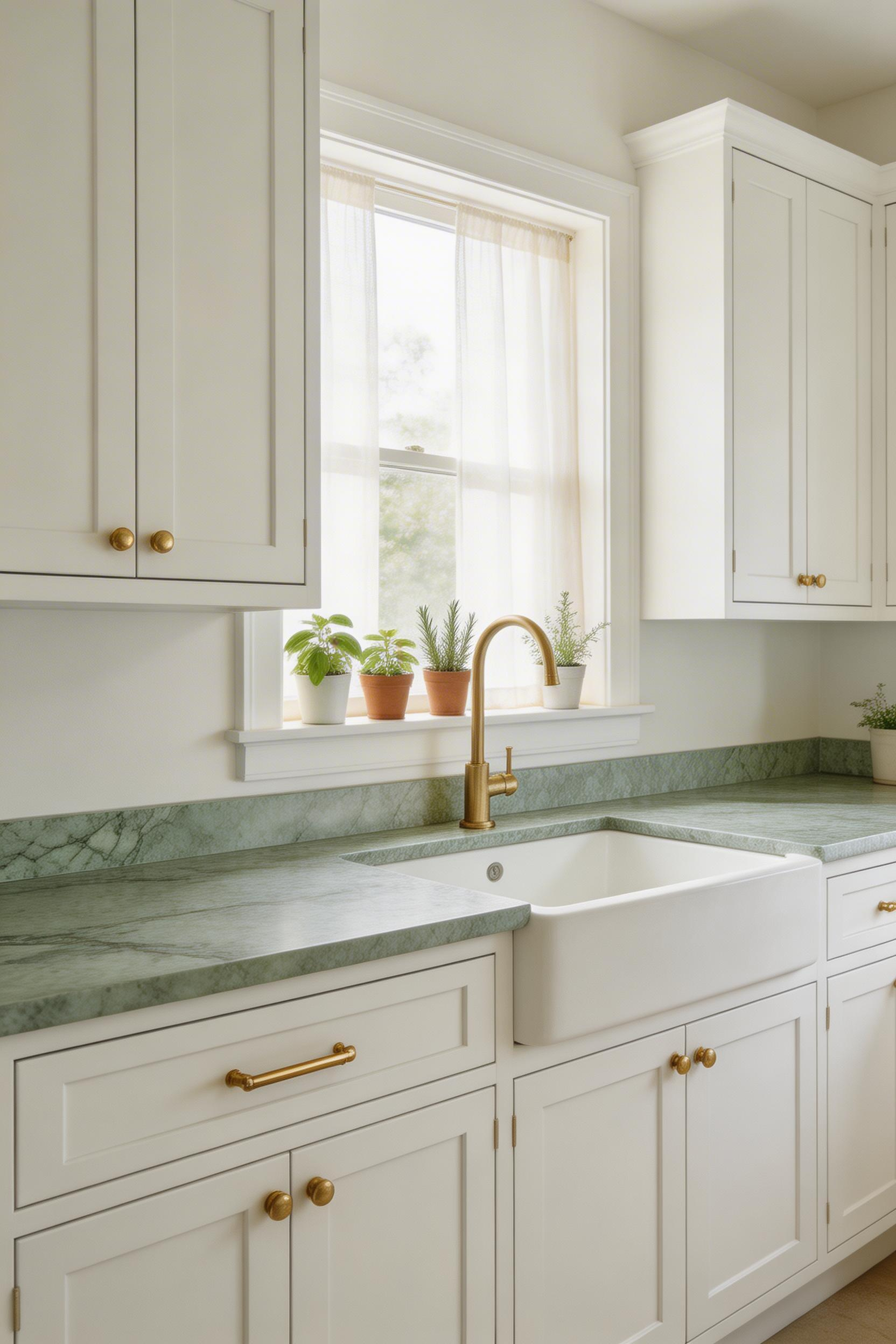
Green quartzite works best with warm-white or slightly cream cabinet paints. It fights cool, bright white — the green-grey contrast can look muddy rather than natural. Benjamin Moore White Dove (OC-17) and Sherwin-Williams Alabaster (SW 7008) are both safe pairings. Against a bright white like Benjamin Moore Chantilly Lace, add warm wood elements (open shelves, barstools) to bridge the temperature gap. Sea Pearl Quartzite ($60–$95/sqft installed) has the most reliable pale green tone. Calacatta Macaubas Green ($70–$110/sqft) runs deeper and more dramatic.
Each slab of green quartzite is unique. View the specific slab you’re buying, not a showroom sample — variation in green quartzite can be significant, ranging from pale sage to deep forest within the same stone category. Take photos of the slab in natural daylight and compare against your cabinet samples at home.
Terracotta tile countertops are an honest signal of a specific kitchen aesthetic: Mediterranean warmth, cottage charm, or Provençal character. Paired with white cabinets — particularly shaker or beadboard styles — the orange-red tones of terracotta create a kitchen that feels distinctly Mediterranean and committed to warmth over minimalism.
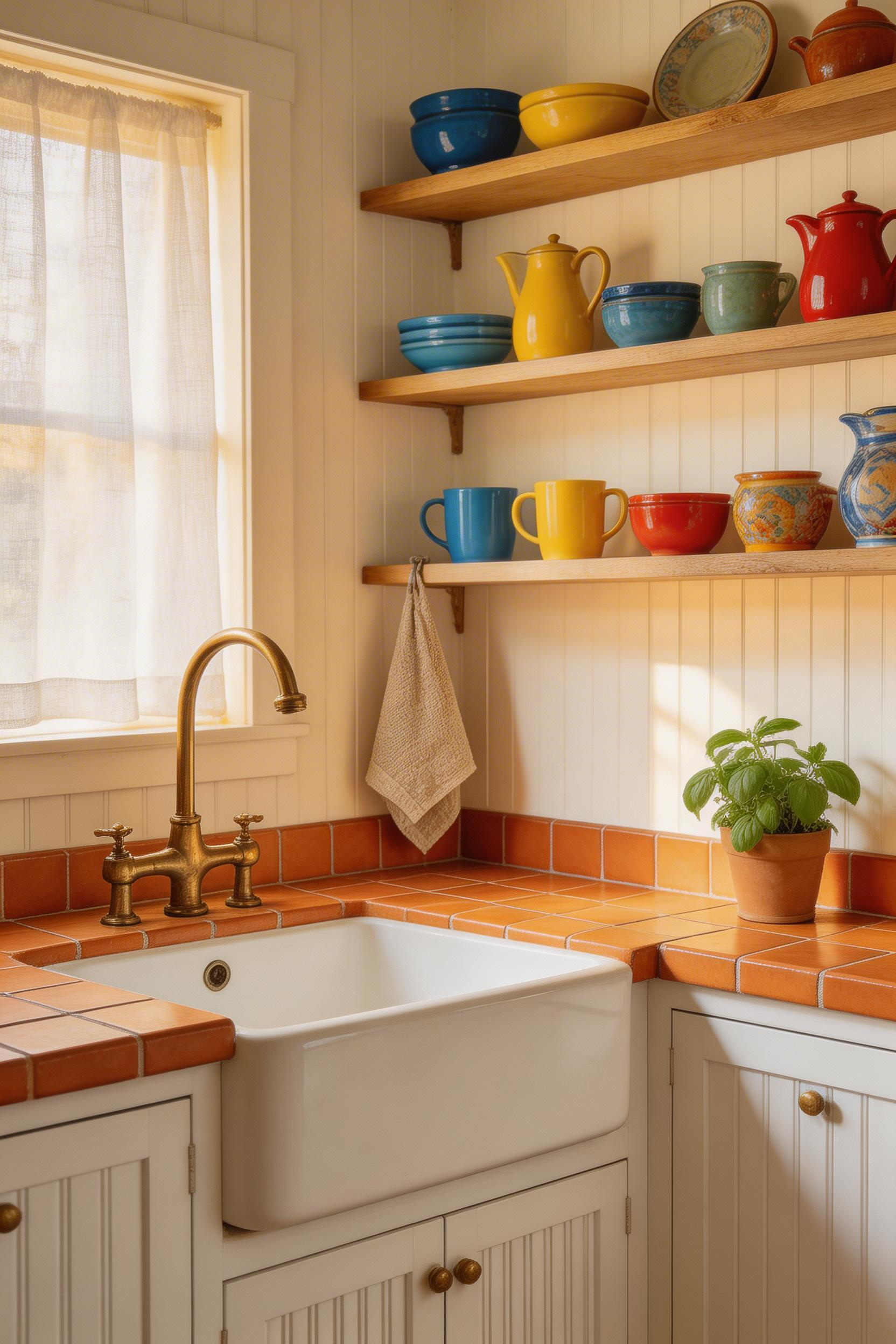
Terracotta is porous and must be sealed with a penetrating impregnator sealer before grouting and re-sealed annually. It’s not well suited to heavy cutting-prep zones — use a cutting board always. Cle Tile handmade terracotta ($12–$18/sqft) has the most authentic hand-formed variation. Standard Saltillo terracotta ($4–$8/sqft) is the budget option. The style is a commitment: terracotta countertops read as cottage or Mediterranean, so they suit shaker and traditional white cabinets naturally. On flat-panel modern white cabinets, the contrast is jarring rather than charming.
Dekton is the countertop material engineered specifically for the things that destroy everything else. Zero percent porosity — won’t stain from wine, coffee, or oils without immediate wiping. Scratch resistance at Mohs 8. Direct flame tolerance. UV stability for outdoor use. If you cook hard and often, Dekton is the most practical option available by a significant margin.
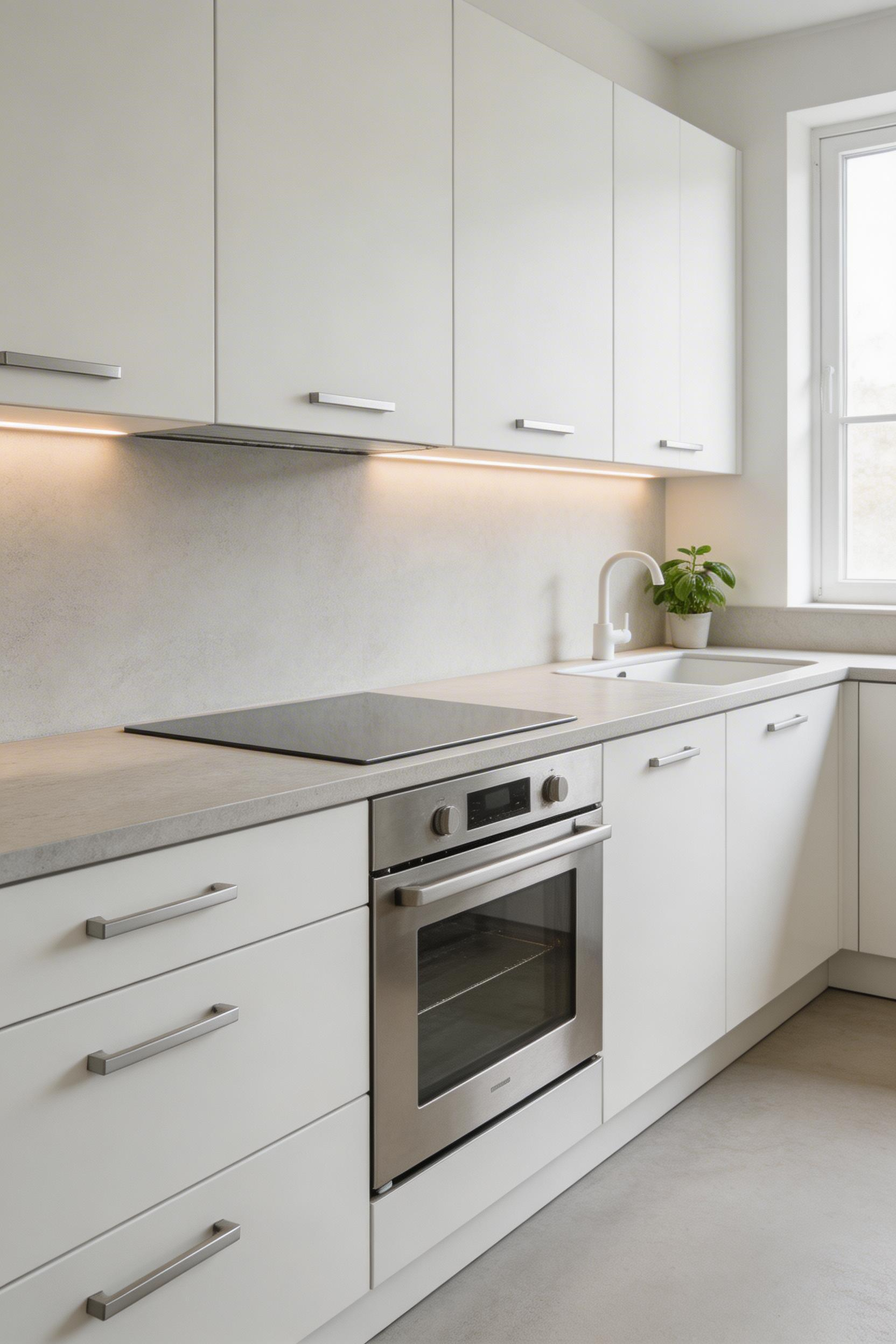
Specify the 20mm (¾ inch) thickness for islands and heavy-use perimeters — not the 12mm version. Dekton chips at edges under impact, and thicker material is significantly more resistant. An eased edge profile rather than a sharp 90-degree edge further reduces chip risk. Dekton Blanc Concrete ($85–$130/sqft installed) reads white-grey and suits both modern and transitional white cabinet kitchens. Dekton Sirius ($80–$125/sqft) adds subtle texture. Cosentino Silestone Nolita ($75–$115/sqft) is the slightly more accessible sister product.
Recycled glass kitchen countertops with white cabinets use 75–100% post-consumer glass — wine bottles, window glass, traffic lights, reclaimed pieces — bound in cement or resin. The result is a surface full of colour and movement that has no direct equivalent in any mined or engineered material. Against white cabinets, the glass reads as a deliberate artistic statement rather than a functional surface.
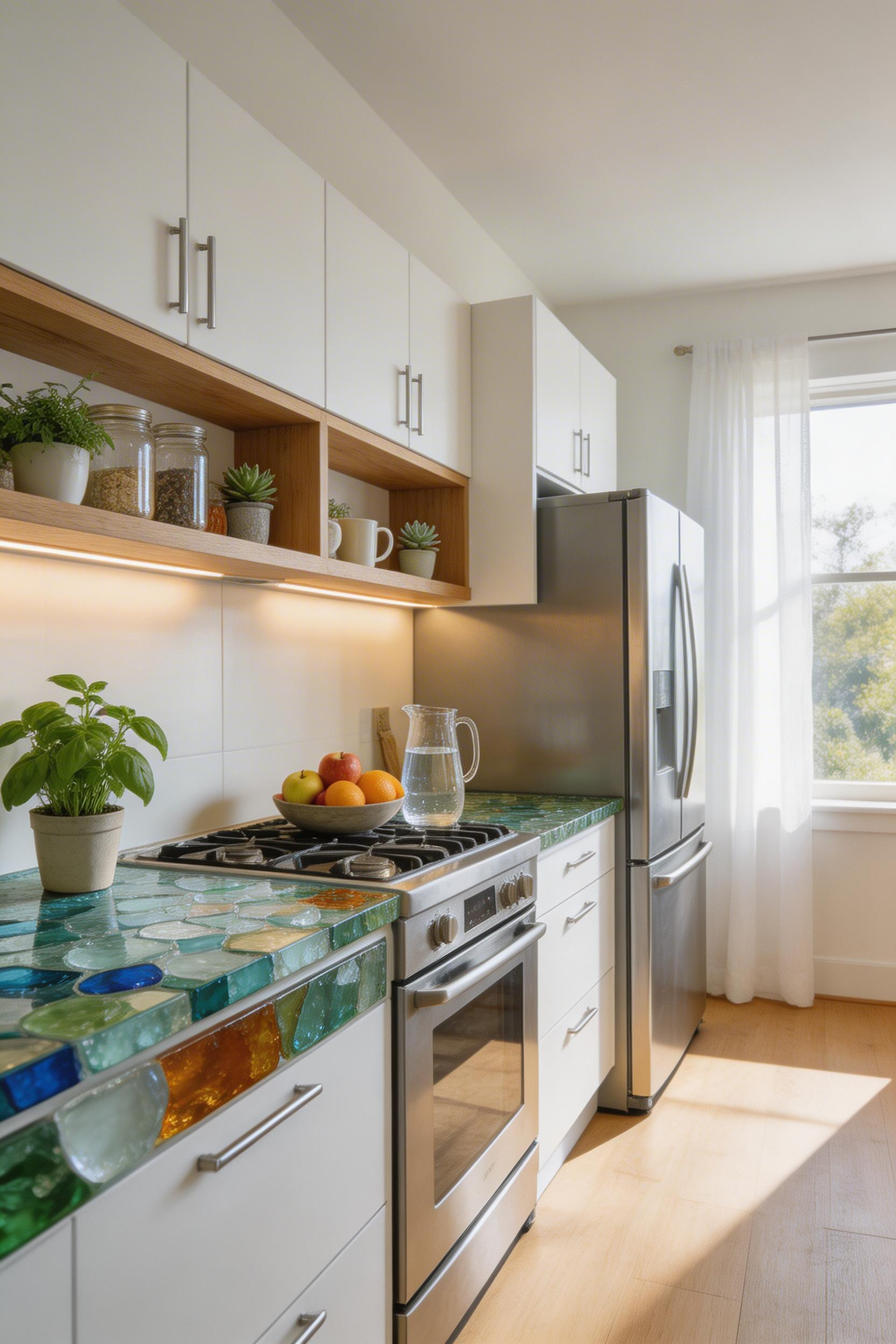
Request the recycled content certificate from the manufacturer. The percentage and source of recycled glass varies significantly by product — some “recycled glass” countertops are mostly resin with glass chips for effect. EnviroGLAS ($65–$125/sqft installed) and IceStone ($80–$130/sqft) both publish recycled content data. Vetrazzo ($90–$150/sqft) discloses each slab’s glass sources. The cement-binder versions have a more handmade appearance. Resin-binder versions are more uniform and easier to maintain.
Using two different countertop materials in one kitchen sounds like a design compromise. Done well, it’s one of the most effective strategies for adding visual interest and depth to a white cabinet kitchen. The most successful version: a dark walnut butcher block island paired with a lighter countertop on the perimeter. Quartz, marble, or quartzite all work well.
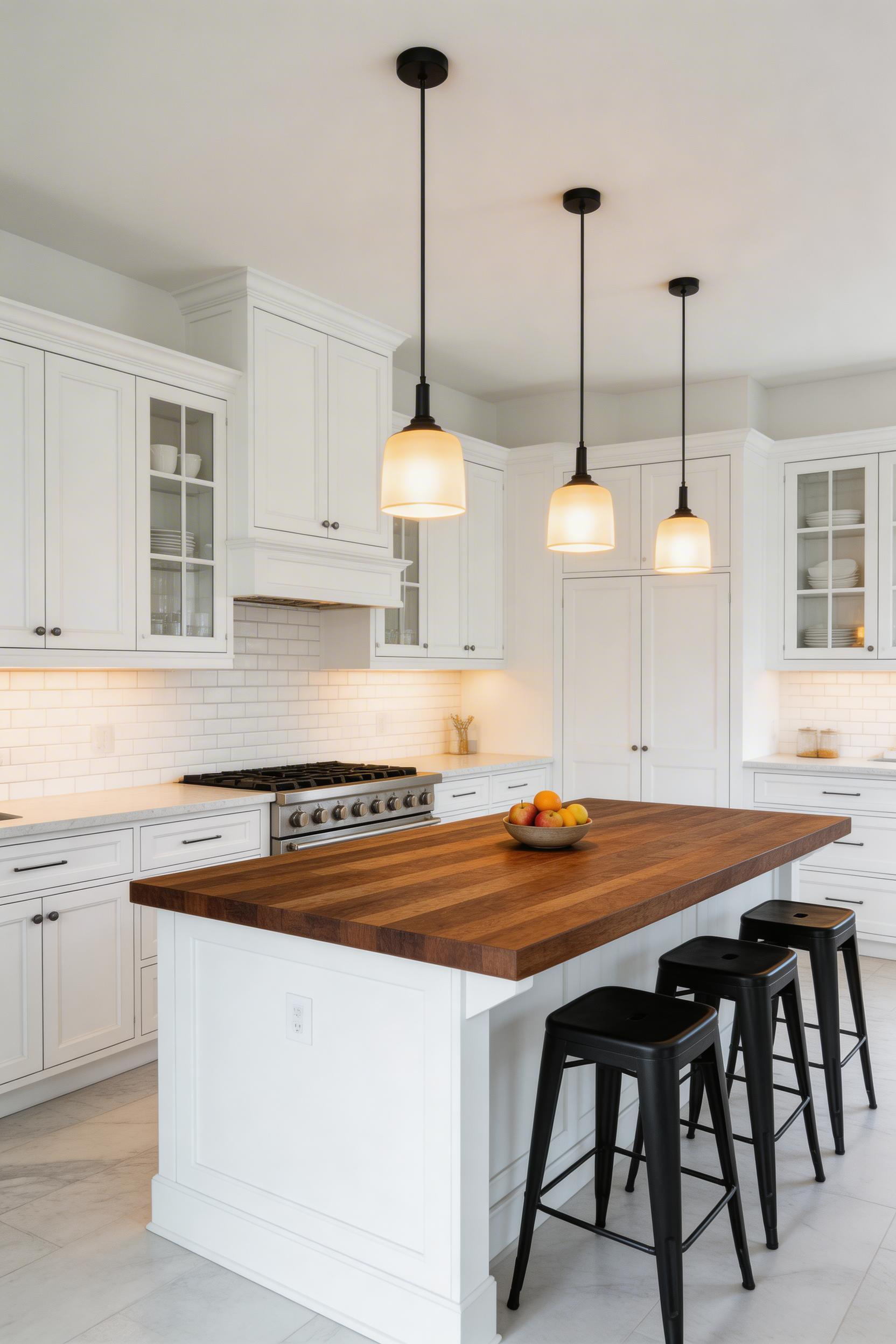
Use walnut on the island only — not the perimeter. Two countertop materials reads as deliberate when one is the island. Three or more materials in a single kitchen reads as indecision. John Boos Walnut Butcher Block ($120–$200/sqft) is the quality benchmark. IKEA KARLBY walnut worktop ($279–$379 per section) is an accessible alternative. The island butcher block still needs the same oiling and sink-zone protection as any wood surface — but the limited area makes maintenance more manageable than a full wood kitchen.
If there’s a single kitchen countertop with white cabinets that works in every situation — every style of cabinet, every kitchen size, every family’s tolerance for maintenance — it’s a concrete gray engineered stone. The warm-grey tone is the sweet spot between cool white and dark contrast. It pairs with everything, hides small messes between cleanings, and never photographs badly.
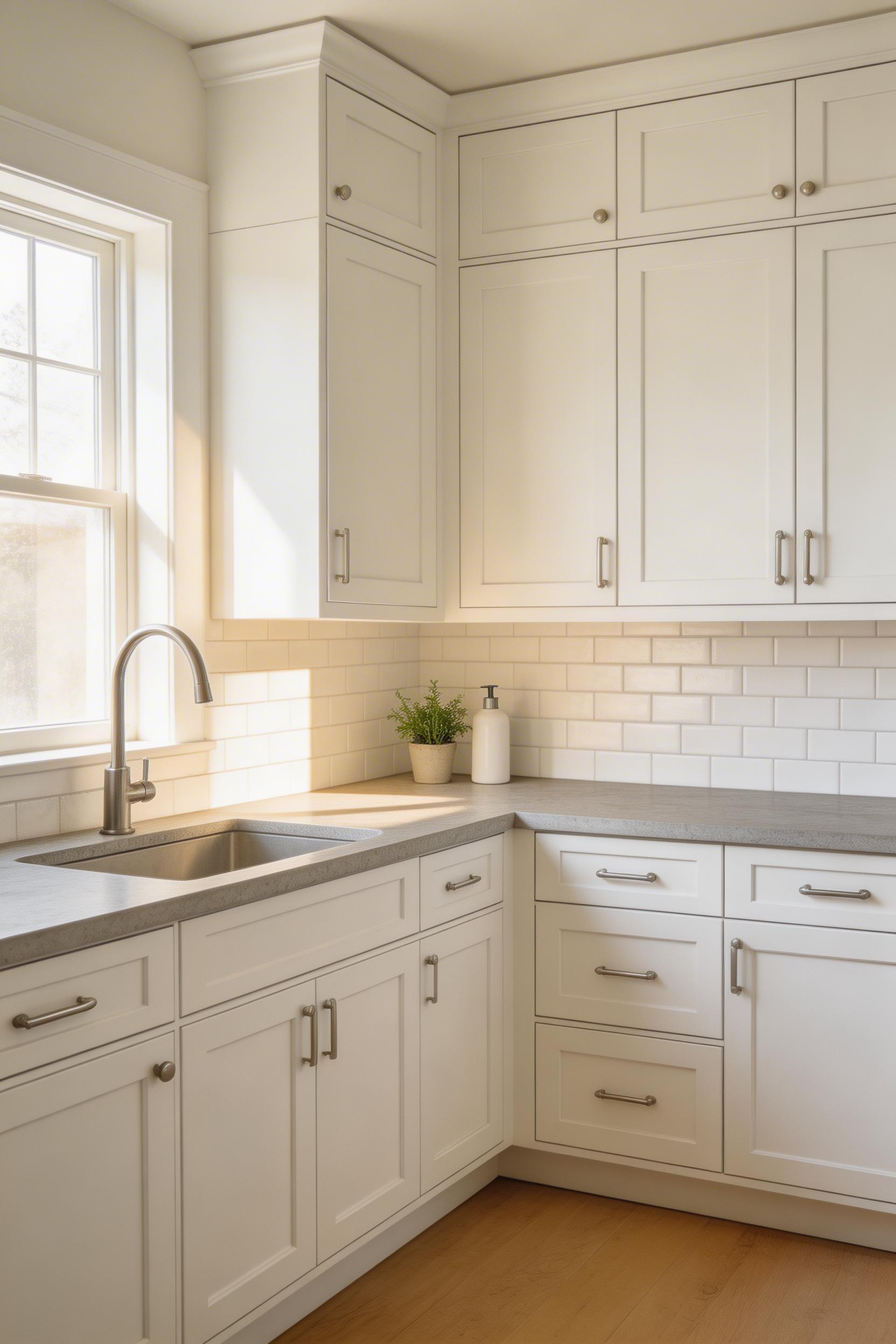
Caesarstone Airy Concrete ($65–$95/sqft installed) and Silestone Kensho ($70–$100/sqft) both deliver the concrete look without any of the actual maintenance concrete requires. Zero porosity, no sealing, consistent colour throughout, chip-resistant edges. The concrete-look quartz has now been a mainstream kitchen choice for long enough that it’s proven — kitchens photographed with it ten years ago still look current today.
Concrete gray quartz is so reliable that it can also be slightly safe. If your kitchen has real design ambition, pick from higher on this list. A strong aesthetic, a commitment to natural materials, or a memorable character deserves a surface worth remembering. The concrete gray is the right choice for the kitchen that needs to function beautifully and look great forever. Save the Calacatta marble and the green quartzite for the kitchen that wants to be remembered.
The most common mistake in choosing kitchen countertops with white cabinets is narrowing the decision to appearance alone. The countertop material you’ll still love five years in is the one that fits how your household actually uses the kitchen. Not just how it looks on the day it’s finished.
Be honest before you visit a stone yard. If you cook frequently, have young children, or tend to wipe surfaces at the end of the day rather than immediately after every spill, then genuine marble and unsealed butcher block are going to cause real frustration. Quartz, porcelain slab, and Dekton handle daily neglect without complaint. Natural stone — marble, quartzite, granite — rewards care and punishes inattention.
Pure white cabinets (Benjamin Moore Chantilly Lace, SW Extra White) pair best with warm-toned countertops — cream quartz, Calacatta marble, pale quartzite — or high-contrast dark materials (black granite, soapstone). They fight cold grey, which can make the kitchen feel clinical. Off-white and cream cabinets (White Dove, Alabaster) have more flexibility and work well with the full range including concrete gray and green quartzite. If you’re still at the paint stage, choose your countertop first and match the cabinet white to it — the countertop is harder to change.