Physical Address
304 North Cardinal St.
Dorchester Center, MA 02124
Physical Address
304 North Cardinal St.
Dorchester Center, MA 02124
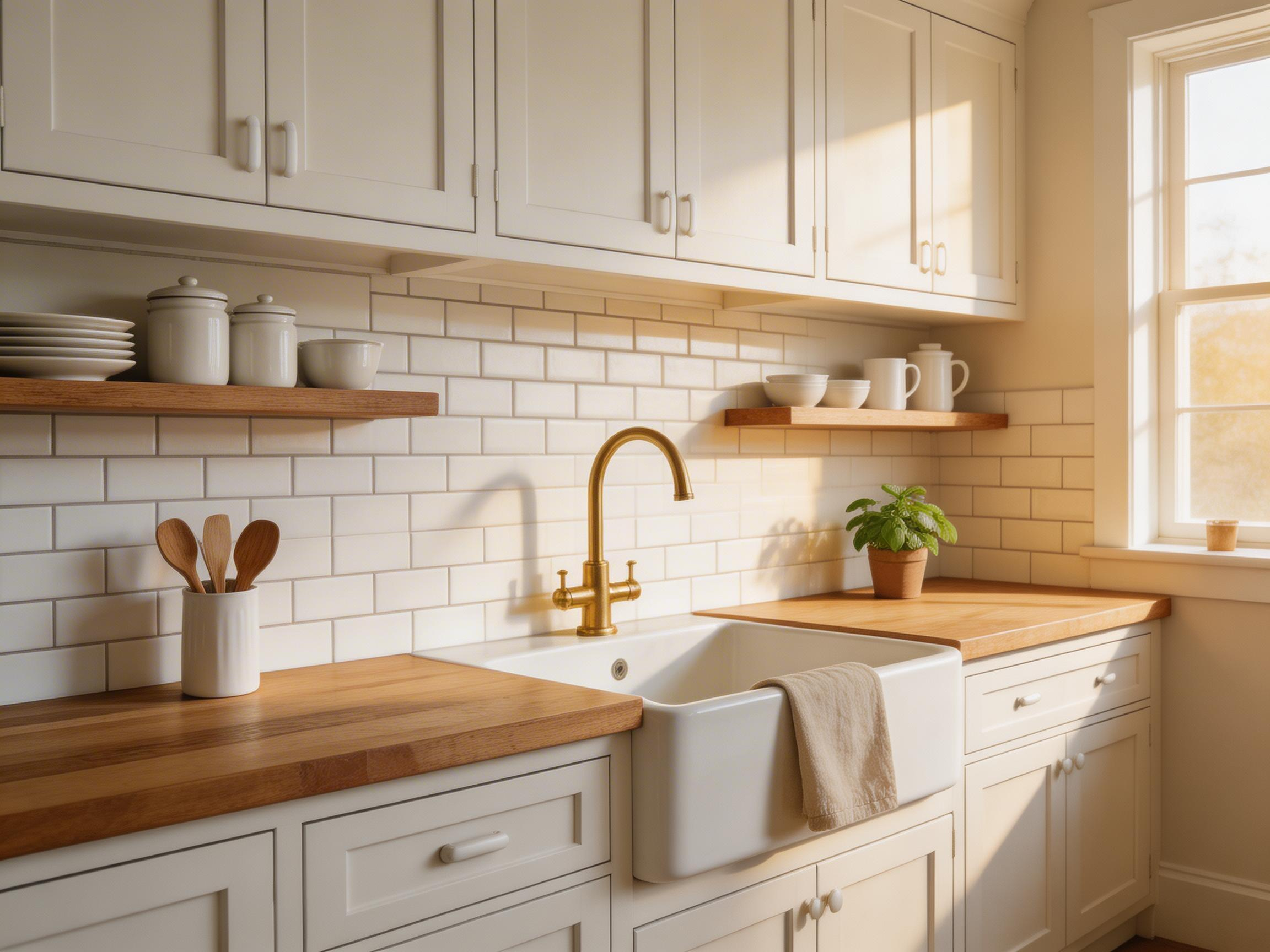
Discover 18 farmhouse kitchen backsplash ideas from classic subway tile to reclaimed wood, cement tile, and renter-friendly peel-and-stick options.
There’s a moment when you walk into a well-done farmhouse kitchen and everything clicks. The smell of coffee, the worn wood counter, the warm afternoon light — and then your eye settles on the backsplash. It might be creamy white subway tile or rough brick behind the range, but it’s holding the whole room together. A good farmhouse kitchen backsplash doesn’t announce itself. It just makes you feel at home.
The backsplash anchors the color palette and sets the texture tone. It tells you immediately whether this kitchen wants to be rustic and raw or warm and refined. Before you pick a faucet or debate cabinet hardware, start here. These 18 farmhouse kitchen backsplash ideas cover every budget, every rental situation, and every version of what “farmhouse” means to you.
White subway tile is the farmhouse kitchen backsplash that has outlasted every trend and renovation cycle. It came from New York City subway stations in 1904, designed for the IRT line, and it has been in American kitchens ever since. The reason it endures isn’t mystery — it’s proportion. That 3×6-inch rectangle works behind countertops, around windows, and under cabinets without ever feeling too big or too small.
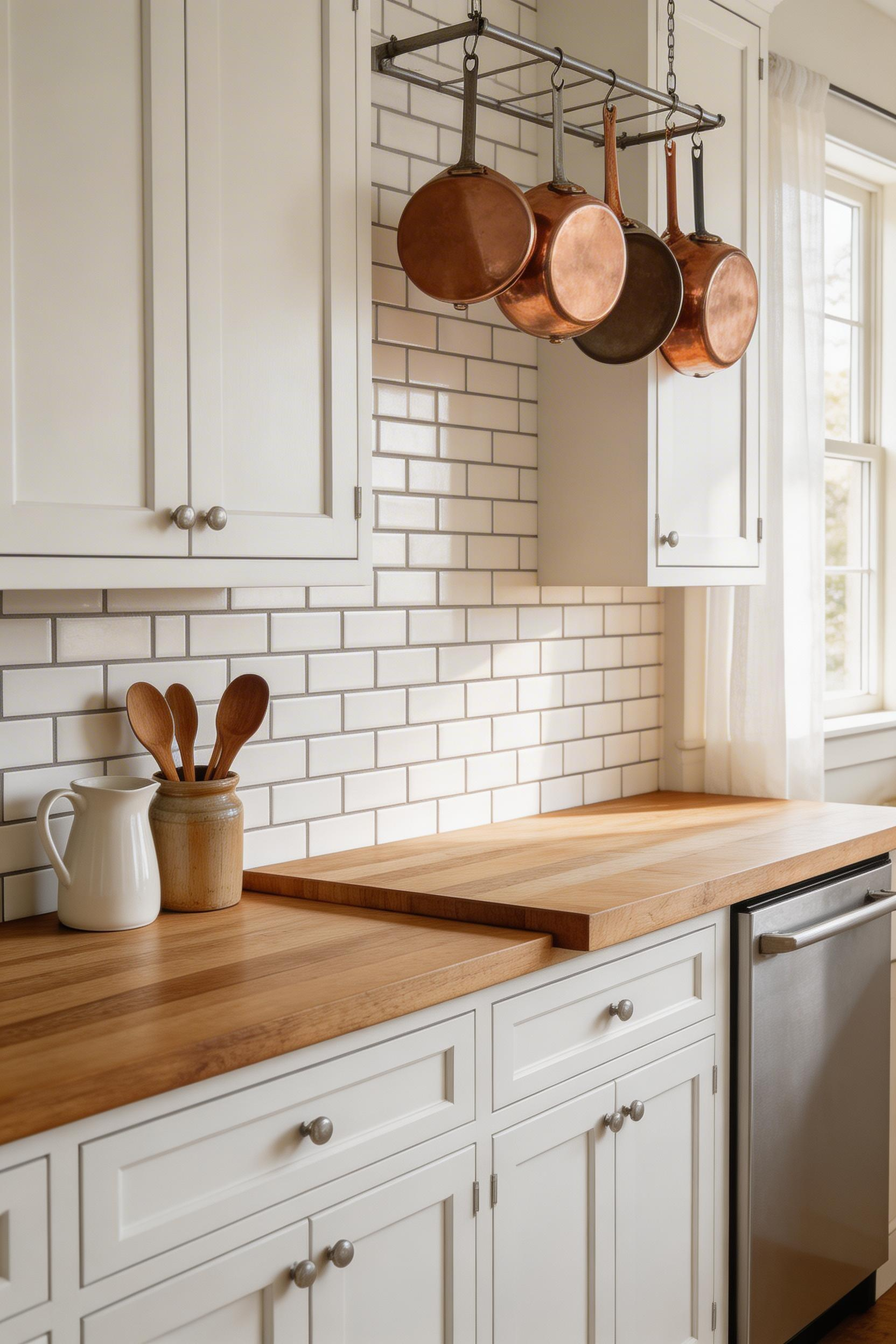
What makes subway tile feel farmhouse rather than generic is in the grout and layout. A stacked grid with bright white grout looks sleek and modern. The same tile in a brick-set offset pattern with warm gray sanded grout looks like it has been in the kitchen for a hundred years. Beveled subway tile, with a raised center ridge that catches light, adds dimension for around $3-8 per square foot. Flat tile starts at $1.50 per square foot at most home improvement stores.
Bright white grout reads clinical. Warm gray — Mapei Silverado or Custom’s Antique White — makes the tile feel softer and more aged. For a true farmhouse result, avoid grout that’s cooler or brighter than the tile itself. Also, charcoal grout creates a completely different effect that gets its own entry later in this list.
The 4×8 format has a more relaxed scale than the standard 3×6. The 4×12 long format looks sophisticated rather than cozy, but pairs beautifully with dark hardware and unlacquered brass fixtures. For coordinating your backsplash with a kitchen island, 18 Kitchen Island Ideas for Small Kitchens That Actually Work shows how to handle two surfaces in the same kitchen.
—
Shiplap became a farmhouse design signature for good reason. Horizontal tongue-and-groove boards with a small shadow gap between each plank create a texture that reads as genuinely old and genuinely comfortable. Also, it gives walls a warmth that no tile can replicate. Used as a backsplash, shiplap transforms the most neglected wall in the kitchen.
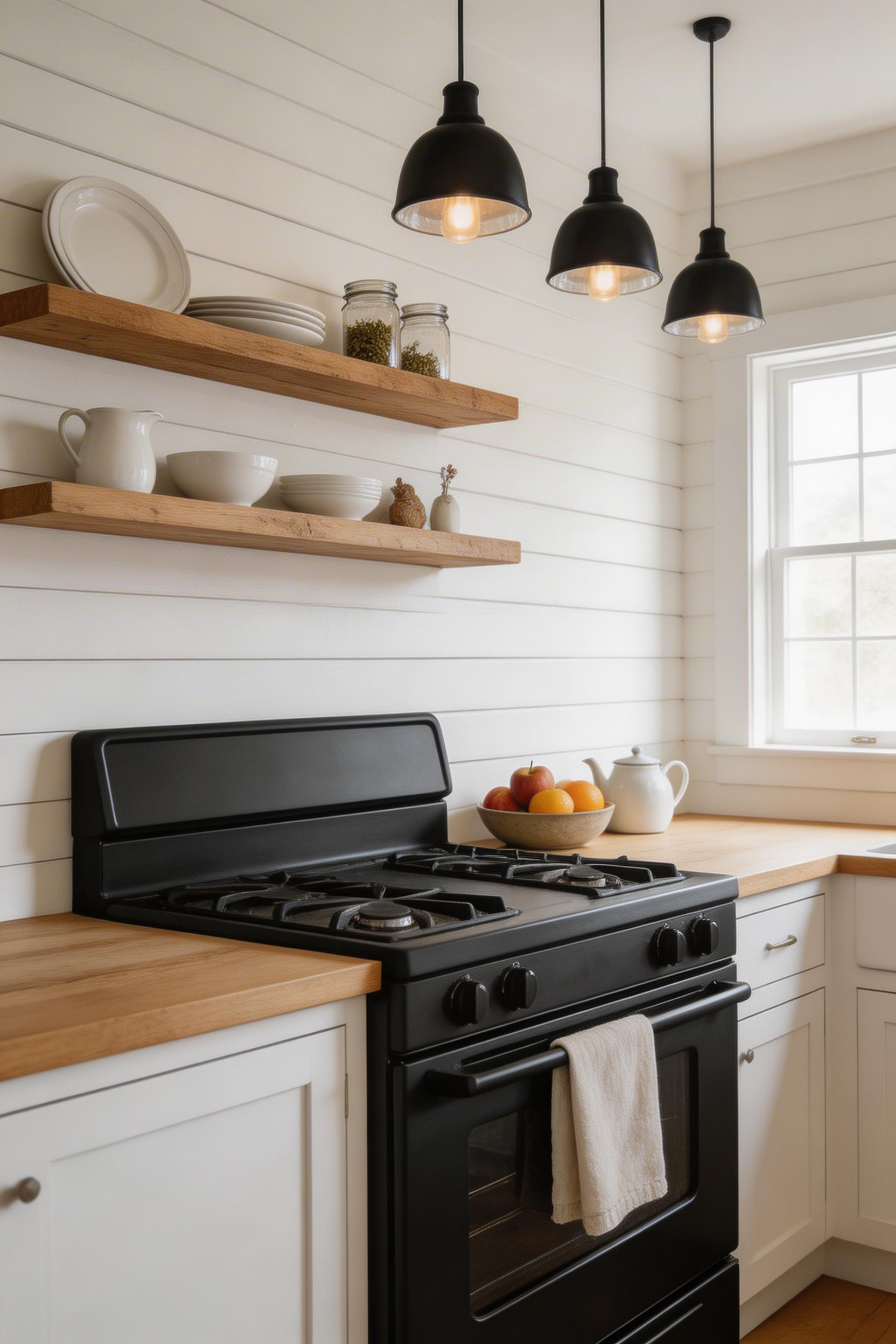
Shiplap is not the right choice near a sink or dishwasher. In those zones, moisture causes real wood to swell and warp over time. PVC shiplap from Azek or Versatex handles humidity far better — a 1×6 PVC nickel-gap plank runs about $3.20 per linear foot versus $1.89 for pine. Behind a range, wood needs at least 18 inches from open burners in most jurisdictions. However, a flush glass panel directly behind the burners — with shiplap flanking it on both sides — is a clean solution that stays code-compliant.
Prime shiplap with an oil-based primer before painting in a kitchen. It creates a harder, more moisture-resistant surface than latex over raw wood. Benjamin Moore White Dove OC-17 is the most popular choice — warm but not yellow, farmhouse without being clinical. For a more textured effect, a dry-brushed coat of diluted chalk paint (80% paint, 20% water) gives an aged, whitewashed quality that suits a more rustic kitchen.
—
Real exposed brick is a rustic kitchen backsplash material that genuinely improves with age. Small grease splatters, tiny chips, and color variation are part of its character rather than flaws. However, most kitchens don’t have genuine brick behind the walls. The practical solution is thin-brick veneer — real brick sliced to about half an inch thick.
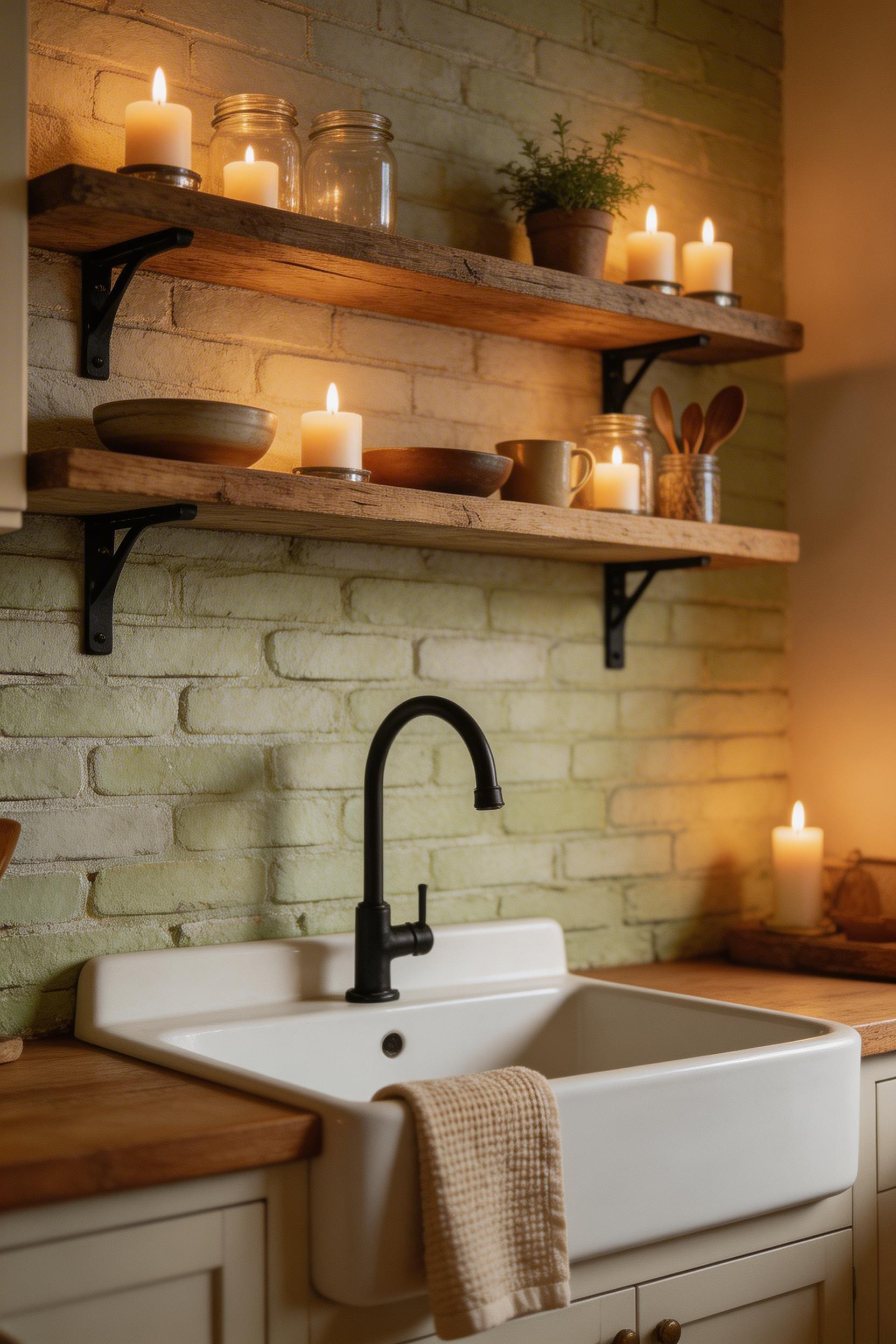
Inglenook Brick Tiles makes some of the most realistic thin-brick product available. Their Old Carolina range costs $8-12 per square foot. The advantage over full brick is weight. Thin veneer is about 8 pounds per square foot rather than 35, so most kitchen walls support it without reinforcement. Before grouting, apply Miracle 511 Impregnator sealer to prevent grout from permanently staining the brick face.
If your brick is orange-red and too bold for your palette, limewashing is the answer. Portola Paints Lime Wash ($75 per gallon) gives brick the chalky, faded quality of old French farmhouse walls. Apply with a thick brush, work it into the grout joints, then wipe back with a damp cloth. The result looks like a hundred years of weathering done in one afternoon.
—
Dutch and English farmhouses used hand-painted ceramic tiles around hearths and kitchen ranges from the 17th century onward. In fact, the look has never been more relevant. A focused panel of blue-and-white Delft tiles behind a range hood creates a focal point that feels genuinely collected rather than assembled.
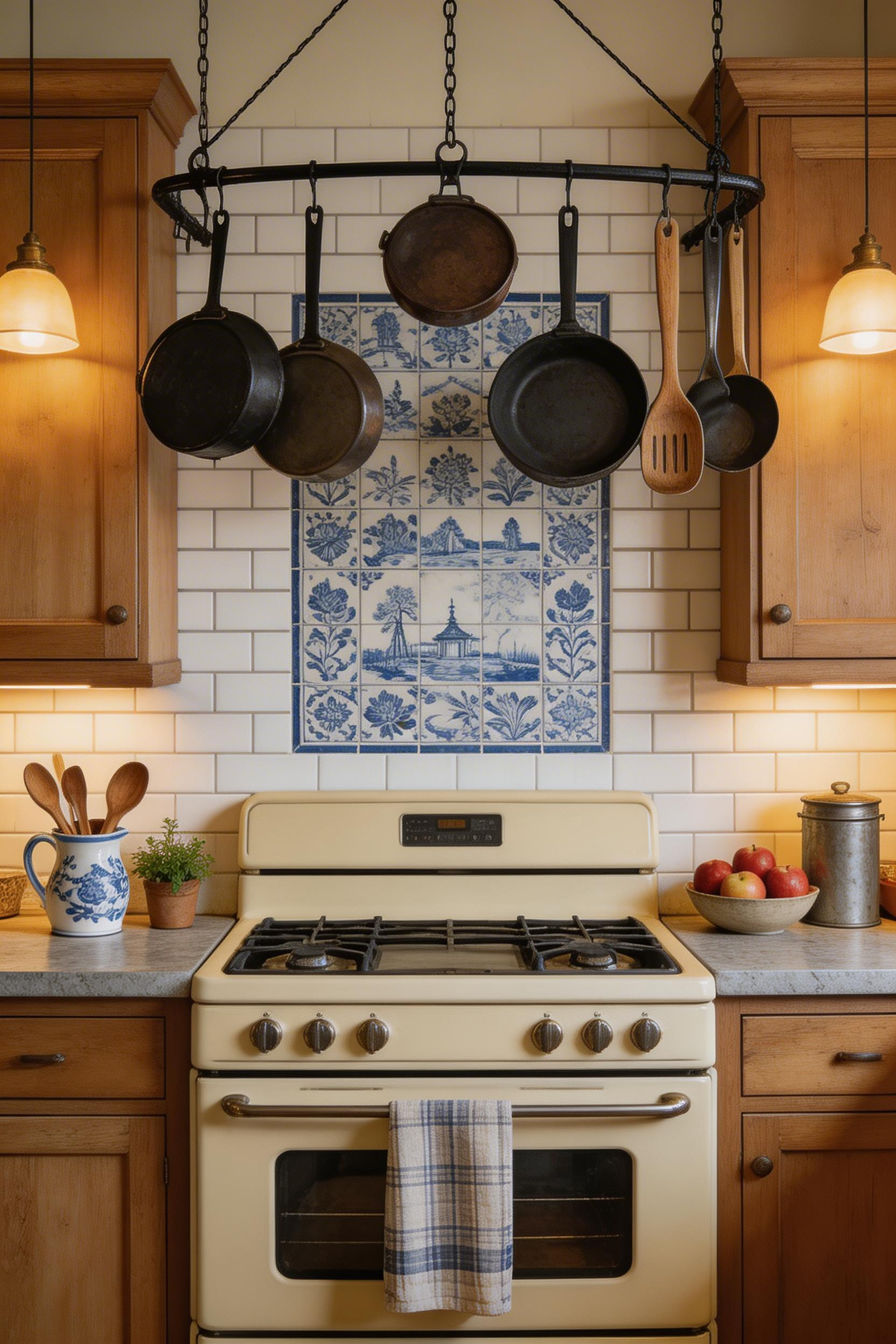
Authentic Delft tiles from Royal Delft cost $80-150 per tile. Reproduction hand-painted tiles from Portuguese or Mexican makers cost $15-40 per tile. A panel of 20 tiles costs $300-800 for good reproductions versus $1,600+ for the real thing. For most kitchens, the reproduction performs just as well visually — under moving kitchen light, the hand-painted glaze looks the same.
You don’t need to tile the entire kitchen in Delft. A contained panel of 12-20 tiles centered behind the range hood, framed by simple white subway tile, creates the focal point without visual chaos. Keep the Delft section rectangular and the surrounding tile consistent. That clear boundary is what makes the arrangement feel designed rather than accidental.
—
Beadboard is one of the best-value farmhouse kitchen backsplash options available. Victorian farmhouse kitchens from the 1870s through the 1920s used it on walls, ceilings, cabinet doors, and as a backsplash. It’s practical, budget-friendly, and it looks like it could have been there since the house was built.
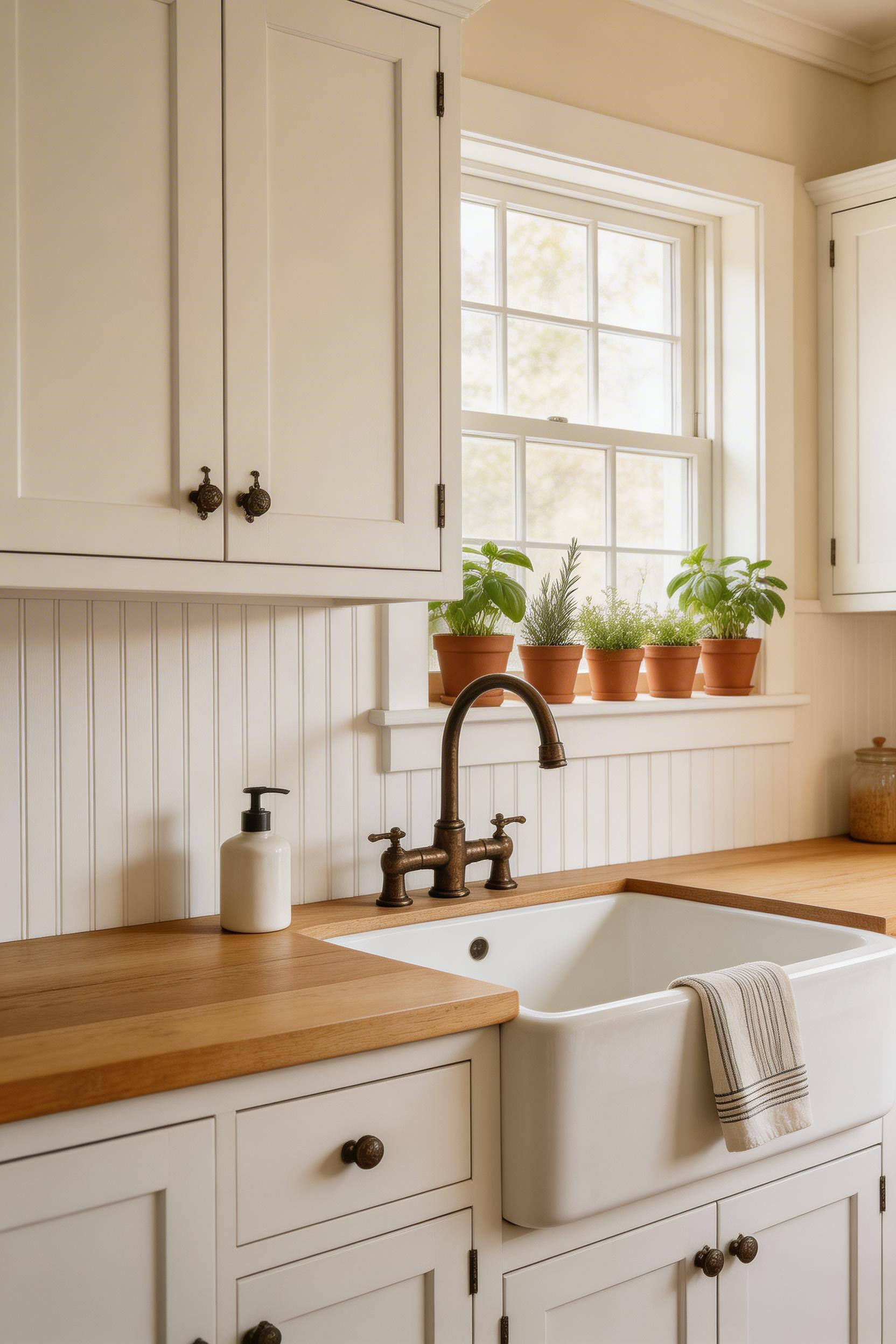
Wood beadboard — pine or MDF — costs $20-30 per 4×8 sheet but swells and deteriorates in humid kitchen conditions over time. PVC beadboard from Veranda or Azek costs $42-55 per sheet and resists moisture, warping, and grease absorption. For a kitchen that gets real daily use, PVC is the better long-term investment. In a rental kitchen, wood is perfectly fine — you’re not planning for a decade of humidity exposure.
Sherwin-Williams Alabaster SW 7008 is warm without yellowing. Benjamin Moore Chantilly Lace OC-65 is brighter and crisper. Either way, use white silicone caulk at every seam and at the countertop edge before painting. Not paintable caulk — silicone specifically — so moisture doesn’t get behind the panels from the sink area.
—
Steel ceiling tiles have been part of American architecture since the 1880s. They offered an affordable version of ornamental plaster ceilings, and they turned up in farmhouses, general stores, and schools across the country. That same character — surface pattern, metallic sheen, honest industrial quality — makes them genuinely interesting as a kitchen backsplash.
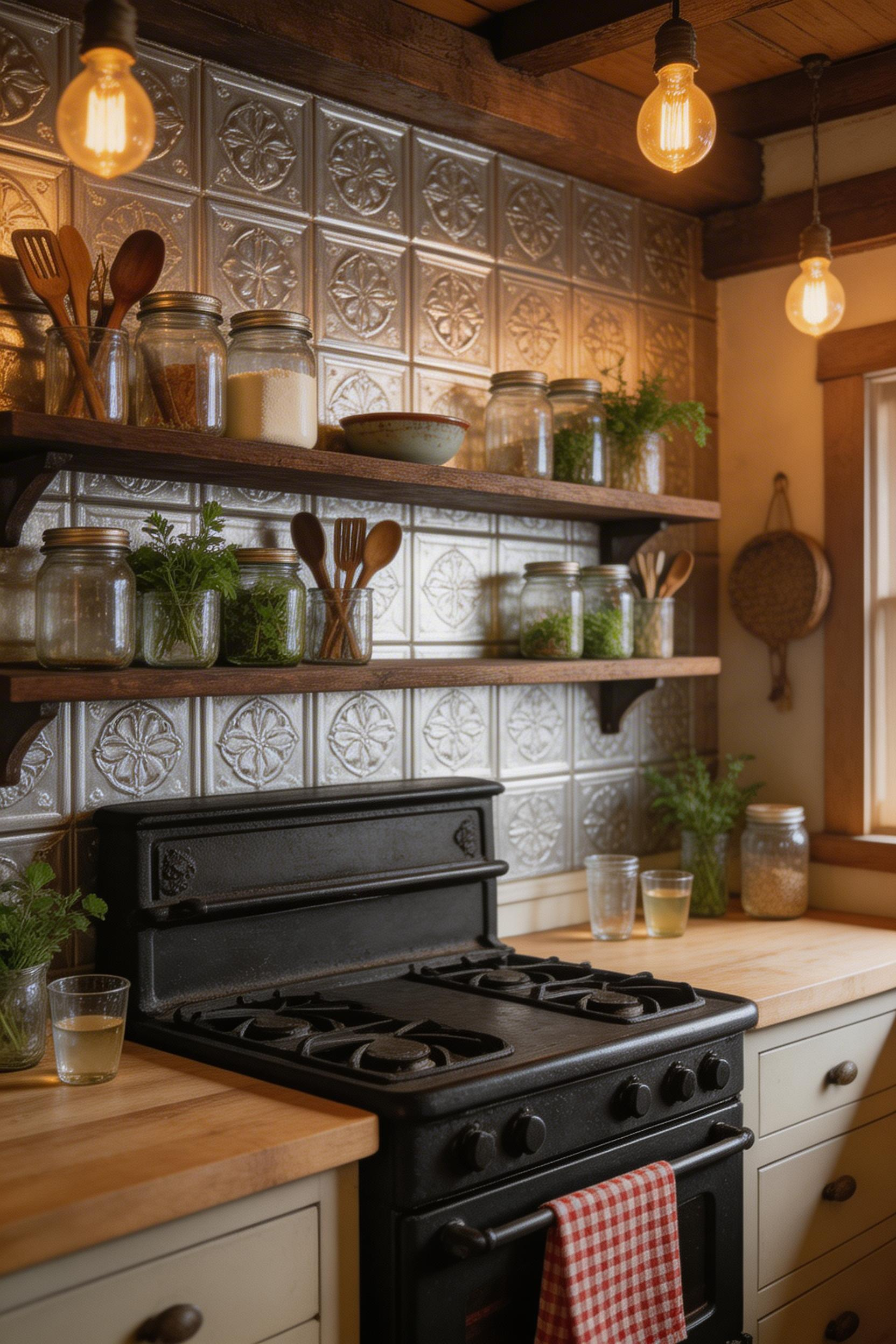
Modern suppliers like American Tin Ceilings start around $2.50 per square foot for steel and $6 for copper-coated finishes. Shanko manufactures 200+ historical patterns still in production. For installation, adhere the panels directly to drywall with construction adhesive and trim the edges with small molding strips. Alternatively, for the most authentic farmhouse look, buy actual vintage tin tiles from an architectural salvage shop. They usually cost $1-3 each, already patinated. No two are identical, which is exactly the point.
—
Stone mosaic brings something genuinely from the earth into the kitchen. Tumbled marble, travertine, and slate have variation, imperfection, and natural depth that no manufactured product can copy. Used as accent strips below the upper cabinets, they add organic texture to a farmhouse kitchen without requiring a full tile installation.
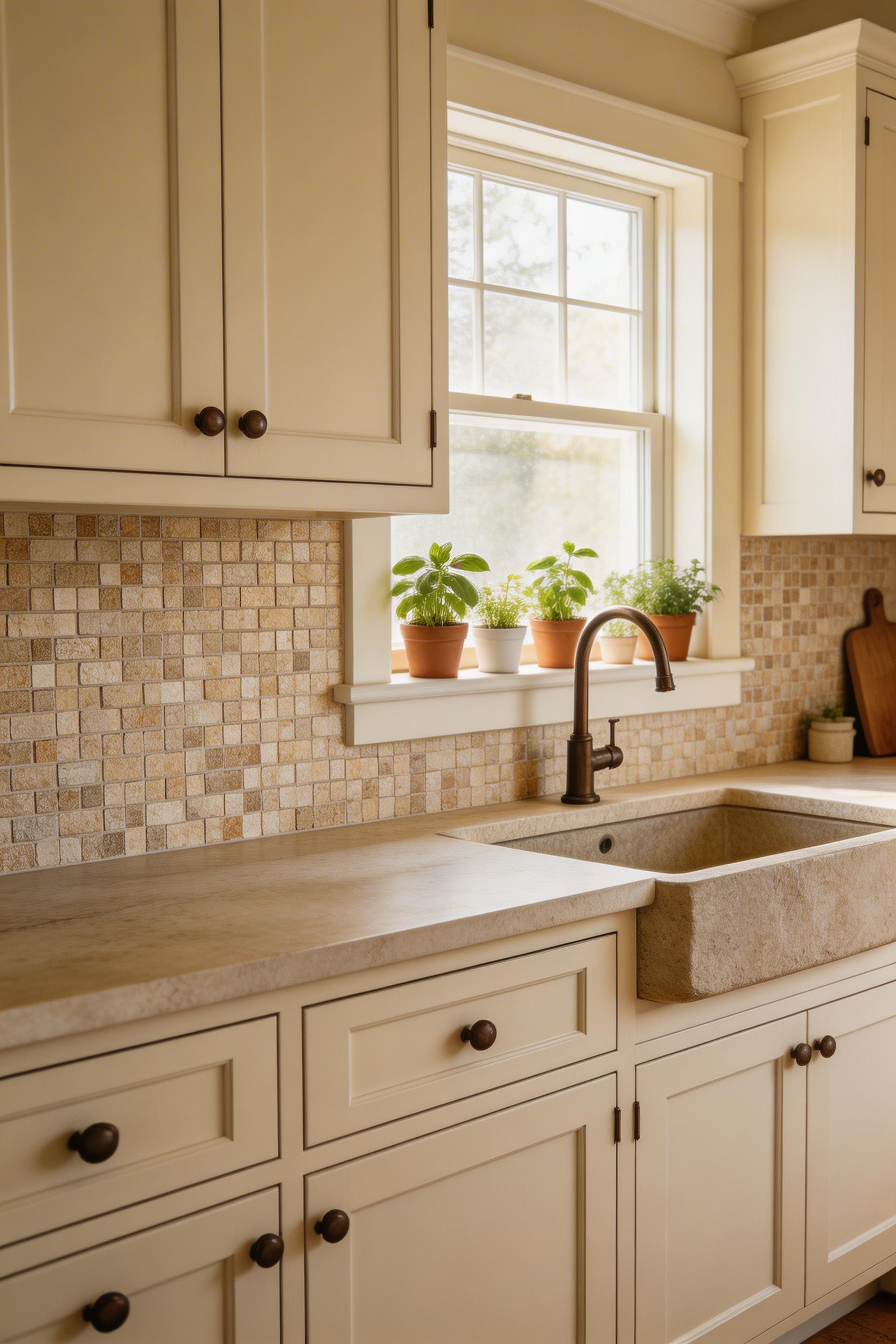
Polished marble is beautiful but shows grease fingerprints and requires careful maintenance. Tumbled marble and tumbled travertine are far more forgiving — the matte, slightly irregular surface hides splatter better. Floor & Decor sells travertine mosaic sheets for $12.99 per square foot. A one-row strip install on a standard 10-foot kitchen run costs $35-50 in tile. That’s genuinely good value for the quality it delivers.
Travertine and slate must be sealed before installation. Apply two coats of Miracle 511 Porous Plus and let each coat cure 24 hours. After the tile is installed and grouted, seal the entire finished surface again. With stone mosaic, the many grout joints accumulate grease. A sealed surface wipes clean with a damp cloth rather than requiring scrubbing.
—
Cement tile — also called encaustic tile or painted concrete tile — is one of the most genuinely artisan options in the farmhouse backsplash category. Each tile is hand-pressed from colored cement slurry poured into a mold, then allowed to cure. There’s no firing or glazing — just compressed mineral pigment and cement. The result is a matte, slightly absorbent surface with natural color variation that gives any kitchen an immediate sense of craft.
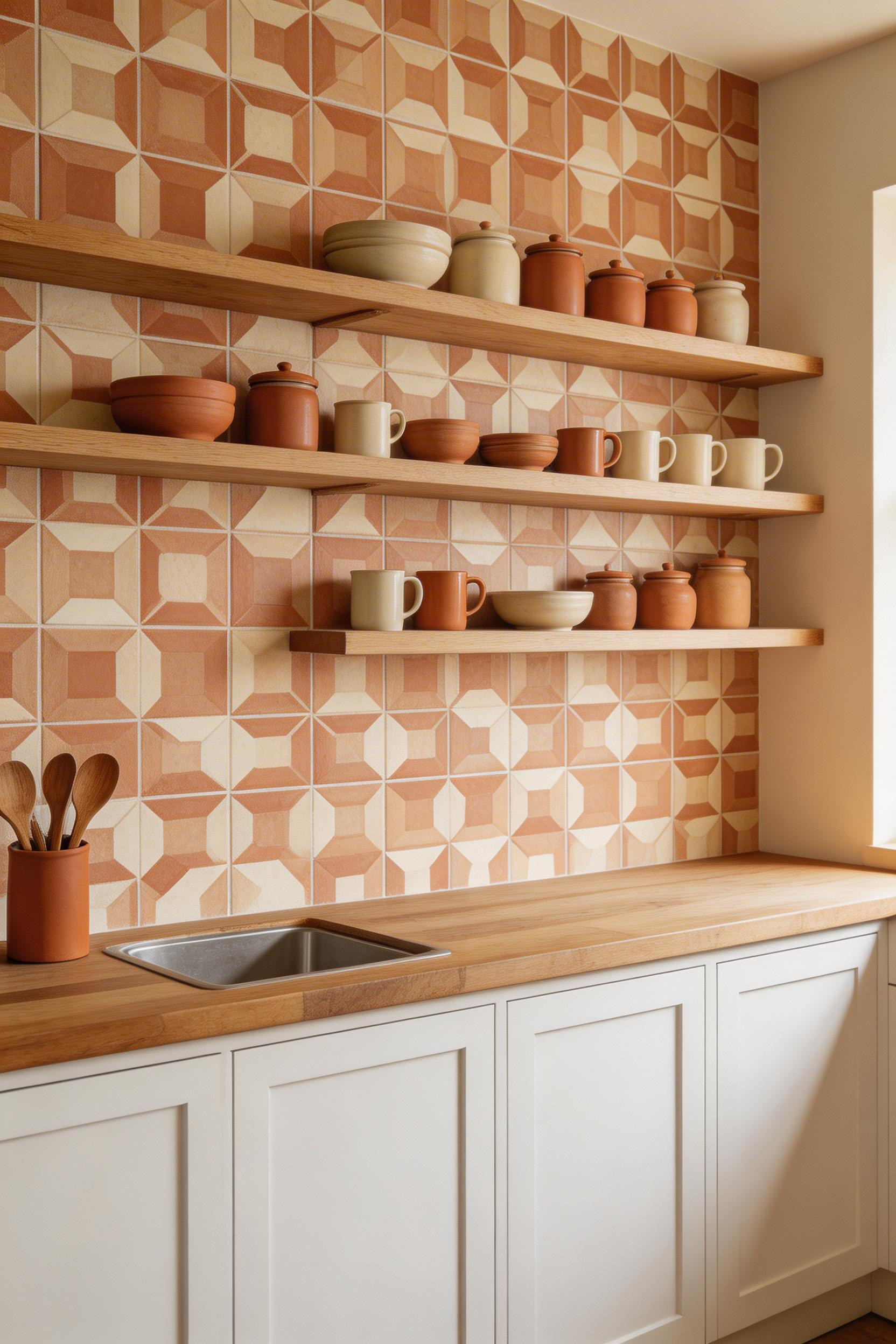
On a 30-40 square foot backsplash, a busy eight-color geometric pattern dominates the entire kitchen. For a farmhouse kitchen, simpler patterns in two or three colors work far better. A classic pin-wheel or cross pattern in off-white and terracotta reads as artisan without competing with everything else in the room. A soft diamond in cream and sage works equally well. Zia Tile and Cle Tile carry farmhouse-appropriate patterns in the $24-45 per square foot range. Also, if you’re planning a compact kitchen with both a backsplash and an island surface, 18 Kitchen Island Ideas for Small Kitchens That Actually Work has practical guidance on coordinating multiple surfaces in tight layouts.
Seal cement tiles with a penetrating sealer before installation. Then seal again after grouting before doing the final clean. In a kitchen with cooking oil in the air constantly, an unsealed cement tile backsplash will stain within days of the first meal. The two-stage sealing makes this a practical surface; skip it, and you’ll regret it.
—
This is the most DIY of the farmhouse kitchen backsplash ideas on this list, and it’s also genuinely functional. A framed pine panel with 19-gauge hardware cloth stretched across part of the surface doubles as a backsplash and an organizer. Hang magnetic spice jars from it, clip recipe cards, or hook small cast-iron tools. Total material cost: under $80. Build time: one afternoon.
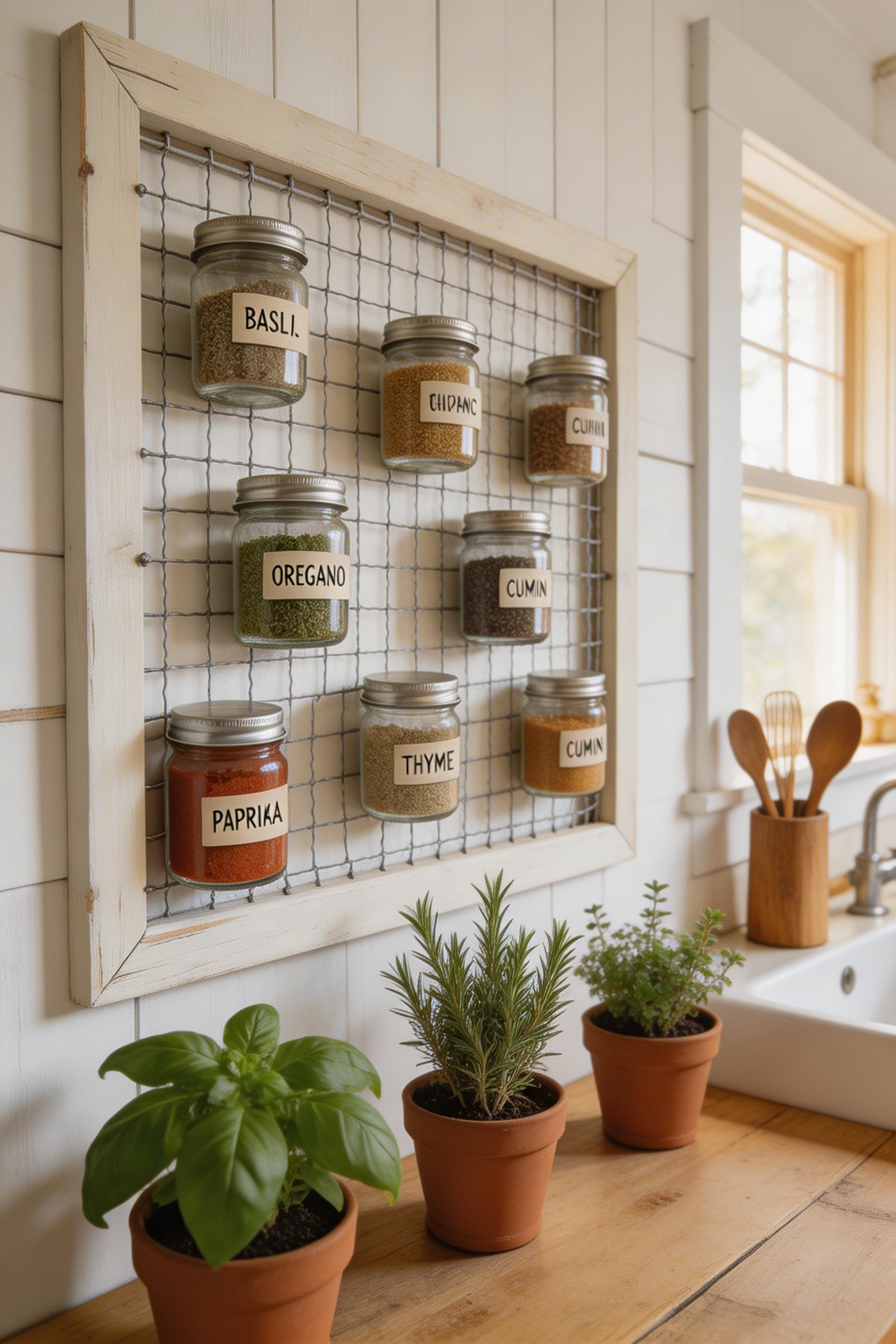
Use 1×4 pine boards to build a rectangular frame. Join the corners with wood screws and glue. Then stretch 19-gauge hardware cloth across the frame and staple it at 3-inch intervals. Use 1/2-inch hex mesh — it’s more rigid than actual chicken wire and holds its shape on the wall. Sand, prime, and paint the frame in white or cream. Mount the whole thing on a French cleat so you can remove it cleanly — ideal for rental kitchens where wall damage matters.
Small magnetic spice jars stick to hardware cloth directly if you add an adhesive-backed steel sheet behind the mesh. Brass cup hooks clip onto the mesh wires and hold small tools, towels, or mason jar herb planters. If you’d rather keep it decorative, tuck dried eucalyptus or wildflowers through the mesh — the kind of casual arrangement that looks intentional without trying too hard.
—
If you want a farmhouse kitchen backsplash that makes visitors ask where you found it, reclaimed wood is the answer. Genuine reclaimed wood comes from old barns, piers, factories, and warehouses. Each plank carries grain, nail holes, saw marks, and weathering that no new wood can replicate. Suppliers like Pioneer Millworks and Elmwood Reclaimed Timber ship planks nationally at $10-18 per square foot.
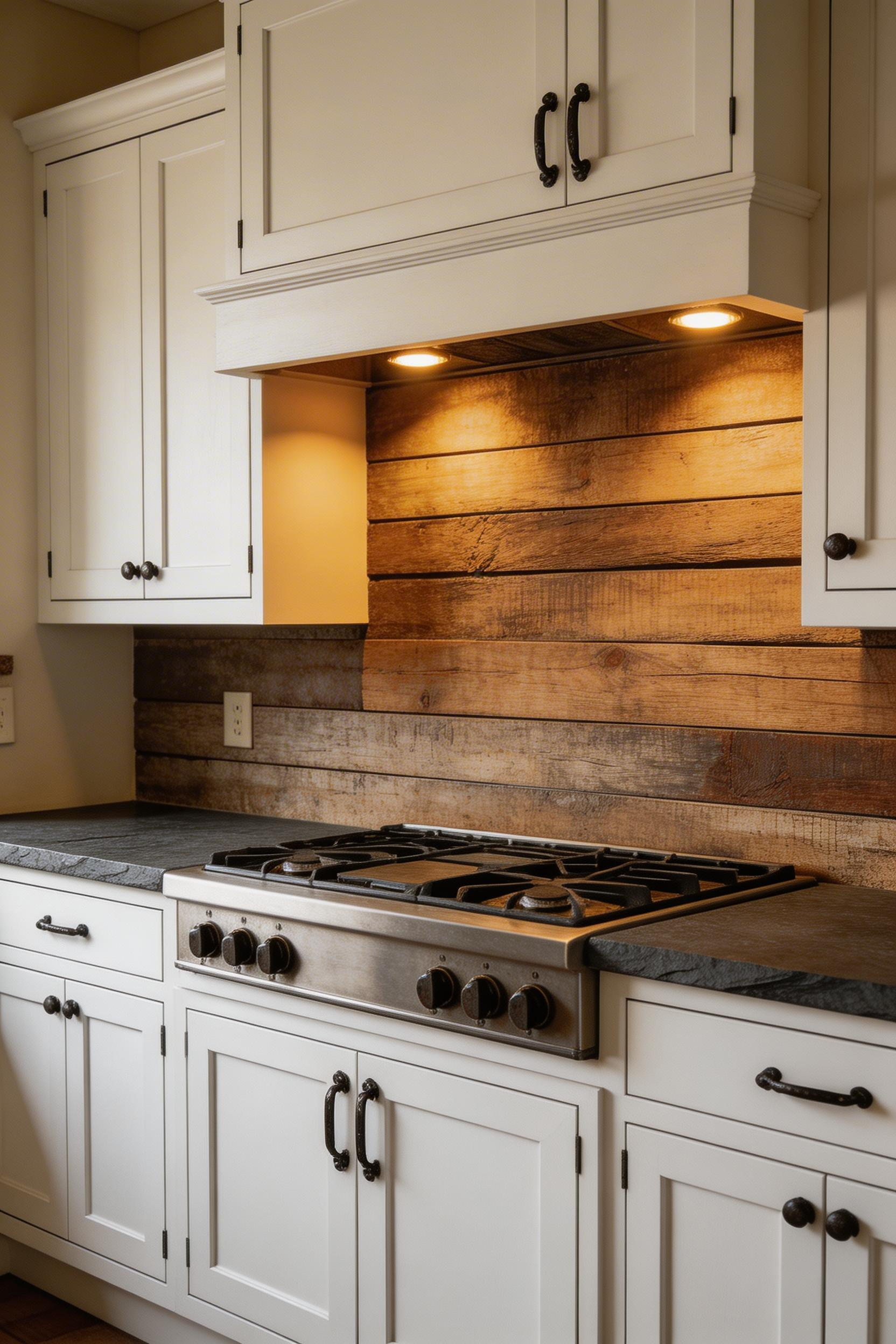
Behind a cooktop, wood must be installed according to local building code — typically at least 18 inches from open burners. Also, apply a layer of RedGard waterproofing membrane on the drywall before installing wood near the sink or dishwasher. This is the step most DIY tutorials skip. Moisture behind a wood backsplash creates mold that lives where you can’t see it until it’s already a problem. For renters or those wanting the look without the complexity, Stikwood’s peel-and-stick reclaimed pine kits at $55 per 20-square-foot kit are genuinely convincing. They’re more credible than most alternatives in this category.
Rubio Monocoat Pure Finish Oil is a food-safe finishing oil used on cutting boards and wood kitchen surfaces. It deepens the grain color without adding a plastic-looking film, and it cures to a genuinely matte surface. For a more aged, wax-finished look, Osmo Wood Wax Finish achieves a similar quality. Both are easy to reapply every two or three years.
—
The herringbone pattern dates to Roman road construction — the Romans called it opus spicatum — and it appeared in 19th-century American kitchen floors. At backsplash scale, in warm neutral tones, it has a quality that a standard brick-set subway tile layout lacks. It reads as slightly considered and elevated, without tipping into formal territory. This is the farmhouse backsplash idea that earns the most compliments per dollar spent.
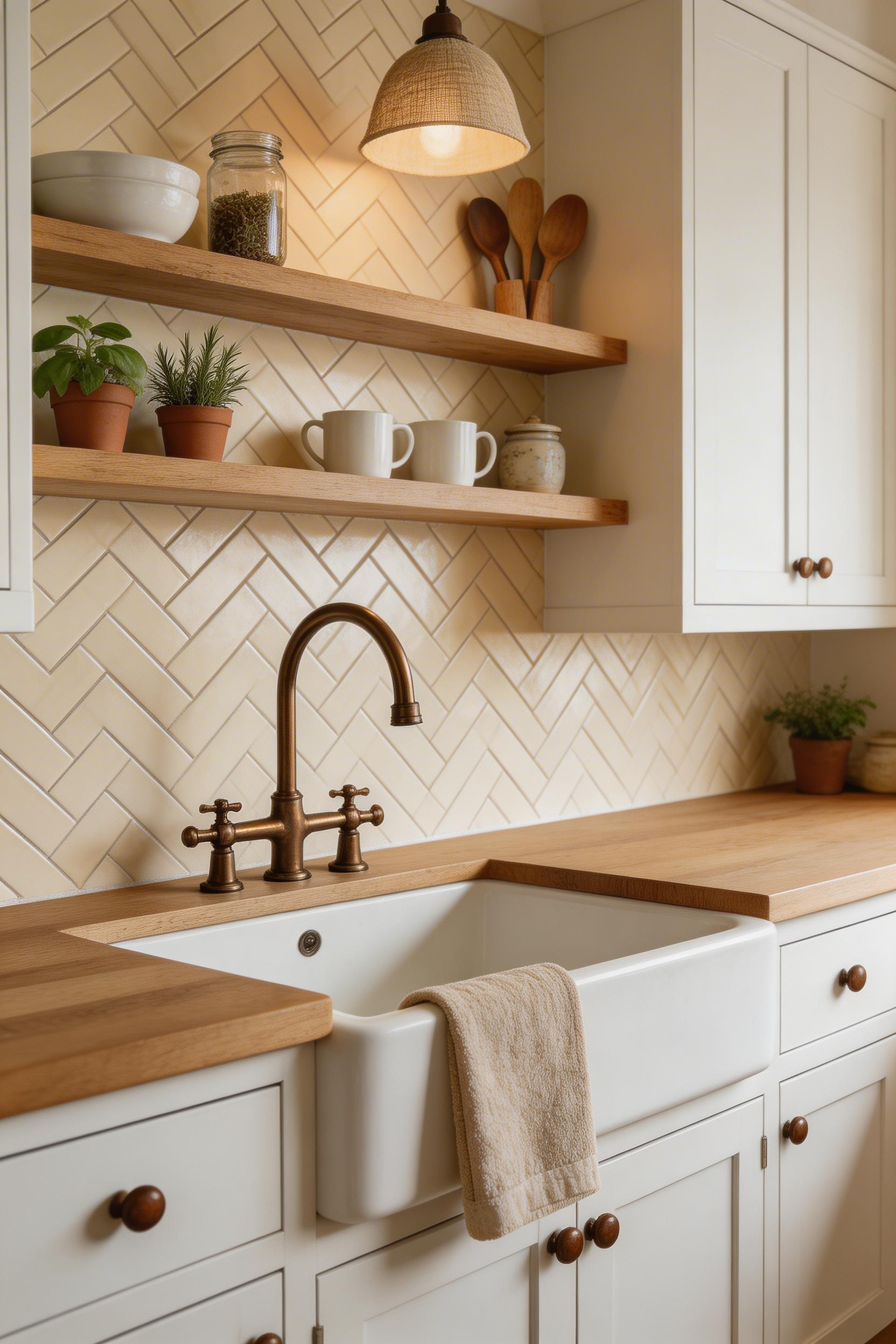
The tile choice and color determine the mood. Herringbone in glossy white marble looks very upscale and formal — not farmhouse. The same pattern in a matte tumbled cream ceramic or a greige picket tile looks warm, rustic, and exactly right. Daltile’s Brixton Bone in a 2×4-inch format runs about $3.49 per square foot. MSI’s Greige Picket is similarly priced. Both have the matte warmth at a scale where the herringbone pattern reads clearly without overwhelming the backsplash height.
For a backsplash that’s 18-20 inches tall, 1×3 or 2×4-inch tiles create the most readable herringbone pattern. Larger 3×6 tiles in herringbone at backsplash scale can feel slightly awkward — the pattern doesn’t complete as many cycles before hitting the upper cabinet. Also, budget an extra 15% in tile quantity beyond your measured area for the diagonal edge cuts.
—
Linen-texture ceramic tile deserves more attention in the farmhouse kitchen backsplash conversation. The tile has an embossed fabric-like surface pressed into the ceramic body before firing — not a print, but an actual three-dimensional texture. It catches light in a way that feels woven and organic. Up close, it rewards the kind of looking that most tile doesn’t invite.
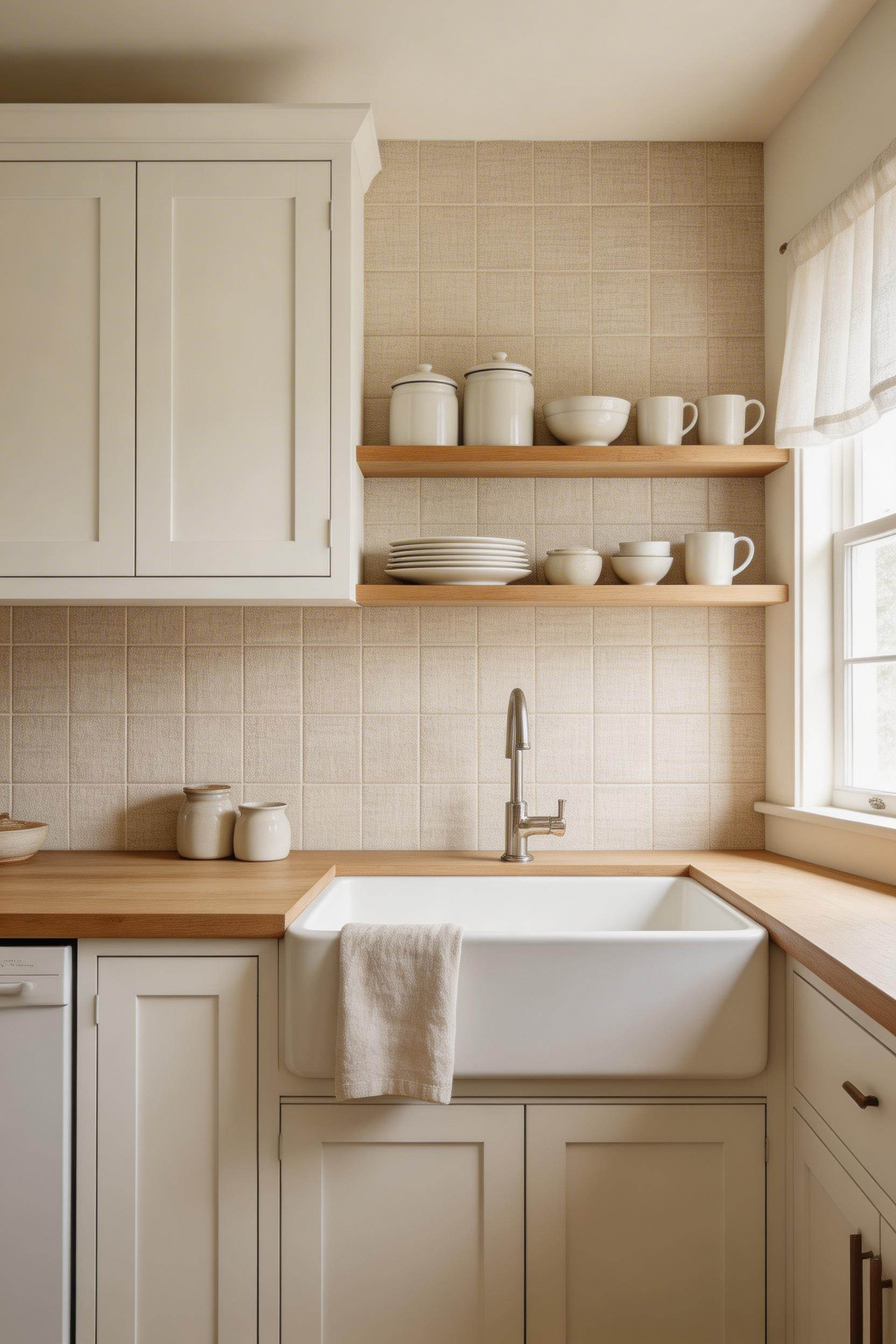
Matte finishes resist fingerprints and splatter marks better than gloss tile. However, they’re harder to clean once grease does accumulate. The practical solution is simple daily maintenance. A quick wipe-down with a damp cloth during cooking seasons keeps the surface clean. This avoids the heavy degreasing sessions that neglected matte tile eventually requires. Use a pH-neutral cleaner rather than vinegar, which can dull ceramic glaze over time.
Linen-look ceramic is an excellent backdrop for open shelving. The soft, woven texture behind ceramic dishes, wooden bread boards, and glass canisters creates a layered visual narrative that feels collected-farmhouse rather than staged. Prices run $2.50-7 per square foot, making this one of the better-value choices for a sophisticated-looking farmhouse kitchen backsplash on a moderate budget. Order a sample first — these tiles photograph differently than they look in person.
—
Sage green subway tile has become the defining farmhouse kitchen backsplash look of the mid-2020s. Houzz placed sage green kitchens among the fastest-growing renovation choices in 2023 and 2024. The reason is straightforward: sage sits between gray and green, earthy and muted, in a range that feels like it came from a garden or a herb jar. It settles into the kitchen and makes everything feel grounded.
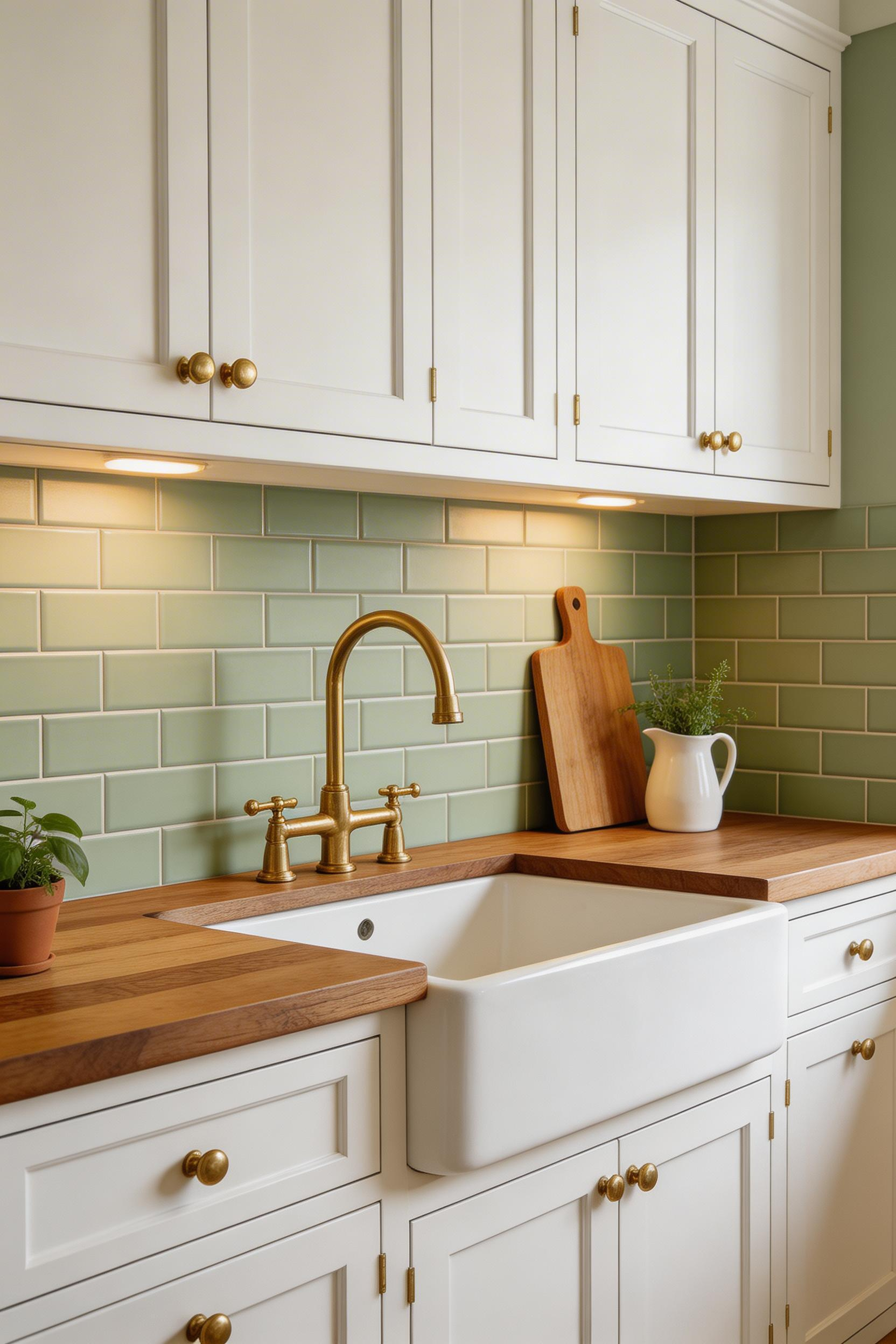
The most-pinned combination is sage green tile with white upper cabinets, butcher-block countertops, and unlacquered brass hardware. The combination works because each element has a distinct role. Sage tile brings color and earthiness. White cabinets keep the room light. Butcher block adds warmth, and brass ties in the warm undertones throughout. Heath Ceramics makes the most beautiful sage tiles at $55 per square foot. For a budget option, Wayfair’s Merola Tile Garden Sage at $4.49 per square foot is genuinely convincing.
Go matte rather than glossy. Glossy sage reads slightly retro; matte sage has the flat, earthy tone that makes it feel genuinely farmhouse rather than vintage. For grout, a soft warm gray — in the same general color family as the tile — makes the joints recede. White grout creates too graphic a grid. Charcoal grout creates a very different effect. Neither suits this particular farmhouse aesthetic as well as a quiet, putty-toned grout.
—
Terracotta tile is clay fired at low temperatures to a warm reddish-orange — the same material used in Mediterranean, Latin American, and Spanish colonial farmhouses for centuries. On a kitchen backsplash, it brings a warmth that no modern manufactured tile can replicate. Because terracotta tiles are formed by hand or in simple molds, each one has slightly different dimensions, color, and surface variation that reads as completely genuine.
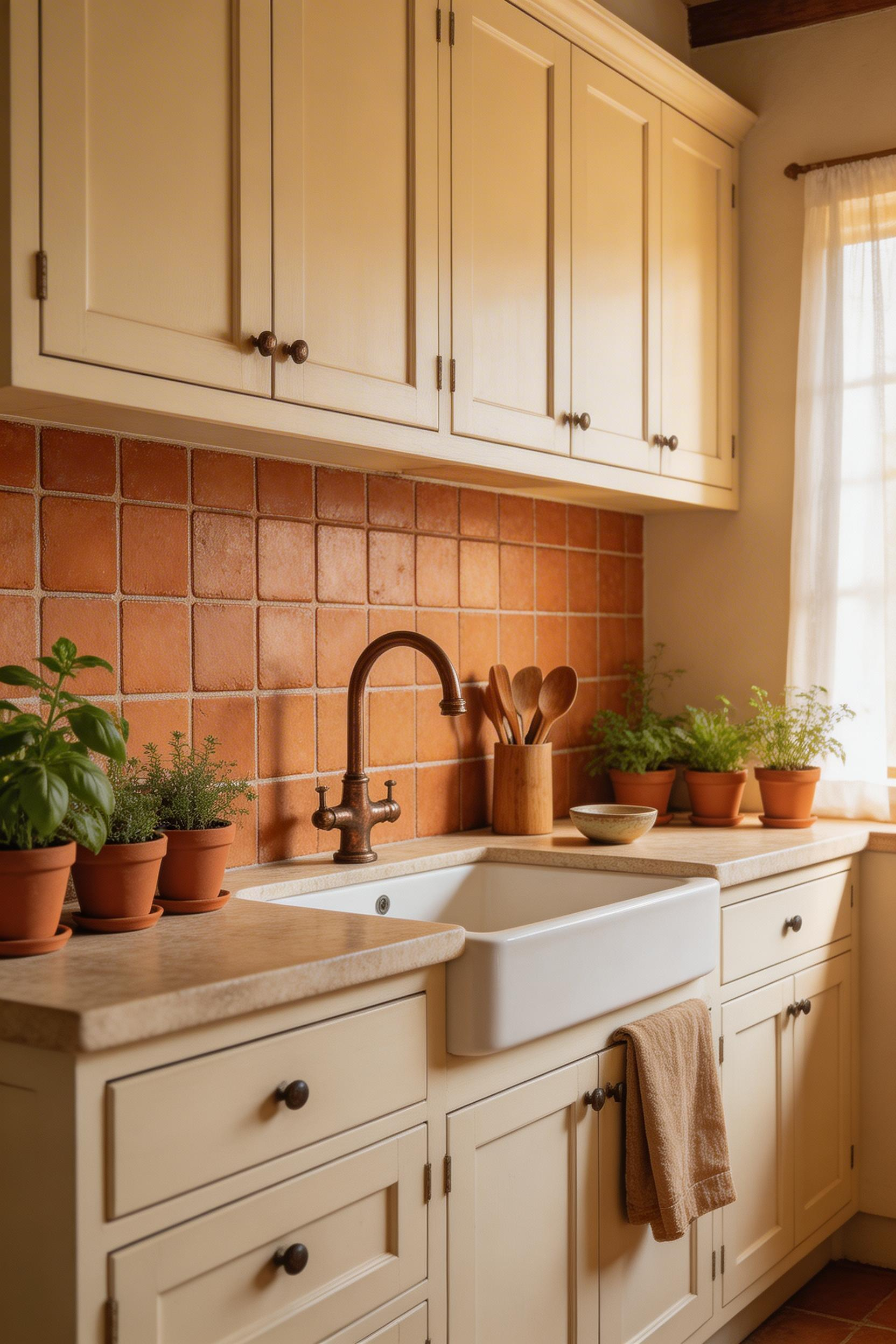
Raw terracotta is highly porous. A drop of cooking oil on an unsealed terracotta tile will permanently stain it within minutes. The protocol: apply Stonetech Bulletproof Sealer to each tile before installation, let cure 24 hours, then install and grout. After grout cures, seal the entire finished surface again. In a kitchen with daily cooking, this two-stage process is non-negotiable. For installation, soak irregular tiles in water for 30 minutes before setting them — it reduces suction that can pull thinset away from the wall before it cures.
Wide grout joints — 3/8 to 1/2 inch — in a warm sand or adobe color enhance the handmade character. Narrow joints and white grout fight the natural quality of the tile and make the installation look like it’s trying to be something it isn’t. Embrace the irregularity. That’s what makes terracotta a farmhouse kitchen backsplash material rather than just a tile.
—
Board-and-batten paneling came from American barn construction — wide vertical boards forming the wall, with narrow strips covering the gaps. In a kitchen, at half-wall height with a small ledge cap at the top, it creates one of the most genuinely farmhouse-feeling backsplash solutions on this list. For thinking about how open wall space and storage balance in a room, 15 Living Room Layout Ideas That Make Every Seat Count applies the same visual logic that works in a kitchen with high wainscoting.
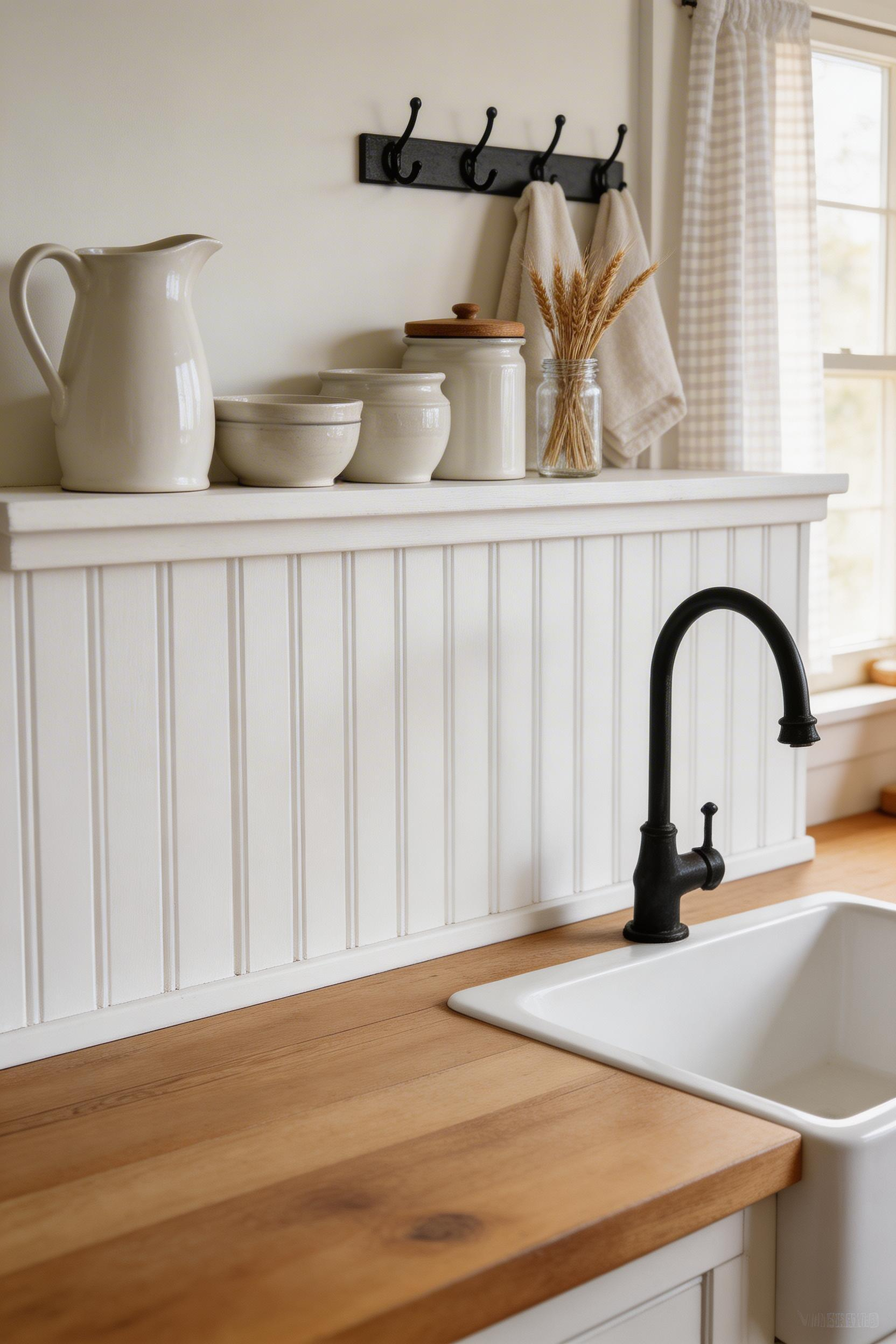
At 36 inches, the panel runs counter-height and acts purely as a backsplash. At 42 inches, it starts to function as a visual break between the counter zone and the cabinet zone. The ledge cap at the top is worth building in: a simple 1×4 or 1×6 pine board, flush with the top of the battens, creates a natural display shelf. Total lumber and materials for a 10-foot kitchen run: $120-180. Caulk every joint with paintable caulk before painting — without it, hairline cracks will appear at every seam within a year of kitchen humidity changes.
—
The combination of white subway tile and charcoal grout creates something unexpected: a graphic, printlike quality that references old English butcher tile work and early-20th-century apothecary design. It reads as deliberate and confident rather than clinical — which is why it works in a farmhouse kitchen that leans toward a more character-driven aesthetic.
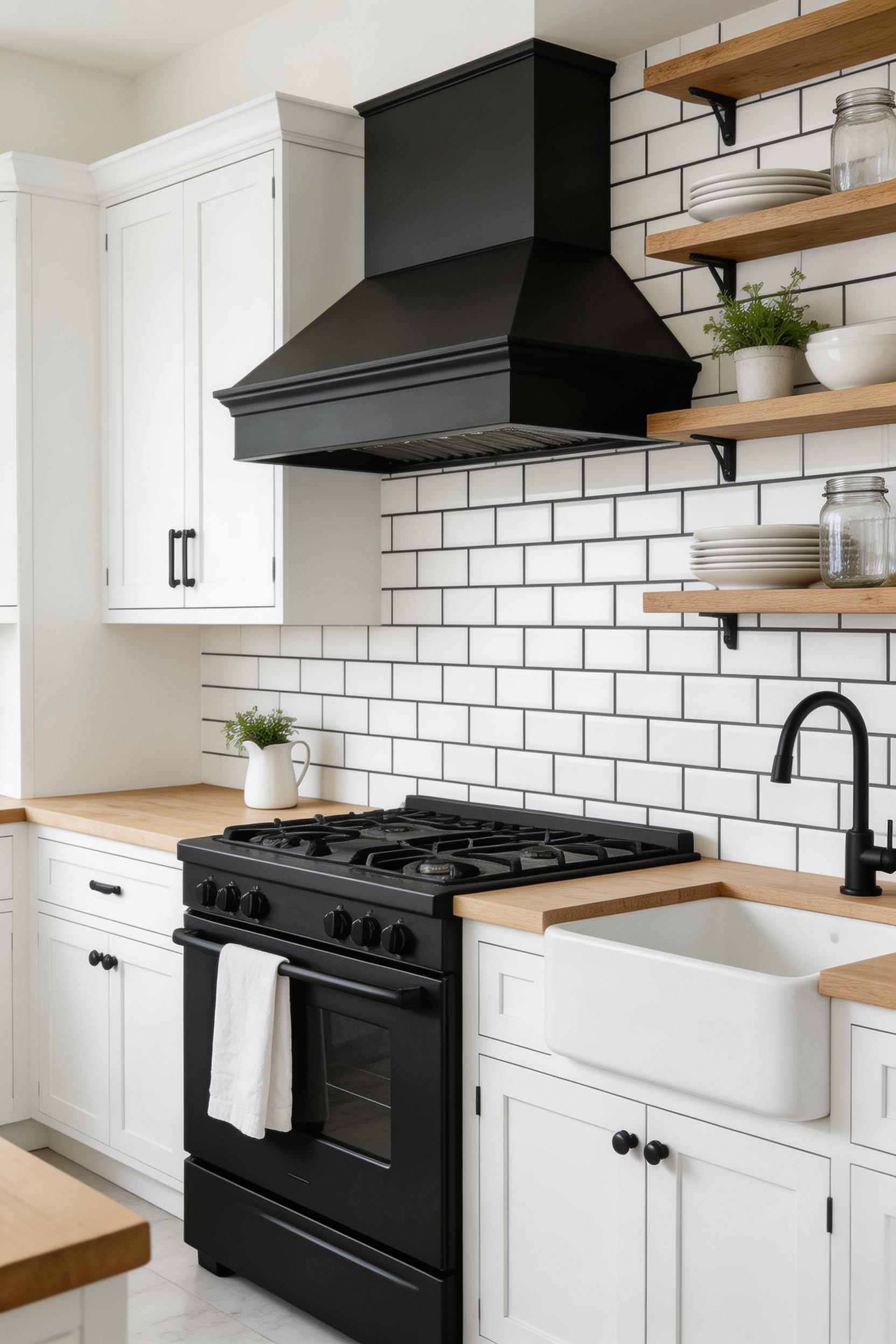
In a kitchen with sleek flat-front cabinets and quartz countertops, black grout reads as modern industrial. However, in a kitchen with shaker cabinetry, a farmhouse sink, bridge faucets, and wood shelving, the same tile reads as historical and collected. The palette around the tile does the positioning. So if you’re going dark grout, commit to the farmhouse context: shaker cabinet profiles, natural countertop materials, and warm fixture finishes.
Seal black grout within 72 hours of installation with Aqua Mix Grout Sealer. Unsealed black grout absorbs kitchen oils quickly and develops a dull, grayish cast that is very hard to reverse. For regular cleaning, use a pH-neutral product — bleach fades black grout over years of use, shifting it toward a flat, muddy gray. Reapply sealer once a year. Do that, and the contrast stays sharp indefinitely.
—
Zellige is handmade Moroccan ceramic tile — each piece is pressed by hand, fired in a wood kiln, and then chipped to shape with a traditional tool called a qadoum. The handmade process creates variation in thickness, finish, and color within a single tile run that is the literal opposite of factory uniformity. In a farmhouse kitchen, authentic zellige creates something that looks genuinely irreplaceable.
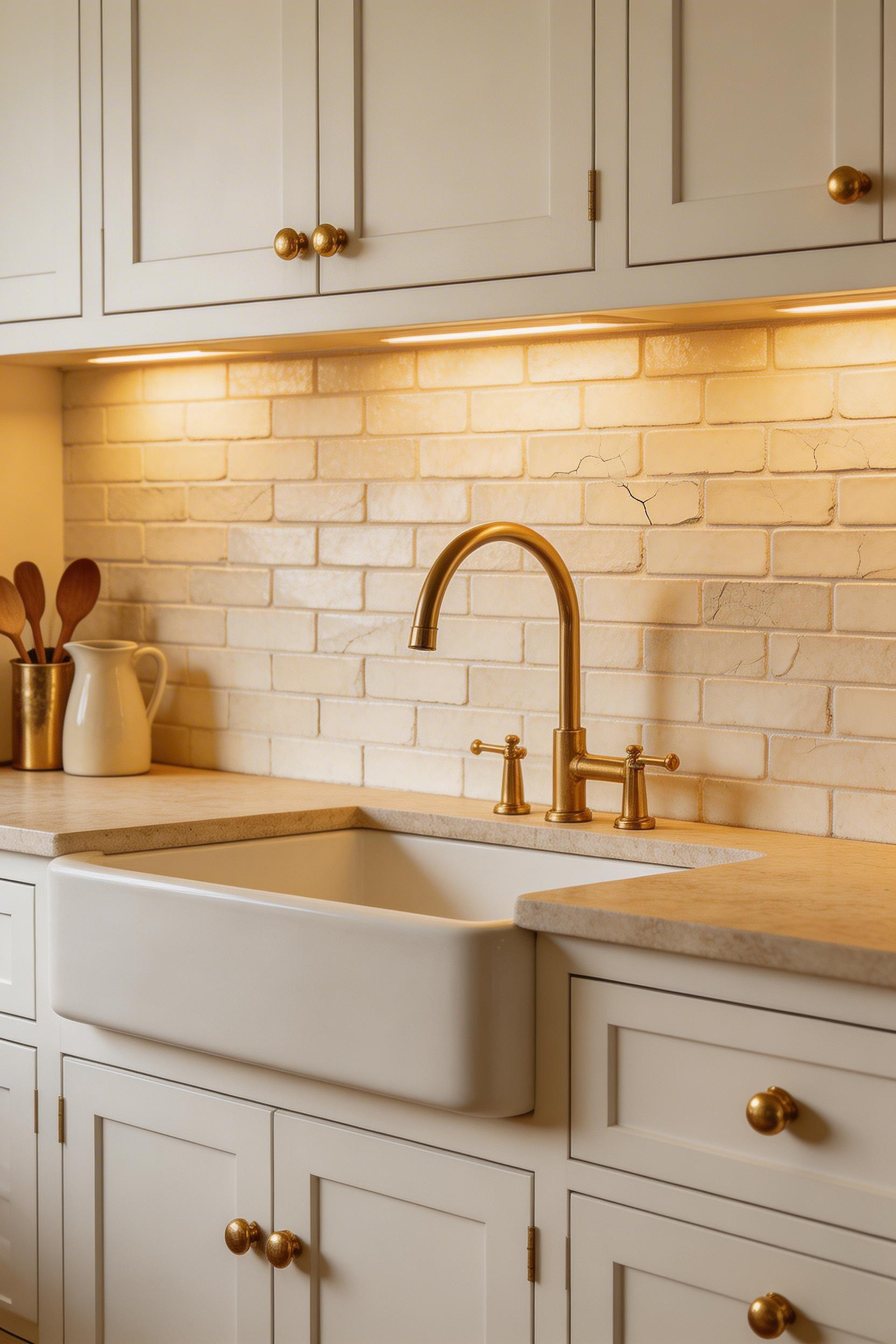
Authentic zellige from Cle Tile costs $38-85 per square foot. Machine-made lookalikes run $8-20 per square foot and are more consistent — which is, ironically, exactly what makes them less interesting. For a farmhouse kitchen, the colors that work are: ivory, warm white with crackle glaze, soft sage green, terracotta, and dusty blue. Deep indigo and multi-color mixed zellige read as Moroccan bohemian rather than farmhouse.
Zellige is genuinely challenging to install because of the thickness variation. The installer must constantly adjust thinset behind each tile to maintain a flat surface. This isn’t a DIY-friendly installation for most people. Budget for 20% tile overage rather than the standard 10-15%, because irregular edge cuts produce more waste. The total installed cost for a standard kitchen backsplash run will be $800-1,800 depending on tile choice and your local market.
—
Early peel-and-stick backsplash tiles had a thin vinyl construction that bubbled and peeled within months. The current generation from brands like Smart Tiles, Art3d, and WallPops is built differently. These are 1.5-3mm thick composite panels with embossed surface texture and heat-rated adhesive for kitchen environments. For rental kitchens or anyone testing a farmhouse aesthetic before committing to tile, they’re a genuinely practical option. Also, for small-space thinking that applies equally to kitchen planning, 15 Small Bedroom Layouts That Make Every Inch Count has transferable ideas about maximizing character in constrained spaces.
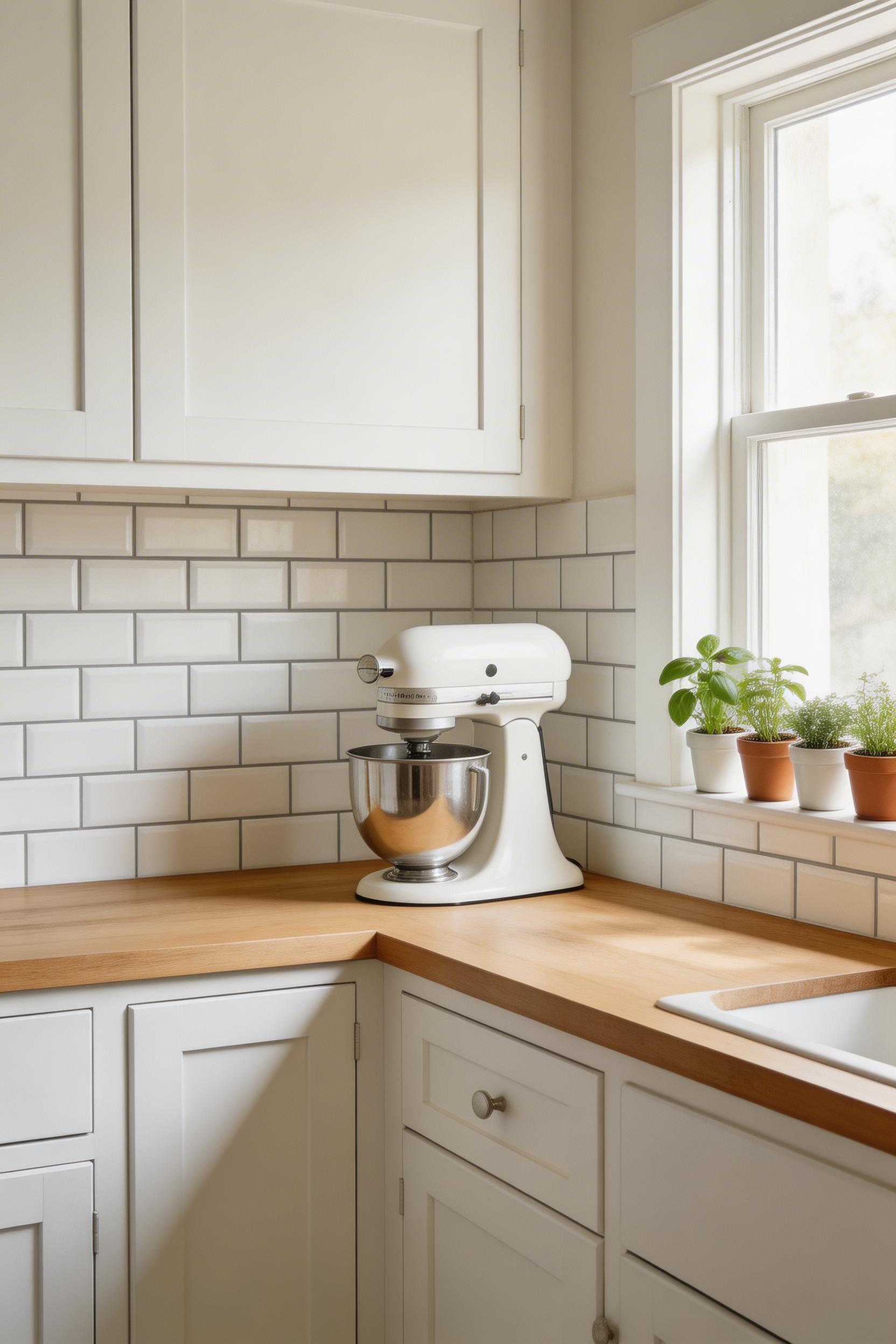
For a subway tile farmhouse look: Smart Tiles Riviera Bianco ($14.99 per panel). Shiplap or plank styling: WallPops Farmhouse Shiplap panels ($29.99 per 3-pack). Brick texture: Art3d 3D Brick White or Beige ($12 per pack). The common thread among the better products is thickness and embossed texture. Very thin, glossy sheets without surface relief look flat and obviously fake under kitchen lighting — avoid those.
Install peel-and-stick tiles on a primed surface rather than directly on painted drywall. A thin coat of clear primer dramatically improves adhesion and, counterintuitively, makes removal easier — the adhesive releases from a hard sealed surface more cleanly than from soft paint. For removal: warm the adhesive with a hair dryer for 30 seconds at each tile edge, then pull at a 45-degree angle slowly and steadily. Done patiently, the wall underneath looks exactly as it did before installation.
—
These 18 farmhouse kitchen backsplash ideas cover everything from a $50 DIY project to a $2,000 professional tile installation. The decision that narrows things down fastest is a simple one: are you renting or owning, and how long do you plan to stay?
Renters should work from items 9, 15, 18, or the PVC shiplap option, where the installation leaves no permanent damage. Homeowners planning to stay more than five years are in a different position. The best long-term investments here are classic white subway tile, sage green ceramic, reclaimed wood done correctly, and exposed brick. All hold their value in a home sale. All hold up to daily use without looking dated.
After material choice, the practical question is your kitchen’s specific conditions. A kitchen that sees three meals a day needs a surface that’s easy to clean and sealed against grease. Cement tile, terracotta, and stone all require more maintenance discipline than glazed ceramic. A kitchen with high humidity near the sink is not the right environment for wood of any kind unless you’ve fully committed to the waterproofing steps. A small rental apartment kitchen with modest cooking use is a completely different environment.
If you’re genuinely uncertain, start with the range wall only. Tile behind the stove first and leave the rest as painted wall temporarily. Living with one section for six months tells you more about how a material behaves than any amount of research. Your specific humidity, your cooking habits, your light — these only reveal themselves in real use. Most people who make their farmhouse kitchen backsplash decision this way end up knowing exactly what they want for the full run.
Whatever you choose, the real job of a backsplash is making the kitchen feel complete, warm, and worth gathering around. Everything else is materials and logistics.